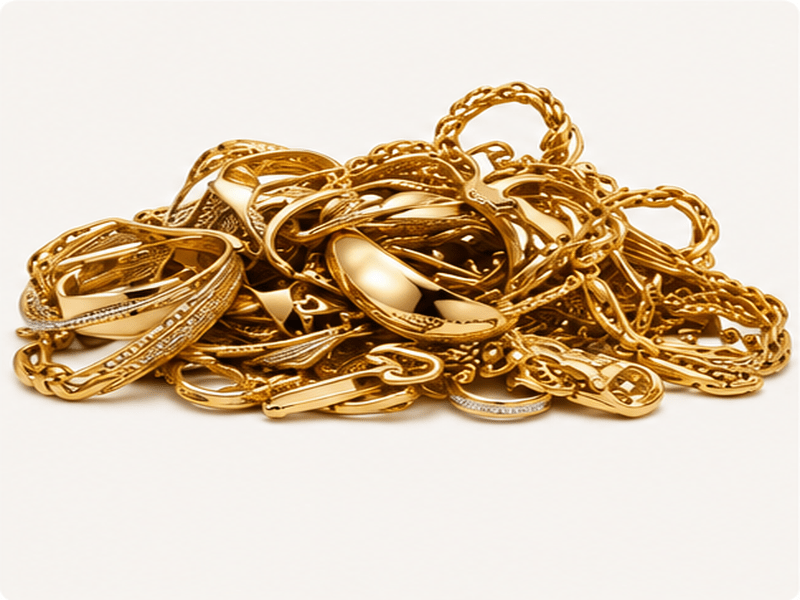
Pure gold does not strongly stick to a magnet.
However, a genuine piece of gold jewelry can sometimes show magnetic attraction in certain areas because jewelry is rarely made entirely from pure gold.
For example, a real gold necklace may have a steel spring inside the clasp. Lower-karat gold is also mixed with other metals, and the exact alloy can affect how the piece reacts.
The most important rule is this:
A strong magnetic pull across the main body of an item is a warning sign—but an item that does not stick to a magnet is not automatically real gold.
At Gold Kings, this is one reason we never determine whether jewelry is real based on a magnet or a karat stamp alone. Professional testing can tell you much more about what the metal actually contains.
For a deeper explanation of the test itself, read Does the Magnet Test Really Work on Gold?.
Why Doesn’t Pure Gold Stick to a Magnet?
Gold has very different magnetic properties from metals such as iron and steel.
Bulk gold is diamagnetic, meaning it does not have the strong magnetic attraction most people associate with magnetic metals. The Royal Society of Chemistry discusses the diamagnetic behavior of bulk gold.
If you put a strong magnet next to a solid piece of high-purity gold, it should not suddenly snap onto the magnet the way a steel object would.
But that does not mean every piece of real gold jewelry will behave exactly like a piece of pure 24K gold.
That’s where karat comes into the picture.
Real Gold Jewelry Is Usually an Alloy
Most jewelry sold as real gold is not pure gold.
10K, 14K, and 18K gold are mixtures of gold and other metals. The other metals make jewelry harder, change its color, and make it more practical to wear.
| Gold purity | Approximate pure gold content |
|---|---|
| 10K | 41.7% |
| 14K | 58.3% |
| 18K | 75% |
| 22K | 91.7% |
| 24K | Nearly pure gold |
A genuine 10K ring, therefore, contains more non-gold metal than gold by weight.
Common gold alloys can contain metals such as copper, silver, zinc, palladium, or nickel. Most do not cause a piece of jewelry to behave like a piece of steel, but alloy composition can sometimes create a slight response.
This is particularly worth remembering with white gold. The Gemological Institute of America explains that white gold may be alloyed with metals including nickel or palladium.
The bottom line is that magnetism alone cannot tell you the karat or precise gold content of jewelry.
Why Does My Gold Chain Stick to a Magnet?
This is one of the most common situations that creates confusion.
Imagine testing a 14K gold chain.
The chain itself does nothing when you bring a magnet close to it.
Then you reach the clasp.
Suddenly the magnet grabs it.
That does not necessarily mean the chain is fake.
Many jewelry clasps contain tiny springs or other internal components made from steel or another magnetic metal. Those pieces provide the tension needed for the clasp to open and close.
So if you are checking a necklace or bracelet, test the main body separately from the clasp.
If only the clasp reacts, the result is much less suspicious than if the entire chain strongly sticks to the magnet.
What Your Magnet Test Result Actually Means
| What happens | What it may mean |
| No magnetic attraction | It could be real gold, but the test does not prove it |
| Strong attraction across the entire item | A significant amount of magnetic metal may be present |
| Only the clasp sticks | A steel spring or clasp component may be responsible |
| Very weak or inconsistent attraction | The result is inconclusive and the item should be tested further |
| Jewelry says 14K but strongly sticks throughout | Do not rely on the stamp without additional testing |
The word may matters.
The magnet test is useful for finding certain obvious problems. It is not an assay.
Will 14K Gold Stick to a Magnet?
Genuine 14K gold normally should not have a strong magnetic attraction throughout the entire piece.
Fourteen-karat gold is approximately 58.3% pure gold, with the remainder made from other metals.
The exact alloy varies by manufacturer, jewelry color, age, and country of origin. A clasp, pin, spring, repair, or soldered component can also be different from the rest of the jewelry.
So if your 14K chain reacts only around the clasp, don’t automatically assume it is fake.
If the entire chain strongly snaps toward the magnet, however, that deserves more testing.
Also remember that a 14K stamp itself is not proof. Counterfeit jewelry can be stamped just as easily as genuine jewelry can.
Will 18K Gold Stick to a Magnet?
Eighteen-karat gold contains about 75% pure gold, so a genuine 18K item generally should not strongly stick to an ordinary magnet.
Again, small components can be different.
A real 18K necklace might have a clasp containing a magnetic spring. An 18K ring could have been repaired with material that differs from the original alloy.
That is why testing several areas of an item is much more useful than touching one spot with a magnet and reaching a conclusion.
Can Fake Gold Pass the Magnet Test?
Yes. Easily.
This is the biggest weakness of the magnet test.
A fake piece of jewelry does not have to be made from iron or steel.
Many non-gold metals are also not strongly magnetic. Gold-plated, gold-filled, or gold-colored jewelry can therefore show little or no reaction to a magnet.
You could test a fake chain, see absolutely no magnetic attraction, and incorrectly conclude:
“It must be real gold.”
That is why the magnet test is better at identifying some suspicious items than proving an item is genuine.
If you are trying to identify an unknown piece, our broader guide explains five simple ways to tell if gold is real.
A Magnet Cannot Tell You the Karat
Suppose two rings both pass your magnet test.
One might be 18K gold.
The other might be inexpensive nonmagnetic costume jewelry.
The magnet cannot tell you the difference.
It also cannot reliably tell you whether something is 10K, 14K, 18K, or 22K.
To determine value, you eventually need to know more than whether an item sticks.
For most ordinary gold jewelry, the important factors are:
actual gold purity × actual weight × current gold price
If you are considering selling the item, those numbers matter much more than the magnet result.
What Is a Better Way to Determine Whether Gold Is Real?
Professional precious-metal testing combines more information.
An experienced evaluation may consider the hallmark, construction, weight, wear patterns, magnet response, acid testing, electronic testing, XRF analysis, or other methods depending on the item.
Gold Kings uses professional testing equipment, including X-ray fluorescence technology, when appropriate.
XRF can identify elements present in the area being analyzed without relying on what the jewelry is stamped.
That is useful because a ring marked “14K” and a ring that actually tests as approximately 14K are not necessarily the same thing.
XRF also has limitations, particularly because plating and surface treatments can affect what is being measured. That is why a knowledgeable evaluation should consider the entire item rather than blindly trusting one machine, one stamp, or one home test.
You can learn more about how an XRF gold tester works.
Think Your Gold Might Be Real? Don’t Throw It Away Because of a Magnet
If a chain, ring, bracelet, earring, coin, or other item reacts strangely to a magnet, don’t immediately decide that it is worthless.
Have it properly tested.
The item may contain real gold even if one component is magnetic. On the other hand, an item that passes the magnet test may still contain little or no gold.
At Gold Kings, we can test and weigh qualifying precious-metal items and explain what we find before you decide whether you want to sell.
You can also review what Gold Kings buys if you have gold jewelry, broken gold, silver, coins, bullion, watches, estate jewelry, or other valuables.
Have Your Gold Tested at Gold Kings
If you’re standing at home with a magnet and an old piece of jewelry wondering, “Is this actually gold?”, you don’t have to guess.
Bring it to either Gold Kings location.
We can evaluate the item, test its precious-metal content, weigh it, and help you understand what you actually own.
There is no need to assume an item is fake because the clasp sticks—or assume it is real simply because the magnet falls away.
Gold Kings of Snellville
Customers in Gwinnett County and surrounding communities can visit Gold Kings of Snellville.
3635 Stone Mountain Hwy
Snellville, GA 30039
770-771-4650
The Snellville location evaluates gold jewelry, broken gold, coins, bullion, silver, watches, estate jewelry, and other qualifying precious-metal items.
Gold Kings of Commerce
Customers in Northeast Georgia can visit Gold Kings of Commerce.
480 Banks Crossing Dr
Commerce, GA 30529
706-336-0043
The Commerce location serves Commerce, Banks Crossing, Jackson County, Banks County, and surrounding Northeast Georgia communities.
At either location, you can have your item evaluated before deciding whether selling makes sense. You can also read how selling your gold works at Gold Kings before visiting.
Frequently Asked Questions
Is real gold magnetic?
Pure or high-purity bulk gold is not strongly attracted to a magnet. Real gold jewelry can sometimes contain alloy metals, clasps, springs, pins, or other components that create a magnetic response.
If gold sticks to a magnet, is it fake?
Not automatically. Strong attraction throughout the main body of an item is a warning sign, but attraction limited to a clasp or small component can occur on genuine gold jewelry.
If my jewelry doesn’t stick to a magnet, is it definitely real gold?
No. Many non-gold metals are also nonmagnetic. A fake or plated piece can pass the magnet test.
Why does only the clasp on my gold necklace stick?
Jewelry clasps often contain small steel springs or other magnetic components. Test the chain itself separately from the clasp.
Does 10K gold stick to a magnet?
Genuine 10K gold should not normally behave like steel and strongly snap to a magnet, but 10K is only about 41.7% pure gold. Its alloy composition and separate jewelry components can affect the result.
Does 14K gold stick to a magnet?
A genuine 14K piece generally should not show strong magnetic attraction throughout the item. A clasp, spring, pin, repair, or other component may react separately.
Does 18K gold stick to a magnet?
Genuine 18K gold normally should not strongly stick to a magnet. Eighteen-karat gold is approximately 75% pure gold, although separate components may contain other metals.
Can gold-plated jewelry be nonmagnetic?
Yes. The base metal underneath gold plating does not have to be magnetic. That is why a gold-plated item can pass a magnet test.
What is the best way to know whether my gold is real?
Use the magnet test only as an initial clue. Professional testing can evaluate the metal’s actual composition and purity using methods such as inspection, acid testing, electronic testing, or XRF analysis.
Before You Decide It’s Real—or Fake—Find Out What You Actually Have
A magnet can give you useful information.
It cannot give you a final answer.
Strong attraction can be a warning sign. No attraction is not proof. And a magnetic clasp does not automatically make a genuine gold chain fake.
If you have jewelry you cannot identify, bring it to Gold Kings of Snellville or Gold Kings of Commerce for professional evaluation.
We’ll help you determine what you’re dealing with, explain the testing and weighing, and give you the information you need before you decide whether to sell.
We test it. We weigh it. We pay you.