
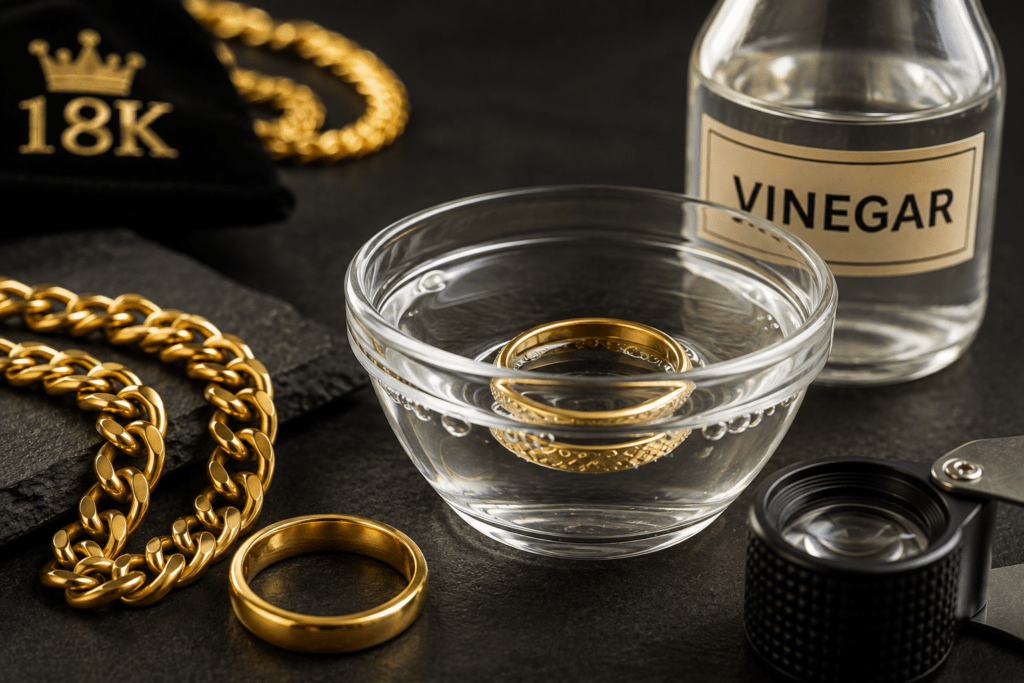
Vinegar can sometimes give you a clue about whether an item is gold, but it cannot reliably prove that your gold is real.
Real gold is highly resistant to corrosion, so ordinary household vinegar usually will not noticeably affect genuine gold. Some base metals, on the other hand, may discolor or react when exposed to vinegar.
The problem is that no reaction does not automatically mean an item is real gold.
Gold-plated jewelry may have enough gold on its surface to resist the vinegar. Some non-gold metals may also show little visible reaction. That means a piece can appear to “pass” the vinegar test and still contain little or no solid gold.
If you have jewelry you genuinely want identified, use the vinegar test only as a preliminary clue—not as your final answer.
At Gold Kings, we regularly evaluate gold jewelry that people are unsure about. Professional testing can tell you much more than color, stamps, magnets, or household vinegar alone.
You can also read our complete guide to how to tell if gold is real using several different tests.
How Does the Vinegar Gold Test Work?
Household white vinegar contains acetic acid. It is much weaker than the specialized acids traditionally used by jewelers and precious-metal professionals.
Gold is unusually resistant to chemical attack. That is one reason it can remain bright for generations without rusting like iron or heavily tarnishing like many other metals.
When vinegar comes into contact with certain base metals, however, you may notice discoloration, dulling, or another visible reaction.
That created the popular idea that vinegar can separate real gold from fake gold.
There is some logic behind the test—but the conclusion people draw from it is often too strong.
What a vinegar reaction may mean
If a gold-colored item changes color noticeably after contact with vinegar, that is a reason to question whether it is solid gold.
What no vinegar reaction means
Very little.
It tells you the surface did not visibly react to weak acetic acid during the test. It does not tell you exactly what metal is underneath, how much gold the item contains, or what karat it is.
That distinction is important.
Can Fake Gold Pass the Vinegar Test?
Yes.
This is the biggest weakness of the vinegar test.
Imagine a bracelet made primarily from a base metal but covered with a layer of real gold. The vinegar initially contacts the gold plating rather than the metal underneath.
The surface may therefore show no obvious reaction.
Your bracelet appears to pass.
But it still is not solid gold.
The same issue can occur with gold-filled, gold-plated, vermeil, and other layered jewelry. Surface tests cannot always tell you what is happening deeper inside the item.
This is why Gold Kings does not decide whether jewelry is genuine based on one home test.
Does Real Gold Change Color in Vinegar?
Generally, genuine high-purity gold should not visibly change color simply because it was exposed briefly to ordinary household vinegar.
But jewelry is rarely pure 24K gold.
Common jewelry alloys include:
- 10K — approximately 41.7% gold
- 14K — approximately 58.3% gold
- 18K — 75% gold
- 22K — approximately 91.7% gold
- 24K — nearly pure gold
The remainder of the alloy may contain copper, silver, zinc, nickel, or other metals.
Jewelry can also contain solder joints, clasps, springs, repairs, plating, gemstones, and other components.
That means the reaction of an entire piece of jewelry can be more complicated than simply saying, “Real gold never reacts.”
Vinegar Test vs. Other Ways to Test Gold
Here is a better way to think about the common gold tests:
| Test | What It Can Tell You | Major Limitation |
|---|---|---|
| Vinegar | May expose some reactive base metals | Passing does not prove real gold |
| Hallmark | Gives a claimed karat or purity | Stamps can be incorrect or misleading |
| Magnet | Can identify strongly magnetic components | Many fake metals are also nonmagnetic |
| Professional acid testing | Can help estimate gold purity | Requires proper acids, experience and safety precautions |
| XRF testing | Analyzes the elemental composition of the tested area | Results must be interpreted correctly, especially with plated or unusual items |
Professional touchstone testing is very different from putting household vinegar on jewelry. The Gemological Institute of America explains professional touchstone gold testing using carefully selected testing acids and known comparison samples.
What About the Gold Stamp?
Before reaching for vinegar, look carefully for a hallmark.
A ring may be stamped inside the band. A chain or bracelet is often marked near the clasp. Earrings may have a mark on the post or back.
You might see markings such as 10K, 14K, 18K, 22K, 417, 585, 750, 916, or 999.
These markings are useful clues, but they are not guarantees.
A fake item can carry a fake stamp. An authentic piece may have a worn or missing hallmark. Repairs and solder can also affect the purity of part of an item.
At Gold Kings, the stamp is part of the evaluation—not the entire evaluation.
Can Vinegar Tell You What Karat Your Gold Is?
No.
This is another important limitation.
Even if your ring appears completely unchanged after the vinegar test, vinegar cannot tell you whether the ring is 10K, 14K, 18K, or 22K.
That difference can have a major effect on value.
For example, 18K gold contains 75% pure gold, while 10K contains only about 41.7%. Two rings of identical weight could therefore contain substantially different amounts of actual gold.
If you’re wondering what your jewelry is worth, determining whether it is simply “real” is only the beginning.
You also need to know its purity and weight.
How Gold Kings Tests Gold
If you want more certainty than a home vinegar test can provide, Gold Kings can professionally evaluate your jewelry.
We use professional precious-metal testing equipment, including XRF technology when appropriate, to help analyze metal composition. We also examine markings, construction, weight, and other characteristics when evaluating an item.
XRF testing is especially useful because it can analyze precious metals without relying solely on what is stamped on the jewelry.
This matters because a piece marked 14K does not automatically mean every part of the item will test exactly as expected. Jewelry can contain solder, repairs, replacement components, plating, or mixed materials.
Our goal is straightforward:
Understand what the item actually is before determining what it may be worth.
If you’re considering selling, you can see the types of gold, silver, coins, bullion, jewelry and other valuables Gold Kings buys.
Is the Vinegar Test Safe for Jewelry?
For a plain piece of inexpensive metal jewelry, a tiny amount of household vinegar may seem harmless.
But valuable jewelry deserves more caution.
Rings, necklaces, earrings, watches, and antique jewelry may contain gemstones, pearls, adhesives, surface treatments, plated areas, solder, or finishes that you do not want to expose unnecessarily to acidic liquids.
There is little reason to experiment on an expensive or sentimental piece when professional testing is available.
The same advice applies especially to gold coins and bullion. Do not scratch, file, acid-test, or otherwise alter a potentially collectible coin simply to see whether it is gold.
What Actually Determines the Value of Gold Jewelry?
Once you establish that an item contains real gold, several other questions matter.
The biggest factors are its weight, tested gold purity, current gold market price, and the type of item.
A broken 14K chain and an intact 14K chain may contain essentially the same amount of gold if their weights are identical. On the other hand, a collectible gold coin, designer jewelry piece, luxury watch, or jewelry containing valuable diamonds may need to be considered differently from ordinary scrap gold.
This is why simply asking whether vinegar changes the color of your jewelry cannot tell you what that jewelry is worth.
Thinking About Selling Your Gold?
Your vinegar test may have been the first step because you found an old chain, ring, bracelet, earring, or piece of inherited jewelry and wondered:
“Is this actually real gold?”
The next question is often:
“What is it worth?”
And eventually:
“Where can I sell gold near me?”
Gold Kings can help answer those questions without requiring you to guess about the metal first.
Your jewelry can be professionally tested and weighed, and the results can be explained before you decide whether you want to sell.
There is no obligation to determine at home whether something is real before bringing it in.
Have Your Gold Tested at Gold Kings in Snellville
For customers in Snellville, Loganville, Lawrenceville, Grayson, Lilburn, Stone Mountain and surrounding Gwinnett County communities, visit Gold Kings of Snellville.
Gold Kings of Snellville
3635 Stone Mountain Hwy
Snellville, GA 30039
770-771-4650
Bring in gold jewelry, broken chains, rings, bracelets, coins, bullion, silver, watches, estate jewelry, or other qualifying valuables you are unsure about.
We can test and weigh the item and explain what you have before you decide whether selling makes sense.
Have Your Gold Tested at Gold Kings in Commerce
For Commerce, Banks Crossing and surrounding Northeast Georgia communities, visit Gold Kings of Commerce.
Gold Kings of Commerce
480 Banks Crossing Dr
Commerce, GA 30529
706-336-0043
The Commerce location evaluates gold jewelry, scrap gold, coins, bullion, silver and other precious-metal items.
If the vinegar test left you with more questions than answers, bring the item with you rather than performing increasingly aggressive tests at home.
Frequently Asked Questions About Testing Gold With Vinegar
Does vinegar prove gold is real?
No. A lack of reaction to vinegar does not prove an item is genuine gold. Some plated and non-gold materials can also show little or no reaction.
Will fake gold change color in vinegar?
Some fake or base-metal jewelry may discolor when exposed to vinegar, but not every fake item will. Gold plating can also protect the underlying metal from immediate contact with the vinegar.
Can vinegar tell whether gold is 10K or 14K?
No. Vinegar cannot reliably determine karat purity.
Should real gold turn black in vinegar?
Genuine gold itself is highly resistant to corrosion, so significant discoloration is a warning sign. However, jewelry alloys and other components can complicate what you see.
Is vinegar better than a magnet test?
Neither test proves an item is gold. They simply look for different warning signs. Combining the hallmark, magnet response, construction, weight and professional testing provides much more useful information.
What is the most reliable way to test gold?
For valuable items, professional evaluation is preferable to relying on a household test. Techniques may include professional acid testing, XRF analysis, careful inspection, weight measurements, and additional verification when necessary.
Can Gold Kings test jewelry with no hallmark?
Yes. An item does not need to have a readable gold stamp before it can be evaluated. Worn, inherited, foreign, repaired, and unmarked jewelry can still be examined and tested.
Don’t Let a Bottle of Vinegar Decide What Your Gold Is Worth
The vinegar test is popular because it is simple.
But simple does not mean conclusive.
A reaction can give you a reason to be suspicious. No reaction does not prove that your jewelry is real gold, and vinegar cannot tell you its exact purity or value.
If you have a piece you are curious about, skip the guesswork.
Visit Gold Kings of Snellville or Gold Kings of Commerce to have your item evaluated. You can also request a Gold Kings gold and silver quote before visiting.
Whether it turns out to be 10K, 14K, 18K, 22K, plated, or something else, the first step is knowing what you actually have.
We test it. We weigh it. We pay you.