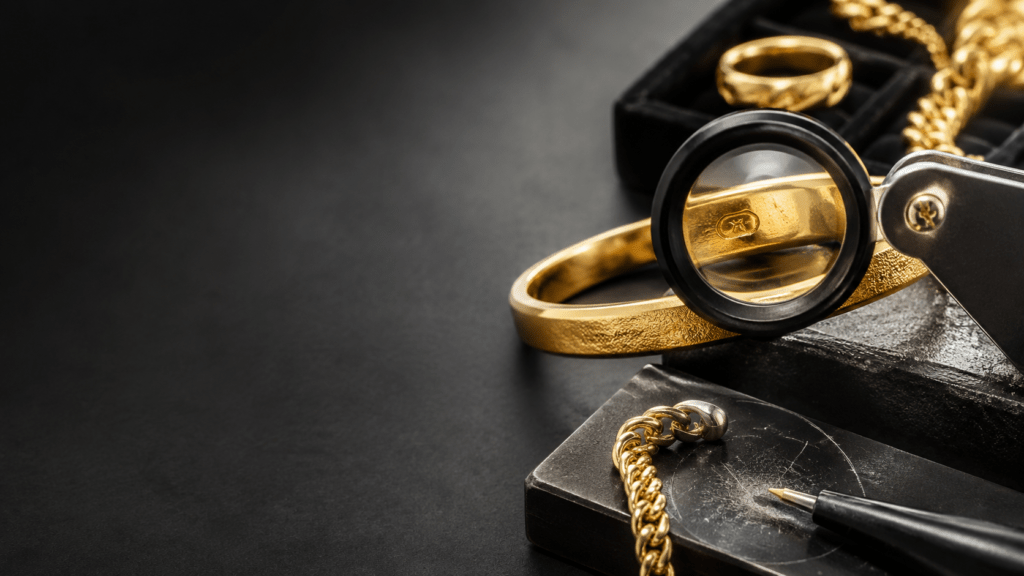
You find
14K stamped inside a ring.
Or
585 on a chain.
Maybe
750 appears on a bracelet or
916 on a piece of high-karat jewelry.
That means it must be real gold, right?
Not necessarily.
A gold hallmark offers a clue about the gold content a maker claims, but
a stamp alone does not prove that the metal is genuine.
Fake, plated, altered, and incorrectly marked jewelry can carry convincing gold stamps. At the same time, genuine gold jewelry can sometimes have no visible stamp at all.
Quick Answer
Yes, a gold hallmark can be fake.
A mark such as
10K, 14K, 18K, 417, 585, 750, 916, or 999 states a claim about the item’s purity. It does not independently verify what is actually inside the metal.
For a reliable answer, ask a professional to examine and test the jewelry.
If you want to learn the basic checks you can perform yourself, see our guide to
how to tell if gold is real.
At Gold Kings, we don’t determine whether jewelry is genuine—or what it is worth—simply by reading the stamp. We examine the item, test the metal, weigh it, and consider whether the test results make sense for the hallmark and construction of the piece.
What Does a Gold Hallmark Actually Tell You?
A gold hallmark or purity stamp normally represents the amount of gold the manufacturer says the item contains.
Common markings include:
| Mark |
Intended Gold Purity |
Approximate Karat |
| 375 |
37.5% |
9K |
| 417 |
41.7% |
10K |
| 585 |
58.5% |
14K |
| 750 |
75.0% |
18K |
| 916 |
91.6% |
22K |
| 999 |
99.9% |
Approximately 24K |
You may also see the karat written directly as
10K, 14K, 18K, 22K, or 24K.
For deeper explanations of common fineness marks, see what
585 means on gold, what
750 means on gold, and what
916 means on gold.
These markings are useful. They give you a starting point.
But think of the stamp as
a claim about the metal—not a laboratory test of the metal.
If you’re trying to identify an unfamiliar mark, our
guide to reading jewelry hallmarks explains many of the numbers and letters found on gold and silver jewelry.
Can Fake Gold Be Stamped 14K?
Yes.
For example, a counterfeit piece can carry a
14K stamp even if it contains little or no gold.
The same is true for other markings.
A fake item could potentially say:
- 10K
- 14K
- 18K
- 585
- 750
- 916
- 999
Putting a tiny stamp into metal is much easier than manufacturing an entire item from genuine gold.
That is why experienced gold buyers don’t stop evaluating an item after finding a karat stamp.
The
Federal Trade Commission’s Jewelry Guides address truthful representations about precious-metal content, and
FTC consumer guidance advises shoppers to look for the company name or U.S. registered trademark associated with a karat quality mark. Rules against deceptive markings, however, don’t prevent dishonest or counterfeit jewelry from existing.
A Genuine-Looking Stamp Can Still Be Misleading
There are several ways a gold stamp can create the wrong impression.
1. The Stamp May Simply Be Counterfeit
Someone can stamp a base-metal ring or chain with
14K,
18K, or another purity mark.
The stamp may look completely legitimate.
That is why the appearance of the hallmark alone isn’t enough.
2. The Jewelry May Be Gold Plated
A piece can have real gold on its surface while another metal forms most of the item underneath.
This becomes especially important when the marking includes additional letters.
For example:
| Marking |
What It Generally Means |
| 14K |
Represented as 14K gold alloy |
| 14K GP |
14K gold plated |
| 14K GEP |
14K gold electroplated |
| 14K HGE |
Heavy gold electroplate |
| 14K GF |
Gold filled using 14K gold alloy |
| 1/20 14K GF |
Gold-filled construction using 14K alloy |
Those small letters can completely change what the marking means.
Therefore, do not value a piece marked
14K GF as though its entire weight were solid 14K gold.
Learn more in our guide to
gold filled vs. gold plated jewelry. The label
24K gold plated also needs to be distinguished from solid 24K gold.
Sometimes Part of the Jewelry Is Gold—and Part Isn’t
Jewelry can combine several separate metal parts.
For example, consider a necklace.
The chain may be one material while the:
- clasp
- jump ring
- end cap
- solder
- replacement component
may be something different.
A stamp located on one component doesn’t automatically prove that every part of the item has the same composition.
Repairs can complicate things further.
For example, an old gold chain may have a clasp that a jeweler added years later. Likewise, a jeweler may have used different solder to resize or repair a ring.
Professional evaluation looks at the
entire item, rather than one tiny stamp.
Can Real Gold Have No Hallmark?
Absolutely.
The opposite mistake is assuming:
No stamp = fake gold.
That isn’t reliable either.
Genuine gold jewelry may be unmarked because:
- The hallmark has worn away.
- A jeweler resized the ring where its stamp once appeared.
- Repairs removed or obscured the mark.
- The jewelry is handmade.
- It is older jewelry.
- A maker in another country produced it.
- The stamp is extremely small or difficult to see.
- A jeweler replaced the marked component.
An unmarked chain could be real gold.
By contrast, a beautifully stamped chain could be fake.
Testing settles the question far better than appearance alone.
If you are dealing with an unmarked piece, see our guide explaining
whether real gold has to be stamped.
How Can You Tell Whether a Gold Hallmark Is Genuine?
You should not rely on one test in every situation.
Instead, professionals look at several pieces of evidence.
Home shortcuts also have limits. Read why the vinegar test and gold bite test cannot reliably verify gold.
Visual Inspection
First, a buyer examines the jewelry itself.
Things worth checking include:
- Hallmark location
- Unusual stamp fonts
- Uneven lettering
- Wear around edges
- Color differences
- Exposed base metal
- Solder joints
- Repairs
- Clasps and connectors
- Areas where plating may have worn through
However, none of these alone proves that an item is fake.
They’re clues.
Skin discoloration is another common source of confusion; see whether real gold can turn your skin green.
Magnet Testing
An ordinary magnet does not strongly attract gold itself.
A strong magnetic attraction can therefore raise questions about an item.
But
passing the magnet test does not prove something is gold.
For example, many inexpensive non-gold metals aren’t strongly magnetic either.
Magnets are useful for screening—not authentication.
Acid Testing
Jewelers have used gold acid testing for generations.
Typically, a jeweler rubs some metal onto a testing stone and applies solutions for different gold purities.
It can provide useful information, but it also has limitations.
However, plating can complicate surface testing, and anyone using testing acids must handle them carefully.
Weight and Density
Gold is unusually dense.
Weight can therefore provide another clue when you compare an item with what you expect from genuine gold.
However, professionals should assess
density testing alongside other evidence instead of treating it as a guarantee.
How Gold Kings Tests Gold
At Gold Kings, one of the tools we use for precious-metal evaluation is
X-ray fluorescence, or XRF.
XRF allows us to analyze the elemental composition of precious-metal items without simply assuming that the stamped karat is correct.
For example, an XRF reading can help identify the presence and approximate percentages of metals such as:
- Gold
- Silver
- Copper
- Platinum
- Palladium
- Other alloying metals
This allows us to compare
what the jewelry says it is with
what testing indicates it contains.
But professional testing also requires understanding the limitations of the equipment.
XRF analyzes surface and near-surface composition. Heavy plating or certain surface treatments can influence a reading, which is why questionable pieces may require testing in multiple areas or additional verification rather than blindly accepting a single result.
Thermo Fisher specifically recommends secondary analysis when a piece may have thick plating or gold-filled construction.
That distinction matters.
Professional testing isn’t just owning a machine. It’s knowing how to interpret what the machine is telling you.
What If My Jewelry Tests Lower Than the Stamp?
Suppose your ring says
14K, but testing doesn’t initially appear to match what you expected.
That doesn’t automatically mean someone deliberately counterfeited the ring.
Several factors may deserve investigation, including:
- Where the evaluator tested the item
- Repairs or solder
- Surface plating
- Rhodium plating on white gold
- Different components
- Previous alterations
- The method the evaluator used
A meaningful difference between the hallmark and the test result is a reason to investigate further—not a reason to jump immediately to a conclusion.
In particular, look closely at older jewelry and pieces with repairs or new finishes.
Does a Fake Gold Hallmark Affect What the Jewelry Is Worth?
The stamp itself doesn’t create gold value.
The actual gold content does.
For precious-metal value, some of the most important factors are:
- Actual tested purity
- Actual precious-metal weight
- Current gold market price
- Whether the buyer must subtract stones or non-gold components from the weight
- Whether the item has resale, designer, antique, or collectible value beyond its gold
Imagine two chains that both weigh 30 grams and both say
14K.
If one contains genuine 14K gold and the other has plating over inexpensive base metal, their precious-metal values may differ dramatically.
They look similar, weigh the same, and even have similar stamps.
But they aren’t the same asset.
Don’t Sell Gold Based Only on the Stamp
This is particularly important if you’re thinking about selling inherited jewelry, an old chain, a class ring, broken jewelry, or pieces you haven’t looked at in years.
You want to know what you actually have
before accepting an offer.
A good evaluation should help answer:
- Is it actually gold?
- What purity did it test?
- How much does the gold portion weigh?
- Are there stones or non-gold components?
- Is the hallmark consistent with the test?
- Could the piece have value beyond scrap gold?
- How did the buyer calculate the offer?
At Gold Kings, customers can watch us test and weigh their precious metals. As a result, you can understand what you have before deciding whether to sell.
You can also review the
types of gold, silver, jewelry, coins, bullion, watches and other items Gold Kings buys.
Have a Questionable Gold Stamp? Have It Tested at Gold Kings
If you’ve found
10K, 14K, 18K, 417, 585, 750, 916, 999, or another marking on your jewelry and aren’t sure whether you can trust it, you don’t have to guess.
Gold Kings can examine the hallmark, test the precious metal, weigh the item, and explain what the results mean.
This is especially useful for:
- Inherited jewelry
- Old chains and bracelets
- Estate jewelry
- Unmarked gold
- Foreign jewelry
- Broken pieces
- Jewelry with questionable stamps
- Gold-plated or gold-filled pieces
- Coins and bullion requiring verification
Gold Kings of Snellville
Customers in Gwinnett County and surrounding communities can visit
Gold Kings of Snellville.
3635 Stone Mountain Hwy
Snellville, GA 30039
770-771-4650
Bring the item with you. We can test and weigh it so you have more information about what you own before deciding whether selling makes sense.
Gold Kings of Commerce
Customers in Commerce, Banks Crossing, Banks County, Jackson County, and surrounding Northeast Georgia communities can visit
Gold Kings of Commerce.
480 Banks Crossing Dr
Commerce, GA 30529
706-336-0043
Both Gold Kings locations evaluate gold jewelry and other precious-metal items.
Frequently Asked Questions
Can fake gold really have a 14K stamp?
Yes. A dishonest seller can put a 14K stamp on metal that isn’t actually 14K gold. The stamp tells you what the item claims to be, which is why professional verification is important when authenticity or value matters.
Can fake gold be stamped 585?
Yes. A genuine 585 mark represents approximately 58.5% gold, which corresponds to 14K gold. However, someone can stamp that number onto an item fraudulently. Therefore, a professional must test the metal to verify its content.
Can fake gold say 750?
Yes. A legitimate 750 hallmark represents 75% gold, or 18K. A counterfeit item can still carry a 750 mark.
Does 916 automatically mean real gold?
No. A legitimate 916 mark represents approximately 91.6% gold, which corresponds to 22K gold. However, a professional should assess the hallmark alongside the item itself and use testing when necessary.
Does real gold have to be stamped?
No. Genuine gold jewelry can have a missing, worn, removed, or difficult-to-find hallmark. Lack of a stamp should not automatically make you assume the item is fake.
Can fake gold pass a magnet test?
Yes. Many non-gold metals are also non-magnetic. A magnet is useful as a quick screening tool but cannot prove that jewelry is genuine gold.
Can plated jewelry fool a gold test?
Surface plating can influence some testing methods. For example, thick plating may prompt professionals to test several areas or combine different testing techniques.
Is XRF testing enough by itself?
XRF is an extremely useful tool for precious-metal analysis, but surface coatings and unusual construction can affect interpretation. A knowledgeable evaluator considers the XRF results together with the item’s construction, markings, appearance, weight, and other testing when necessary.
Where can I have questionable gold tested near me?
If you’re in Georgia, Gold Kings evaluates precious-metal items at its Snellville and Commerce locations. If you’re searching for a
gold buyer near me because you’re considering selling, have the item properly identified before making your decision.
A Stamp Is a Clue. Testing Gives You the Answer.
The tiny
14K,
585,
750, or
916 inside your jewelry can tell you a lot.
But it cannot tell you everything.
Don’t assume jewelry is real because it has a stamp.
And don’t assume jewelry is fake simply because it doesn’t.
If you have gold jewelry you’re unsure about, bring it to
Gold Kings of Snellville or
Gold Kings of Commerce.
We’ll examine it, test it, weigh it, and explain what you have before you decide whether you want to sell.
We test it, we weigh it, and we pay you.