
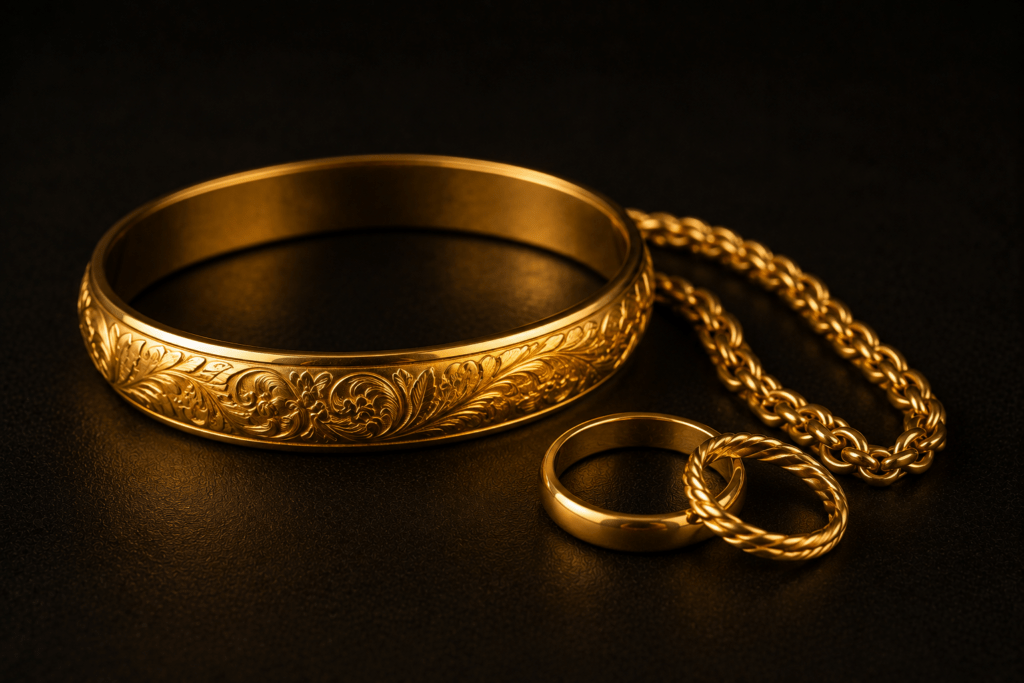
If you found 916 stamped on a ring, bracelet, necklace, chain, or other piece of jewelry, you probably have high-purity gold.
916 on gold means the item is approximately 91.6% pure gold.
That is essentially 22 karat gold, commonly written as 22K.
Quick Answer
916 gold = 91.6% pure gold = approximately 22K gold
The remaining 8.4% is usually made from other metals added to make the jewelry stronger and more practical to wear.
If you own jewelry marked 916, don’t overlook it. Because of its high gold content, 916 jewelry can have significant melt value even if it is broken, damaged, outdated, or missing stones.
Why Does 916 Mean 22K Gold?
Gold purity can be expressed in two common ways:
- Karat purity, such as 10K, 14K, 18K or 22K
- Millesimal fineness, such as 417, 585, 750 or 916
You can learn more about these numbers in our Gold Hallmarks & Stamps guide.
Pure gold is considered 24 karat.
To calculate the purity of 22K gold:
22 ÷ 24 = 91.67%
That is why 22K jewelry is commonly stamped 916.
The number tells you that approximately 916 parts out of every 1,000 parts are pure gold.
| Gold Mark | Karat | Approx. Gold Purity |
|---|---|---|
| 375 | 9K | 37.5% |
| 417 | 10K | 41.7% |
| 585 | 14K | 58.5% |
| 750 | 18K | 75% |
| 916 | 22K | 91.6% |
| 999 | 24K | 99.9% |
So if you see 916 inside your jewelry, it is one of the highest-purity gold markings commonly found on wearable jewelry.
Is 916 Gold Real Gold?
Yes. 916 gold is real gold.
In fact, it contains considerably more pure gold than the jewelry commonly sold as 10K, 14K or 18K in the United States.
For comparison:
- 10K gold is approximately 41.7% gold
- 14K gold is approximately 58.5% gold
- 18K gold is 75% gold
- 22K / 916 gold is approximately 91.6% gold
That higher purity is also why 22K jewelry usually has a deeper, richer yellow color than lower-karat gold.
However, there is an important distinction:
A 916 stamp does not automatically prove that an item actually contains 91.6% gold.
Stamps can be inaccurate, jewelry can be altered, and counterfeit pieces can carry fake gold markings.
Professional testing and weighing is the best way to determine the actual gold content.
Can Fake Gold Be Stamped 916?
Yes.
Just as fake jewelry can be stamped 10K, 14K or 18K, counterfeit jewelry can also have a 916 stamp.
A hallmark is useful evidence, but it should not be the only thing used to determine whether an item is genuine.
Warning signs can include:
- Unusual discoloration
- Gold plating wearing away
- Different colors appearing underneath scratches
- Suspiciously light weight
- Magnetic components
- Poor-quality construction
- A purity test that does not match the stamp
This is especially important when buying gold jewelry from an unknown seller.
When selling gold, a professional buyer should test the jewelry instead of simply assuming the stamp is correct.
Where Is 916 Gold Commonly Found?
916 gold is especially common in high-purity jewelry.
You may find the 916 hallmark on:
- Gold chains
- Bangles
- Bracelets
- Rings
- Necklaces
- Earrings
- Pendants
- Wedding jewelry
- Religious jewelry
- Estate jewelry
- Imported gold jewelry
22K jewelry is particularly popular in many cultures where gold jewelry is purchased not only for appearance but also as a way to hold wealth.
Because 22K gold contains so much pure gold, even relatively small pieces can be worth more than people expect.
Is 916 Gold the Same as 22K Gold?
For practical purposes, yes.
A 916 hallmark is commonly used to identify 22K gold.
Mathematically, 22K gold is:
22 ÷ 24 = 91.67% pure
The 916 marking represents approximately 91.6% purity.
You may therefore see the same type of jewelry described as:
- 916 gold
- 22K gold
- 22 karat gold
- 22 carat gold
They are generally referring to the same purity range.
Is 916 Gold Better Than 18K or 14K Gold?
It depends on what you mean by “better.”
For Gold Content
916 gold contains substantially more pure gold.
A 100-gram piece of jewelry would theoretically contain approximately:
- 41.7 grams of gold at 10K
- 58.5 grams at 14K
- 75 grams at 18K
- 91.6 grams at 916 / 22K
That can make 916 jewelry considerably more valuable based on gold content.
For Durability
Lower-karat jewelry can sometimes be harder and more resistant to everyday wear because it contains a larger percentage of alloy metals.
916 gold is relatively soft because it contains so much pure gold.
That doesn’t make it inferior. It simply means the different purities have different characteristics.
How Much Is 916 Gold Worth?
The value of 916 gold changes with the current gold spot price.
A simple estimate starts with three things:
- The weight of the item
- Its actual gold purity
- The current market price of gold
For an item that truly tests at 91.6% gold:
Weight × 91.6% = approximate pure gold content
For example, a 50-gram 916 bracelet contains approximately:
50 × .916 = 45.8 grams of pure gold
The market value of that gold then depends on the current gold price.
Important
The total weight of a piece of jewelry isn’t always gold.
The weight may also include:
- Diamonds
- Gemstones
- Pearls
- Non-gold clasps
- Springs
- Other components
That is why an accurate gold evaluation involves more than putting the entire piece on a scale.
Does 916 Gold Have Good Resale Value?
Yes.
Because 916 jewelry contains approximately 91.6% gold, its intrinsic gold value can be substantial.
Even jewelry that is:
- Broken
- Bent
- Missing stones
- Scratched
- Outdated
- Unwanted
- Damaged
may still contain the same valuable gold.
When selling 916 jewelry for its gold content, its condition may matter far less than its weight and actual purity.
How Do I Know If My 916 Gold Is Genuine?
Start by looking carefully at the jewelry.
The mark may appear as:
916
or it may be accompanied by additional letters, symbols, manufacturer marks or hallmarks.
But remember:
Do not rely on the stamp alone.
A professional gold test can determine whether the metal actually matches the purity marked on the jewelry.
This is especially useful for older jewelry, imported pieces, inherited jewelry or pieces whose history you do not know.
What If My Jewelry Is Marked 916 but Tests Lower?
This can happen.
A stamp represents what the jewelry is supposed to be, but the actual metal composition is what ultimately matters when determining its gold value.
Reasons an item may test differently include:
- Manufacturing tolerances
- Repairs or solder
- Mixed-metal components
- Plated sections
- Alterations made over the years
- Incorrect hallmarks
- Counterfeit markings
A professional gold buyer should determine the actual gold content before calculating an offer.
Want to Sell 916 or 22K Gold?
If you have jewelry marked 916 or 22K, it may contain considerably more gold than typical 10K or 14K jewelry.
Gold Kings buys gold jewelry including:
- 916 gold
- 22K gold
- 18K gold
- 14K gold
- 10K gold
- Broken gold jewelry
- Estate jewelry
- Gold chains
- Rings
- Bracelets
- Bangles
- Earrings
- Other unwanted gold
We can examine your jewelry, determine its gold content, weigh it and explain how its value is calculated.
If you’re thinking about selling, request a free Gold Kings quote before making the trip.
Choose Your Gold Kings Location
- Gold Kings of Snellville — 3635 Stone Mountain Hwy, Snellville, GA 30039 — 770-771-4650
- Gold Kings of Commerce — 480 Banks Crossing Dr, Commerce, GA 30529 — 706-336-0043
No appointment is necessary. Bring your gold in for testing, weighing and a no-obligation evaluation.
Frequently Asked Questions About 916 Gold
What does 916 mean stamped on gold?
A 916 stamp means the item is approximately 91.6% pure gold, which corresponds to about 22 karat gold.
What karat is 916 gold?
916 gold is generally considered 22K gold.
Is 916 real gold?
Yes. Genuine 916 gold contains approximately 91.6% pure gold, making it significantly higher in purity than 10K, 14K or 18K jewelry.
Is 916 gold the same as 22K?
Yes, for practical jewelry purposes. 22K gold is approximately 91.67% pure, which is commonly represented by the 916 hallmark.
Can fake gold have a 916 stamp?
Yes. A stamp alone does not guarantee purity. Counterfeit or incorrectly marked jewelry can carry a 916 hallmark, so professional testing is recommended.
Is 916 gold valuable?
Yes. Because it contains approximately 91.6% pure gold, 916 jewelry can have significant value depending on its weight and the current gold market price.
How much is 1 gram of 916 gold worth?
Its value changes with the gold spot price. To estimate the pure gold content of one gram of 916 gold, multiply one gram by 0.916 and then apply the current gold value per gram.
Is 916 gold better than 750 gold?
916 gold contains more pure gold. 916 is approximately 91.6% gold or 22K, while 750 is 75% gold or 18K. However, 18K may be harder and more durable for certain types of jewelry.
Can I sell jewelry marked 916?
Yes. Genuine 916 jewelry contains a high percentage of gold and can be sold based primarily on its actual gold content and weight. See how the Gold Kings selling process works.
Does all real 22K gold have a 916 stamp?
No. Genuine gold does not always have a visible hallmark. Marks can wear away, older jewelry may follow different standards, and some pieces may never have been stamped.
The Bottom Line
If you see 916 stamped on gold jewelry, the mark normally means:
916 = 91.6% pure gold = approximately 22K gold
That makes 916 one of the highest-purity forms of gold commonly used for jewelry.
The stamp is a great clue, but it isn’t proof by itself. The best way to determine what your jewelry actually contains—and what it may be worth—is to have the gold properly tested and weighed.
Have 916 or 22K gold you want to sell? Get a quote from Gold Kings or visit Snellville or Commerce for an evaluation.