
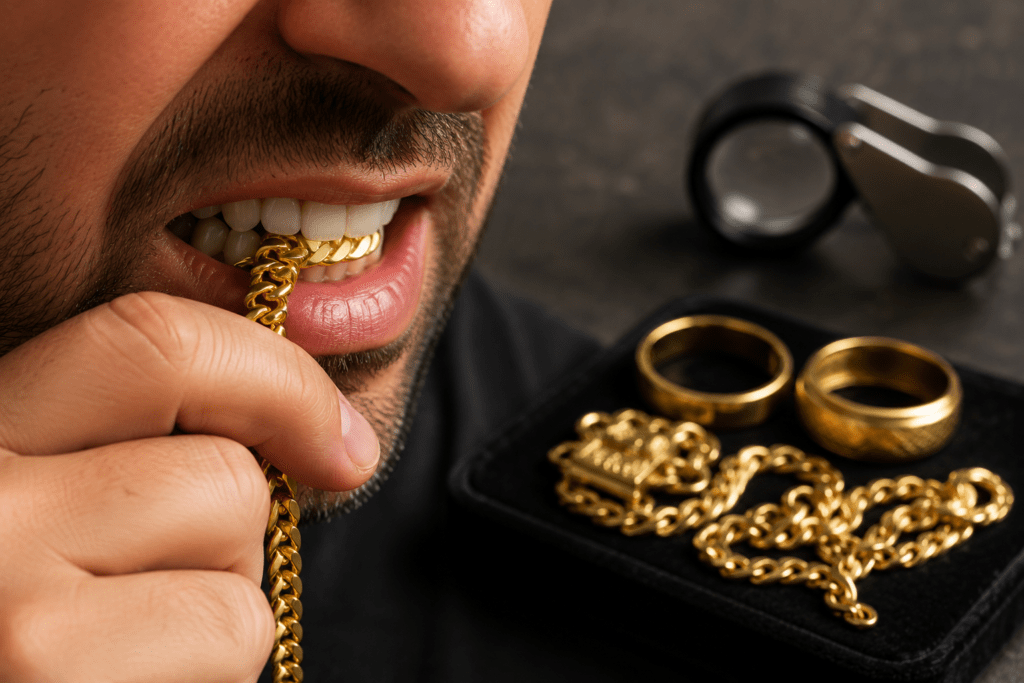
You have probably seen it in movies.
Someone finds a gold coin, bites down on it, looks for a tooth mark and declares:
“It’s real gold.”
There is a little science behind the idea, but the gold bite test is not a reliable way to tell whether gold is real.
Pure gold is unusually soft and malleable. Under enough pressure, it can be dented or scratched more easily than many other metals.
But that does not mean an object that dents when you bite it is real gold. It also does not mean real gold that fails to dent is fake.
Modern gold jewelry, coins and bullion require much better testing.
If you have an item you are unsure about, Gold Kings can professionally test and evaluate it at our locations in Snellville and Commerce, Georgia. You can also start with our complete guide to how to tell if gold is real.
Quick Answer: Does Biting Gold Prove It Is Real?
No.
The bite test is based on the fact that high-purity gold is relatively soft.
However:
- Some fake metals are also soft.
- Most gold jewelry is an alloy rather than pure 24K gold.
- Lower-karat gold is harder than pure gold.
- Gold-plated items may behave unpredictably.
- A tooth mark tells you very little about actual gold purity.
- Biting jewelry or coins can damage the item.
- Biting metal can damage your teeth or dental work.
A bite test might tell you that an object is soft.
It cannot reliably tell you that the object is gold.
Why Did People Bite Gold in the First Place?
The idea did not come completely out of nowhere.
Gold is one of the most malleable metals. Pure 24K gold can be bent, scratched and deformed much more easily than many common metals.
Historically, someone handling a high-purity gold coin could theoretically apply pressure with their teeth and see whether the surface showed an indentation.
The thinking was simple:
Soft coin = possibly high-purity gold.
Hard coin = possibly another metal.
But even historically, the test had major weaknesses.
Coins could contain gold mixed with copper or other metals to make them more durable. Counterfeiters could also use other relatively soft metals.
So the famous pirate-style bite test was never the foolproof authentication method movies make it appear to be.
Why Is Pure Gold So Soft?
Pure gold is 24-karat gold.
Gold is extremely malleable, meaning it can be shaped without easily cracking or breaking.
That is one reason pure gold is often alloyed with other metals when making jewelry.
Adding metals such as copper, silver, nickel or palladium can increase hardness and durability.
For example:
| Gold Purity | Approximate Gold Content |
|---|---|
| 10K | 41.7% |
| 14K | 58.5% |
| 18K | 75% |
| 22K | 91.7% |
| 24K | Approximately 99.9% |
A 24K item and a 10K item can therefore behave very differently even though both may legitimately be called gold.
This is one of the biggest problems with the bite test.
Real Gold Might Not Leave a Tooth Mark
Suppose you bite a genuine 14K gold ring and it does not dent.
Does that mean the ring is fake?
No.
Fourteen-karat gold contains approximately 58.5% pure gold. The rest consists of other metals added to create an alloy.
Those additional metals generally make the jewelry harder and more durable than pure 24K gold.
The same applies to many 18K and 22K items.
Jewelry is intentionally made durable enough to withstand everyday use.
So failing the bite test cannot prove that an item is fake.
A Fake Item Could Pass the Bite Test
This is the opposite problem.
A soft gold-colored object is not automatically gold.
Other metals can also be relatively soft. An object could also consist of a base metal covered with gold plating.
That means you could bite something, see an indentation and incorrectly conclude:
“This must be real gold.”
All you have actually demonstrated is that the material you bit was soft enough to be dented.
You still do not know:
- Whether it contains gold
- How much gold it contains
- Whether it is plated
- Whether it is gold-filled
- Whether it is 10K, 14K, 18K, 22K or 24K
- What other metals are present
That is why Gold Kings does not authenticate precious metals based on softness, appearance or a hallmark alone.
Does a Deeper Bite Mark Mean Higher-Karat Gold?
No.
You cannot accurately estimate gold purity based on the size or depth of a tooth mark.
A deeper indentation could be affected by:
- How hard you bit
- The thickness of the item
- Its shape
- The metals mixed with the gold
- Whether the piece is hollow
- Whether the surface is plated
- Previous wear or damage
There is no dependable conversion such as:
“Small dent means 14K.”
or
“Large dent means 24K.”
Gold purity requires actual testing.
Don’t Bite Gold Coins
Biting a gold coin is an especially bad idea.
Even if the coin contains real gold, deliberately putting tooth marks or scratches into its surface may damage it.
And some gold coins can be worth more than their basic gold content because of their:
- Date
- Mint
- Condition
- Rarity
- Collector demand
- Historical significance
If you own a gold coin, authentication should come before intentionally damaging it.
Gold Kings evaluates both gold jewelry and qualifying coins and bullion, so an unusual coin should be identified before assuming its only value is the gold inside it.
Better Ways to Tell If Gold Is Real
There are several useful ways to investigate gold without using your teeth.
No single home test is perfect, but some provide much more useful information than the bite test.
1. Check the Hallmark
Look for markings such as:
- 10K
- 14K
- 18K
- 22K
- 24K
- 417
- 585
- 750
- 916
- 999
These markings can provide an important clue about intended purity.
However, a stamp is not proof.
Fake jewelry can carry a convincing-looking gold mark, while genuine older or repaired jewelry may have a missing or worn hallmark.
2. Try a Magnet Test
Gold itself is not strongly attracted to an ordinary magnet.
A strong magnetic pull can therefore be a warning sign.
But the reverse is not true.
Plenty of non-gold metals are also nonmagnetic.
So an item that does not stick to a magnet has not automatically passed as genuine gold.
Read our full explanation of whether the magnet test really works on gold.
3. Consider a Density Test
Gold is unusually dense.
Pure gold has a density of approximately 19.3 grams per cubic centimeter, making density potentially useful when evaluating certain coins, bars and solid objects.
However, jewelry creates complications.
Hollow pieces, stones, clasps and mixed materials can make density testing more difficult to interpret.
See our guide explaining how to test gold using a density test.
4. Gold Acid Testing
Acid testing has been used for generations to help estimate gold purity.
A tester can compare how a metal sample reacts to acids designed for different karat levels.
It can be useful, but acids require proper handling and can potentially damage an item if used incorrectly.
Read more about how gold acid testing works.
5. Professional XRF Testing
For valuable jewelry and precious metals, professional testing provides much more information than biting, scratching or guessing.
Gold Kings uses professional testing equipment including X-ray fluorescence, or XRF, technology.
An XRF analyzer examines the elemental composition of metal and can help identify percentages of metals such as:
- Gold
- Silver
- Copper
- Zinc
- Nickel
- Platinum
- Palladium
Instead of asking only:
“Is this gold?”
testing can help answer the more useful question:
“What is this item actually made of?”
Learn more about how an XRF gold tester works.
XRF is extremely useful, but professional evaluation still matters because surface plating, repairs, solder and an item’s construction can affect how results should be interpreted.
Gold Test Comparison
| Test | What It Can Tell You | Main Limitation |
| Bite test | Material may be soft | Does not prove gold |
| Hallmark | Intended purity | Stamps can be misleading |
| Magnet | Can identify some suspicious metals | Nonmagnetic does not mean gold |
| Density | Can compare weight and volume | Difficult with complex jewelry |
| Acid test | Can help estimate karat | Requires experience and chemicals |
| XRF | Identifies elemental composition | Results must be interpreted properly |
The important lesson is simple:
Testing gold works best when several pieces of evidence agree.
Think You Found Real Gold? Have It Tested Before You Sell It
An old chain, inherited ring, broken bracelet or unusual coin may be worth investigating even if you are not sure whether it is genuine.
Do not throw an item away simply because:
- You cannot find a stamp
- It failed a home test
- It looks old
- It is broken
- It is tarnished or dirty
- Someone told you it was fake
- A magnet reacted to one small component
- It did not leave a tooth mark
At Gold Kings, we can test and weigh qualifying precious-metal items so you have a better understanding of what you own before deciding whether you want to sell.
You can also review the full list of items Gold Kings buys, including gold jewelry, scrap gold, silver, coins, bullion, watches and other qualifying valuables.
Have Your Gold Tested at Gold Kings
If you are wondering whether an old ring, necklace, bracelet, coin or other item is actually gold, you do not need to risk your teeth—or damage the item—to find out.
Gold Kings has two Georgia locations offering professional precious-metal evaluation.
Gold Kings of Snellville
Gold Kings of Snellville
3635 Stone Mountain Hwy
Snellville, GA 30039
770-771-4650
Our Snellville location serves customers throughout Snellville, Loganville, Lawrenceville, Grayson, Lilburn, Stone Mountain and surrounding Gwinnett County communities.
Bring your gold, silver, coins, bullion or jewelry in for testing and evaluation before guessing what it contains.
Gold Kings of Commerce
Gold Kings of Commerce
480 Banks Crossing Dr
Commerce, GA 30529
706-336-0043
Our Commerce location serves Commerce, Banks Crossing and communities throughout Banks County, Jackson County and Northeast Georgia.
If you are unsure whether an item is real gold, professional testing can help you understand what you have before you decide whether selling it makes sense.
Frequently Asked Questions
Does real gold leave a mark when you bite it?
High-purity gold is soft enough that sufficient pressure may leave an indentation. However, whether a particular gold item dents depends on its purity, alloy, thickness and construction. A tooth mark does not prove that an item is real gold.
Does 14K gold pass the bite test?
There is no meaningful pass or fail standard. Genuine 14K gold is an alloy containing approximately 58.5% gold and is considerably more durable than pure gold. It may not show an obvious tooth mark.
Can fake gold be soft?
Yes. Other metals can also be relatively soft, so softness alone cannot identify gold.
Can I test a gold ring by biting it?
You could physically try, but you should not. The result would be unreliable, you could damage the ring and you could injure your teeth or dental work.
Is the bite test better for 24K gold?
The idea makes more sense with very high-purity gold because pure gold is softer than common jewelry alloys. Even then, biting the metal cannot confirm its chemical composition.
Why do people bite gold medals?
The pose comes from the old association between biting and checking the softness of gold. Today it is largely a recognizable tradition and photo pose rather than a legitimate precious-metal test.
What is the best way to tell whether gold is real?
Start with visual inspection and hallmarks, then use appropriate testing methods such as magnet, density or acid testing when useful. For items that may have meaningful value, professional precious-metal testing provides much better information than any one home test.
Can Gold Kings tell me what karat my gold is?
Gold Kings uses professional precious-metal testing methods, including XRF analysis when appropriate, to evaluate metal composition and help determine gold purity. We also weigh the item and explain the evaluation before you decide whether you want to sell.
Skip the Bite Test—Find Out What You Actually Own
The gold bite test survives because the basic idea sounds believable:
Gold is soft, so real gold should dent.
But real-world gold testing is more complicated.
Different karats have different hardness. Fake metals can also be soft. Plating can hide what is underneath. Jewelry can contain multiple metals, solder, clasps and repairs.
So a bite mark cannot tell you what your gold is—or what it is worth.
If you have jewelry, coins or another gold-colored item you are curious about, bring it to Gold Kings of Snellville or Gold Kings of Commerce.
We can test it, weigh it and explain what you have before you make a decision about selling.
Use your teeth for smiling. Let the testing equipment handle the gold.