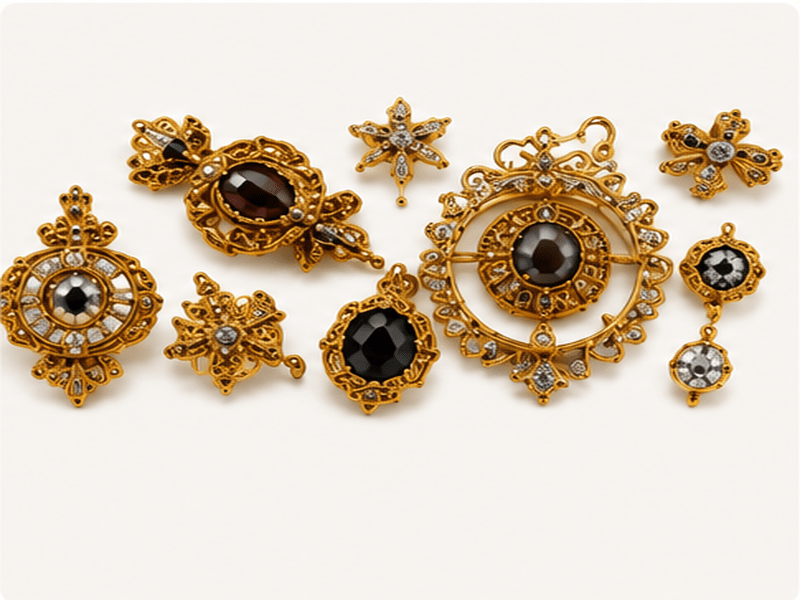
You find an old gold ring, necklace, bracelet, or brooch and decide you no longer want it.
Should you simply sell it for the value of the gold?
Or could the jewelry itself be worth more than its scrap value?
Quick Answer
Gold jewelry should be appraised or more carefully evaluated before being sold for scrap when there is a reasonable chance that the complete piece is worth more than the gold it contains.
That is especially true for jewelry that is:
- Made by a recognized designer or luxury brand
- Antique or vintage
- Set with significant diamonds or gemstones
- Unusually well made
- Rare or collectible
- Accompanied by original paperwork or provenance
- In excellent condition and desirable as jewelry
- Difficult to identify
On the other hand, broken chains, ordinary mass-produced rings, single earrings, damaged bracelets, and other common gold jewelry often derive most of their value from their precious-metal content.
The important part is figuring that out before the jewelry is destroyed or treated only as scrap.
At Gold Kings, we regularly evaluate gold jewelry by testing its precious-metal content and accurately weighing it before an owner decides whether to sell. Understanding the gold value gives you a starting point—but sometimes the evaluation should go further.
Appraised Value and Scrap Value Are Not the Same Thing
This distinction causes a lot of confusion.
Scrap Gold Value
Scrap value is primarily determined by:
Gold purity × gold weight × current gold price
For example, a 14K gold piece contains approximately 58.5% gold. An ordinary 14K bracelet with no meaningful collectible, designer, or gemstone value may be purchased primarily for the gold it contains.
You can learn more about how market pricing affects jewelry on our Gold & Silver Prices page.
Jewelry or Resale Value
A complete piece of jewelry may have additional value because of:
- Designer
- Maker
- Age
- Rarity
- Craftsmanship
- Condition
- Diamonds
- Gemstones
- Style
- Collector demand
- Provenance
That additional value can sometimes make selling the jewelry intact more attractive than selling it strictly for gold content.
Formal Appraised Value
A formal jewelry appraisal is something different again.
An appraisal may be prepared for:
- Insurance coverage
- Estate purposes
- Divorce or legal proceedings
- Probate
- Tax documentation
- Replacement-value documentation
An insurance appraisal, for example, may represent what it could cost to replace an item at retail. That does not necessarily mean someone will pay that amount for the jewelry in cash.
If an appraisal says a ring has a replacement value of $8,000, that does not automatically mean a dealer, auction house, or private buyer would pay $8,000 for it.
For someone trying to sell jewelry, actual resale value and actual scrap value are usually more useful numbers than insurance replacement value.
7 Times You Should Look More Closely Before Selling Gold for Scrap
1. The Jewelry Has a Recognized Designer or Maker’s Mark
Check the piece carefully before treating it as scrap.
You may find the name or hallmark of a recognized jewelry maker.
Designer jewelry can sometimes sell for more than the value of the gold because buyers are purchasing the finished piece and the brand, not merely its precious-metal content.
This is particularly important with older jewelry because the mark may be tiny, worn, or hidden near a clasp or inside a ring.
If you find a maker’s name you recognize—or one you do not recognize at all—research it before selling.
Our guide to when designer gold jewelry may be worth more than its gold explains this in greater detail.
2. The Jewelry Appears Antique or Vintage
Old jewelry is not automatically valuable.
But age can matter.
An older piece may have additional value because of its:
- Period
- Construction
- Design
- Rarity
- Maker
- Historical interest
- Collector demand
Certain Victorian, Edwardian, Art Nouveau, Art Deco, Mid-Century, and other period pieces may attract buyers as jewelry rather than scrap.
That doesn’t mean every old ring deserves an expensive formal appraisal.
It means you should identify what you have before making an irreversible decision.
Read more about whether vintage gold jewelry can be worth more than melt value.
3. The Jewelry Contains Significant Diamonds or Gemstones
A heavy gold ring may contain valuable gold.
But the center diamond or gemstone could potentially be worth as much—or considerably more—than the metal.
Important factors can include:
- Stone type
- Carat weight
- Cut
- Color
- Clarity
- Natural versus laboratory-grown origin
- Treatment
- Condition
- Certification
Small commercial stones may contribute relatively little to the resale value of some pieces.
A large, high-quality diamond or important colored gemstone is a completely different situation.
If the stones appear substantial, identifying them before selling the mounting for scrap is sensible.
Our Diamonds & Jewelry section contains additional information about identifying and valuing jewelry before a sale.
4. The Piece Has Exceptional Craftsmanship
Some jewelry does not have a famous brand name but is still desirable because it is exceptionally well made.
Look for things such as:
- Detailed hand engraving
- Intricate filigree
- Unusual construction
- Handmade settings
- Fine enamel work
- High-quality stone setting
- Unusual or artistic designs
A buyer interested only in gold weight may not place a premium on craftsmanship.
A collector or estate-jewelry buyer might.
When a piece clearly looks different from ordinary mass-produced jewelry, investigate it before treating it as scrap.
5. You Have Original Documents, Boxes or Provenance
Do not throw away the paperwork.
Original receipts, certificates, laboratory reports, branded boxes, photographs, or documentation about previous ownership can help identify an item.
They may also help establish:
- Who made it
- Where it was purchased
- Approximate age
- Diamond characteristics
- Original model or collection
- History of the piece
Provenance does not automatically make jewelry valuable, but it can help prove something that would otherwise be difficult to establish.
6. The Jewelry Is Intact, Attractive and Still Desirable
Condition matters when jewelry is going to be resold as jewelry.
Consider two identical gold bracelets.
One is badly damaged, missing parts, and heavily worn.
The other is complete, attractive, and ready to wear.
Their gold content might be nearly identical.
Their resale potential might not be.
This is why the question should not simply be:
“How much gold is in this?”
It should sometimes be:
“Would someone pay more for this as jewelry than for the gold inside it?”
7. You Simply Don’t Know What You Have
Inherited jewelry boxes are a perfect example.
One box may contain:
- Costume jewelry
- Gold-plated jewelry
- Sterling silver
- 10K gold
- 14K gold
- 18K gold
- Designer jewelry
- Real diamonds
- Synthetic stones
- Broken jewelry
- Collectible pieces
Trying to determine everything yourself can be difficult.
The safer approach is to separate and identify the pieces before assuming the entire collection is scrap.
Gold Kings can help establish the precious-metal side of the equation. We can test and weigh qualifying gold, silver, jewelry, coins, bullion, and other items so you have better information before deciding what to sell. See the full list on our What We Buy page.
When Does Selling Gold Jewelry as Scrap Make Sense?
There is nothing wrong with selling jewelry for scrap.
In many situations, it is exactly what makes sense.
Examples include:
- Broken gold chains
- Bent rings
- Single earrings
- Damaged bracelets
- Missing clasps
- Tangled necklaces
- Worn-out jewelry
- Common mass-produced pieces
- Jewelry with missing low-value stones
- Unwanted class rings
- Outdated generic jewelry
- Gold fragments
If the piece has no meaningful resale premium, the gold itself may represent most of its practical value.
And importantly, broken jewelry does not need to be repaired before its gold content can be evaluated.
You also normally should not melt jewelry yourself before selling it. Melting changes its shape, not the amount of gold it contains, and it can permanently destroy any value the piece might have had as jewelry.
See our guide on selling gold jewelry versus melting it before making that decision.
A Simple Way to Decide: Use the Three-Value Test
Before selling an unusual piece of jewelry, consider three possible sources of value.
| Value | What Matters |
|---|---|
| Gold value | Weight, purity and current gold price |
| Gemstone value | Diamonds, colored stones, quality and size |
| Jewelry value | Maker, age, craftsmanship, rarity, condition and demand |
Start with the gold.
That gives you a measurable baseline.
Then ask whether the stones or finished jewelry could reasonably add enough value to justify further investigation.
Example
Suppose an old bracelet contains $1,000 worth of gold.
If it is an ordinary damaged bracelet with no significant stones or maker, its value may primarily be tied to that gold.
But suppose the same amount of gold is contained in a desirable signed vintage bracelet that collectors buy for considerably more than its metal content.
Selling the second bracelet strictly as scrap could leave money on the table.
Same gold. Very different item.
Does a Gold Stamp Tell You What the Jewelry Is Worth?
No.
A stamp such as:
- 417
- 10K
- 585
- 14K
- 750
- 18K
- 916
- 22K
can provide useful information about the intended gold purity.
But the hallmark alone doesn’t tell you:
- The actual tested purity
- The exact gold weight
- Whether stones add value
- Whether the piece is collectible
- Whether the maker matters
- Whether the item is worth more intact
Stamps can also be worn, incorrect, altered, or misleading.
That is one reason professional precious-metal testing can be useful.
At Gold Kings, XRF testing can help determine metallic composition without simply relying on the stamp. The jewelry can then be weighed so you understand its underlying precious-metal value.
An XRF test, however, is not the same as a formal jewelry or gemstone appraisal. It answers an important part of the value question: what metal do you actually have?
Should You Pay for a Formal Appraisal Before Selling?
Not necessarily.
This is where people sometimes spend money they did not need to spend.
If you have a broken, ordinary 14K chain that is clearly being sold for its gold content, paying for a lengthy written insurance appraisal probably makes little sense.
A formal appraisal becomes more reasonable when:
- The jewelry appears unusually valuable
- You need documentation for insurance
- The item is part of an estate
- There is a legal or tax reason for establishing value
- You have a potentially important diamond or gemstone
- There is disagreement about the item’s value
- The piece appears rare or historically important
For ordinary unwanted gold jewelry, an initial professional evaluation may tell you enough to determine whether further appraisal is worthwhile.
What Should You Bring When Having Jewelry Evaluated?
If you still have them, bring:
- Original box
- Receipt
- Previous appraisal
- Diamond grading report
- Gemstone certificate
- Repair records
- Manufacturer paperwork
- Photographs
- Any information about where the jewelry came from
Do not clean, repair, remove stones from, or melt an unusual piece simply to prepare it for sale.
Bring it as it is.
Have Your Gold Jewelry Evaluated at Gold Kings
If you are unsure whether your jewelry is ordinary scrap gold or something that deserves a closer look, start by understanding what you actually own.
Gold Kings can professionally test and weigh gold jewelry to help establish its precious-metal content and underlying gold value.
You can see how selling your gold works at Gold Kings before visiting.
Gold Kings of Snellville
Gold Kings of Snellville serves customers throughout Gwinnett County and surrounding communities.
3635 Stone Mountain Hwy
Snellville, GA 30039
770-771-4650
Bring in gold jewelry, broken gold, estate jewelry, coins, bullion, silver, watches, and other qualifying valuables for evaluation.
Your items can be tested and weighed so you have a clearer understanding of what you own before deciding whether to sell.
Gold Kings of Commerce
For Northeast Georgia, visit Gold Kings of Commerce.
480 Banks Crossing Dr
Commerce, GA 30529
706-336-0043
The Commerce location evaluates gold jewelry and other precious-metal items for customers in Commerce, Banks Crossing, Jackson County, Banks County, and surrounding Northeast Georgia communities.
There is no reason to guess whether an old piece of jewelry is valuable simply because you no longer wear it.
Frequently Asked Questions
Do I need to have all gold jewelry appraised before selling it?
No. Most ordinary gold jewelry does not require a formal written appraisal before being sold. Testing the purity, determining the weight, and calculating the underlying gold value may be enough.
A more detailed appraisal becomes important when the piece could have significant value beyond its gold content.
Is appraisal value the same as what someone will pay me?
Usually not.
An insurance appraisal may represent retail replacement cost rather than actual resale or liquidation value. A buyer’s offer reflects what the item is worth in the current resale or precious-metals market.
Always ask what type of value the appraisal represents.
Should broken gold jewelry be appraised?
Usually not unless there is something special about it.
A broken generic chain may primarily have scrap value.
A broken signed designer necklace, antique ring, or valuable gemstone piece could still deserve additional evaluation.
Does being old make jewelry more valuable?
No.
Old jewelry can be valuable, but age by itself does not create value.
Maker, rarity, design, condition, materials, craftsmanship, and demand matter much more.
Should I remove diamonds before selling gold jewelry?
Not automatically.
Removing stones can damage a mounting or eliminate value the piece had as complete jewelry.
Have the entire piece evaluated first.
What if my jewelry says 14K but tests differently?
The actual metal content matters when establishing precious-metal value.
Jewelry stamps are helpful identification clues, but professional testing provides more information about what the item actually contains.
Can Gold Kings tell me whether my jewelry is gold?
Gold Kings can test precious-metal items and weigh them to help determine their composition and underlying metal value.
For potentially rare jewelry, important gemstones, or situations requiring formal documentation, additional specialized appraisal may still be appropriate.
Know What You Own Before You Sell It
The biggest mistake is not selling jewelry for scrap.
The mistake is selling something as scrap before determining whether it deserves to be treated as something more.
For ordinary unwanted or broken gold jewelry, precious-metal value may be the most important number.
For designer, antique, vintage, collectible, diamond, gemstone, or unusual jewelry, take an extra look before making an irreversible decision.
Start by establishing the metal value. Then determine whether anything else contributes meaningful value.
If you’re ready to find out what your jewelry contains, visit Gold Kings of Snellville or Gold Kings of Commerce. You can also review what Gold Kings buys before bringing in your items.
Understand what you have first. Then decide whether selling it makes sense.