
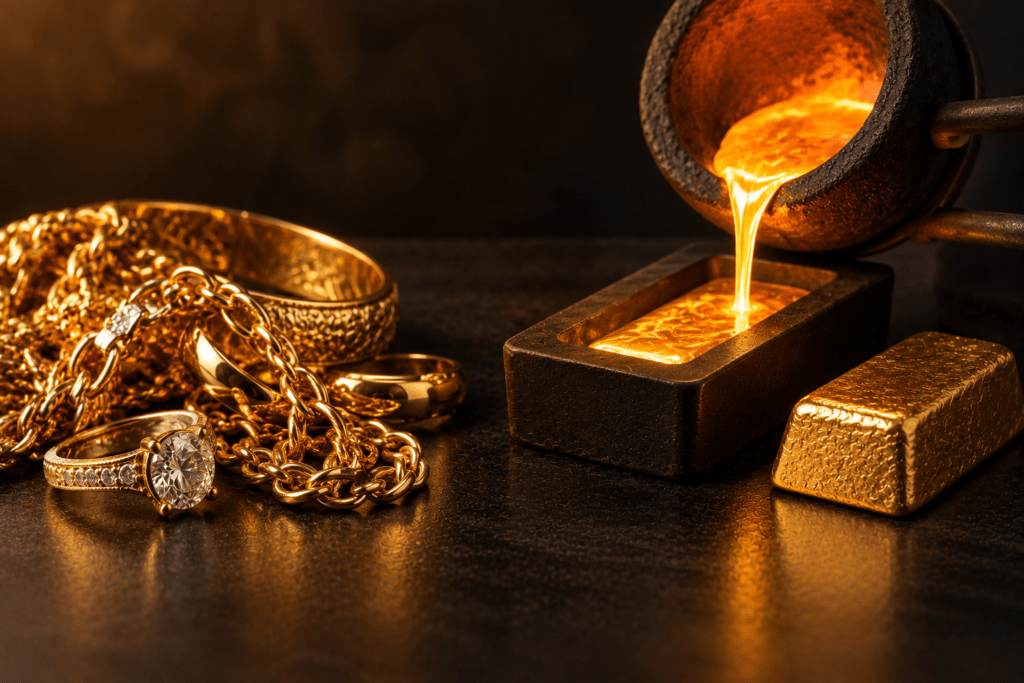
Quick answer: In most cases, it is better to sell gold jewelry as-is rather than melt it yourself.
Melting gold does not increase the amount of gold you own. In fact, melting a ring, necklace, bracelet, or other piece before having it evaluated could actually reduce what the item is worth if it has value beyond its gold content.
The better approach is usually to have the jewelry professionally tested, weighed, and evaluated first. Then you can determine whether its highest value comes from the gold itself or from the jewelry as a complete piece.
At Gold Kings, we evaluate gold jewelry based on what it actually contains. That includes checking its purity, weight, hallmarks, stones, and other factors that could affect its value.
Selling Gold Jewelry vs. Melting It
There are really three possibilities when you have unwanted gold jewelry:
| Option | When It Usually Makes Sense |
|---|---|
| Sell the jewelry intact | Best for most consumers |
| Sell it as scrap gold | Good for broken, damaged, mismatched, or unwanted jewelry |
| Melt the gold yourself | Rarely necessary for an individual seller |
The important thing to understand is that selling gold as scrap does not mean you have to melt it first.
A broken 14K chain is still 14K gold whether it is shaped like a chain or melted into a lump.
If the buyer is interested primarily in the precious-metal content, the item can usually be tested and valued exactly as it is.
Why You Usually Shouldn’t Melt Gold Jewelry Before Selling It
1. Melting Gold Does Not Create More Gold
Suppose you have a 20-gram 14K gold bracelet.
Pure gold is 24K. Fourteen-karat gold contains approximately 58.3% pure gold.
That means the bracelet contains roughly:
20 grams × 58.3% = 11.66 grams of pure gold
Melting the bracelet does not change that.
Before melting:
11.66 grams of pure gold content
After melting:
11.66 grams of pure gold content
You have changed the shape—not the underlying amount of gold.
2. You Could Destroy Value That Has Nothing to Do With Melt
This is one of the biggest reasons to have jewelry evaluated before melting it.
Some gold jewelry may be worth more intact because of:
- Brand
- Designer
- Age
- Craftsmanship
- Collectibility
- Condition
- Diamonds
- Valuable gemstones
- Historical significance
- Resale demand
Imagine melting an older designer bracelet only to discover afterward that someone would have paid more for the bracelet than the value of the gold contained inside it.
Once it has been melted, that additional value is gone permanently.
Have the piece evaluated before making an irreversible decision.
If you’re unsure whether your jewelry is simply scrap gold or potentially worth more as jewelry, Gold Kings can test and evaluate it before you decide what to do.
3. A Homemade Gold Bar Still Has to Be Tested
Some people assume that melting their jewelry into a small bar will make it easier to sell.
Usually, it does the opposite.
A gold buyer cannot simply look at an unmarked piece of melted metal and assume it is pure gold.
For example, melting several pieces together could combine:
- 10K gold
- 14K gold
- 18K gold
- Solder
- Copper
- Silver
- Nickel
- Zinc
- Other alloys
The resulting piece still has to be tested to determine its actual gold content.
Professional testing is therefore important whether the gold is a ring, necklace, broken chain, dental gold, scrap, or a melted piece.
At Gold Kings, precious metals can be professionally evaluated using methods including XRF testing, which helps determine metallic composition rather than relying only on the stamp on the jewelry.
Does Broken Gold Jewelry Need to Be Melted?
No.
Broken jewelry can still have substantial gold value.
A broken clasp doesn’t remove the gold from a necklace.
A bent ring doesn’t make the gold disappear.
A single earring can still contain exactly as much gold as it did when it had a matching pair.
Examples of gold that may be sold without repairing or melting it include:
- Broken chains
- Bent rings
- Single earrings
- Damaged bracelets
- Tangled necklaces
- Old class rings
- Missing clasps
- Jewelry with missing stones
- Outdated jewelry
- Dental gold
- Gold fragments
If you’re searching for a scrap gold buyer near you, you generally do not need to spend money repairing or melting these items first.
Their value may primarily come from the metal itself.
How Is Gold Jewelry Actually Valued?
For ordinary scrap gold jewelry, three factors matter most:
Gold Purity
Gold jewelry is normally mixed with other metals to make it stronger.
Common purities include:
| Marking | Karat | Approx. Pure Gold |
| 417 | 10K | 41.7% |
| 585 | 14K | 58.5% |
| 750 | 18K | 75.0% |
| 916 | 22K | 91.6% |
| 999 | 24K | 99.9% |
The higher the gold content, the more valuable the metal is per gram.
Weight
Once the purity is known, the jewelry needs to be accurately weighed.
A heavy 14K chain will normally contain more gold than a lightweight 14K ring, even though both have the same purity.
Current Gold Price
Gold trades on a global market, and the spot price of gold changes throughout the day.
The underlying metal value of jewelry therefore changes as gold prices move.
A simplified calculation is:
Weight × gold purity × current gold price per gram = approximate gross gold value
That is the underlying metal value before considering refining expenses, buyer margins, stones, resale potential, or other factors.
Is the Karat Stamp Always Accurate?
Not necessarily.
A stamp such as 10K, 14K, 18K, 585, 750, or 916 is useful, but it should not be the only thing used to determine value.
Jewelry can contain:
- Solder from repairs
- Replacement parts
- Different-karat components
- Base-metal sections
- Plated parts
- Incorrect or counterfeit hallmarks
Older jewelry may also have unusual markings or no visible hallmark at all.
That is why professional testing can be much more useful than simply reading the stamp.
At Gold Kings, we regularly evaluate precious-metal items by testing the actual metal and weighing it so the seller can better understand what they own.
What About Gold Jewelry With Diamonds?
This is another reason not to melt first.
If your gold ring, pendant, bracelet, or necklace contains diamonds or valuable gemstones, those stones should be considered before the jewelry is treated strictly as scrap.
Small or low-value stones may contribute little to the overall value of some pieces.
Larger diamonds or more valuable stones can be very different.
The smartest order is:
- Identify the gold purity.
- Determine the metal weight.
- Examine the stones.
- Consider the jewelry’s resale value.
- Compare that with its scrap-gold value.
- Decide how to sell it.
Melting first skips several of those steps.
When Does Melting Gold Make Sense?
There are situations where gold legitimately needs to be melted.
Professional refiners routinely melt precious metals when processing scrap. Our guide explains what happens to gold jewelry after you sell it.
A large commercial lot of mixed gold may also be melted and assayed to determine its overall precious-metal content.
This can make sense when dealing with:
- Large quantities of scrap
- Manufacturing waste
- Bench jeweler scrap
- Gold filings
- Casting material
- Industrial precious-metal scrap
- Refinery lots
But that is very different from someone at home with a jewelry box containing a few rings and chains.
For the typical person deciding whether to sell gold jewelry, melting it beforehand usually provides little benefit.
Could Melting Gold Actually Cost You Money?
Yes.
Depending on how it is done, melting can introduce unnecessary:
- Refining fees
- Assay costs
- Labor
- Equipment expenses
- Metal losses
- Contamination
- Safety risks
You could spend money converting recognizable jewelry into an unidentified piece of metal that still needs to be tested.
And if the jewelry had collectible, designer, gemstone, or resale value, you could lose that as well.
For most consumers, professional evaluation before melting is the safer choice.
Should I Repair Gold Jewelry Before Selling It?
Usually not if you’re selling it primarily for its gold value.
Repairing a broken clasp or replacing a missing part generally won’t increase the amount of gold contained in the piece enough to justify the repair expense.
If the piece has significant resale, antique, or designer value, however, condition could matter.
Again, evaluation should come first.
Don’t pay to repair, restore, or melt jewelry until you know how it will actually be valued.
Sell Gold Jewelry or Sell It as Scrap?
The terminology can be confusing.
You can sell jewelry as scrap without melting it.
For example, Gold Kings buys gold jewelry in many conditions, including:
- Wearable jewelry
- Broken jewelry
- Old jewelry
- Mismatched jewelry
- Single earrings
- Damaged jewelry
- Scrap gold
- Melted gold
A buyer may determine that an ordinary broken chain is worth primarily its precious-metal content.
Another piece may deserve additional evaluation because of its stones, brand, or other characteristics.
That’s why separating valuable jewelry from true scrap before melting anything is so important.
Thinking About Selling Gold? Find Out What You Have First.
If you have old rings, necklaces, bracelets, broken chains, single earrings, inherited jewelry, or other gold sitting in a drawer, you don’t have to determine its purity yourself.
Gold Kings can test and weigh your items and explain what the evaluation shows before you decide whether to sell.
Knowing the actual purity, actual weight, and current gold market value gives you much more useful information than melting the jewelry first.
Where Can I Sell Gold Jewelry Near Me?
People looking to sell unwanted jewelry often search for a “gold buyer near me” or “where to sell gold jewelry.” Regardless of how you find a buyer, the important thing is understanding how your gold will be tested, weighed and valued.
Regardless of what brought you here, look for a gold buyer who will clearly explain:
- How your gold is tested
- What purity it tested
- How much it weighs
- What gold price is being used
- How the offer was calculated
- Whether something may have value beyond its gold content
Gold Kings tests and weighs precious metals in front of customers and provides an evaluation before you decide whether you want to sell.
There is no reason to permanently melt a piece simply to find out what it is worth.
Have Your Gold Tested at Gold Kings
If you’re unsure whether your jewelry should be sold intact or valued as scrap, bring it to Gold Kings before melting it.
Gold Kings of Snellville
3635 Stone Mountain Hwy
Snellville, GA 30039
Gold Kings of Snellville evaluates gold jewelry, broken gold, coins, bullion, silver, watches, and other precious-metal items for customers throughout Gwinnett County and surrounding communities.
Gold Kings of Commerce
480 Banks Crossing Dr
Commerce, GA 30529
The Commerce location provides precious-metal evaluations for customers in Commerce, Banks Crossing, Jackson County, Banks County, and surrounding Northeast Georgia communities.
Your jewelry can be tested and weighed so you can understand what you own before deciding whether you want to sell it.
Frequently Asked Questions
Will I get more money if I melt my gold jewelry first?
Usually not. Melting does not increase the amount of gold in the jewelry. It can also destroy resale, designer, collectible, or gemstone value.
Do gold buyers melt jewelry?
Scrap jewelry may ultimately be sent to a precious-metal refiner where it is processed and refined. That does not mean you need to melt it before selling it.
Can I sell a broken gold chain without repairing it?
Yes. If the chain is being valued primarily for its gold content, a broken clasp or damaged link usually does not remove its precious-metal value.
Is melted gold worth more than gold jewelry?
Not automatically. Its value depends on the amount and purity of the gold it contains. A piece of jewelry could actually be worth more intact if it has resale, designer, antique, collectible, diamond, or gemstone value.
Should I remove diamonds before selling gold jewelry?
Don’t automatically remove them. Have the entire piece evaluated first. Valuable stones may deserve separate consideration, while removing stones yourself can potentially damage them or the jewelry.
How do I know whether my jewelry is 10K, 14K, or 18K?
Look for markings such as 417, 10K, 585, 14K, 750, or 18K. However, stamps are not always enough. Professional testing can help determine the item’s actual metal composition.
Can unmarked gold still be valuable?
Yes. A missing or worn-away hallmark does not automatically mean the item isn’t gold. Professional testing can determine whether an unmarked item contains precious metal.
Does Gold Kings buy melted gold?
Yes. Gold Kings buys many forms of precious metals, including gold jewelry, broken gold, scrap gold, and melted gold, subject to testing and evaluation.
Before You Melt Gold Jewelry, Know What It’s Worth
For most people, the answer to “Is it better to sell gold jewelry or melt it?” is simple:
Have it evaluated first.
Melting gold doesn’t make it purer, heavier, or automatically more valuable. What it can do is permanently eliminate any value the piece had as jewelry.
If the item turns out to be ordinary scrap gold, it can still be sold based largely on its precious-metal content without you melting it yourself.
And if it turns out to be something more valuable, you’ll be glad you didn’t destroy it.
Gold Kings can professionally test and weigh your gold, explain what the results mean, and provide an evaluation so you can make an informed decision about what to do next.