
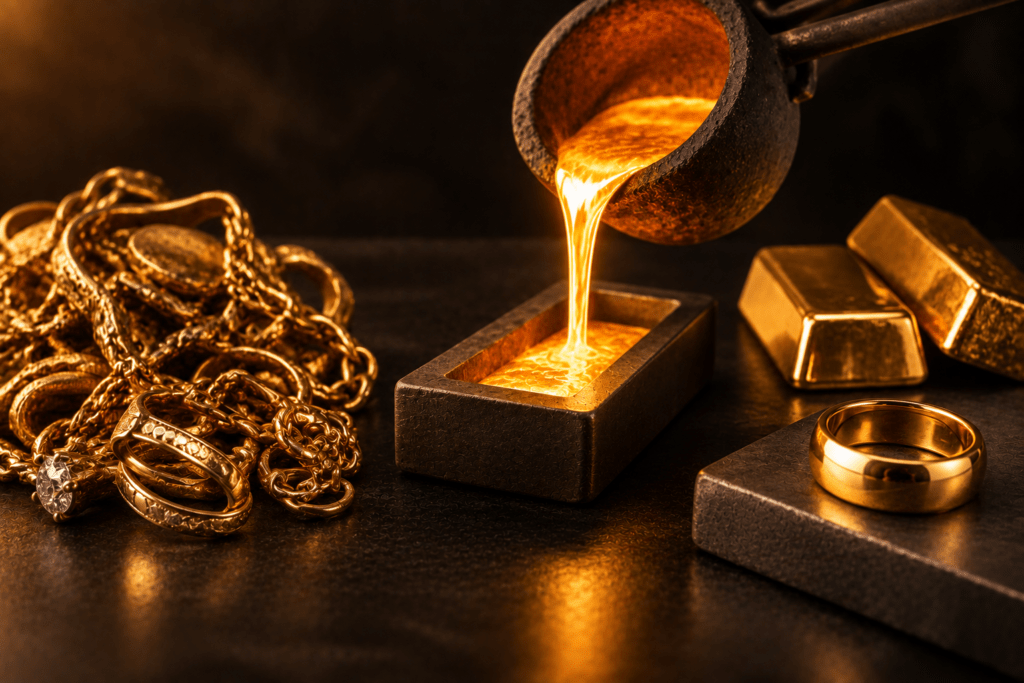
You hand over an old gold chain, ring, bracelet, or pair of earrings. The gold buyer pays you, you leave the store—and then what?
What actually happens to your gold jewelry after you sell it?
The short answer is that it depends on the piece.
Some gold jewelry may eventually be resold as jewelry. Other pieces are treated as scrap gold, sent to a precious-metals refiner, melted, separated from other metals, and recycled into gold that can be used again.
At Gold Kings, the process starts before you ever decide to sell. Your jewelry is professionally evaluated for its weight, purity, precious-metal content, and potential value so you can better understand what you own.
Here is what typically happens from the moment gold jewelry reaches a professional gold buyer until the gold finds its next use.
Quick Answer: What Happens After You Sell Gold Jewelry?
After gold jewelry is sold, it generally goes through several stages:
- The transaction is documented.
- The jewelry is securely stored during any legally required holding period.
- The item is evaluated to determine whether it makes sense to resell it or recycle it.
- Scrap jewelry may be grouped with similar precious metals.
- The material can be sent to a refinery.
- The gold is melted, assayed, refined, and separated from other metals.
- The recovered gold can eventually be used to manufacture new jewelry, bullion, electronics, or other products.
Not every piece of gold jewelry is immediately melted down.
A wearable designer ring and a broken 10K chain may follow very different paths.
First, the Gold Has to Be Properly Tested
Before a buyer can determine what your jewelry is worth, they need to know what it actually contains.
A stamp inside a piece of jewelry can provide a clue.
Common markings include:
- 10K or 417 — about 41.7% gold
- 14K or 585 — about 58.5% gold
- 18K or 750 — 75% gold
- 22K or 916 — about 91.6% gold
- 24K or 999 — nearly pure gold
However, a stamp alone should not always be treated as proof of purity.
Jewelry can be incorrectly stamped, altered, repaired with different metals, plated, or manufactured at a slightly different purity than the marking suggests.
How Gold Kings Evaluates Gold Jewelry
At Gold Kings, precious metals can be professionally tested using methods that include XRF analysis when appropriate.
An XRF analyzer can help determine the metallic composition of an item rather than relying only on the number stamped inside it.
The jewelry is also weighed so the buyer can determine how much precious metal is present.
That matters because the basic value of scrap gold is largely determined by:
Weight × actual gold purity × current gold market price
The testing process gives you a much better idea of what you actually own before you decide whether selling makes sense.
What Happens Immediately After You Sell the Jewelry?
Selling gold jewelry does not normally mean someone immediately tosses your ring into a furnace.
Licensed precious-metals dealers must follow applicable laws governing the purchase and handling of secondhand precious metals.
At Gold Kings, purchased items are documented and securely stored according to applicable requirements.
There may also be a legally required holding period before an item can be altered, resold, or processed.
These requirements help protect legitimate sellers, buyers, and victims of stolen property.
Once the applicable requirements have been satisfied, the jewelry can move to the next stage.
Is All Gold Jewelry Melted Down?
No.
This is one of the biggest misconceptions about selling gold jewelry.
Whether a piece is eventually resold or recycled depends on what it is.
Jewelry That May Be Worth Reselling
A buyer may consider keeping a piece intact if it has value beyond its basic gold content.
Examples can include:
- Designer jewelry
- Vintage jewelry
- Antique jewelry
- High-quality diamond jewelry
- Popular jewelry styles
- Collectible pieces
- Luxury-brand jewelry
- Pieces in excellent wearable condition
For these items, the finished piece may be worth more than the gold would be worth after melting.
Jewelry More Likely to Become Scrap Gold
Other pieces may have little resale demand even though the metal itself is valuable.
Examples include:
- Broken chains
- Damaged bracelets
- Bent rings
- Single earrings
- Tangled necklaces
- Worn-out jewelry
- Outdated jewelry
- Broken clasps
- Unwanted class rings
- Dental gold
- Jewelry missing stones
- Miscellaneous pieces from an estate
In those cases, the important part may be the gold itself rather than the finished jewelry.
That is why broken jewelry can still be valuable.
You do not necessarily need to repair a broken gold chain before selling it.
What Happens to Scrap Gold Jewelry?
Gold that is purchased primarily for its precious-metal content can eventually enter the precious-metals recycling process.
This is where things become interesting.
Your old bracelet may eventually become part of an entirely different gold product.
Step 1: The Jewelry Is Sorted
Scrap gold may first be separated according to factors such as:
- Purity
- Metal composition
- Type of material
- Gold content
- Refining requirements
For example, 10K jewelry contains considerably less pure gold than 18K jewelry.
The metals mixed with the gold can also vary.
Gold jewelry commonly contains other metals such as:
- Copper
- Silver
- Zinc
- Nickel
- Palladium
These additional metals help change the strength, hardness, and color of jewelry.
Step 2: The Gold Goes to a Precious-Metals Refiner
A professional refiner specializes in recovering precious metals from scrap material.
Instead of processing one customer’s ring individually, refiners generally process larger quantities of material together.
Your ring might therefore become part of a larger batch containing chains, bracelets, earrings, rings, and other gold scrap.
The refinery’s job is to determine exactly how much recoverable precious metal is present.
Step 3: The Gold Is Melted
At the refinery, gold-bearing material may be melted into a larger homogeneous batch.
Melting combines the material so it can be accurately analyzed.
At this point, the jewelry no longer exists as a necklace, ring, or bracelet.
It has become precious-metal material.
That distinction is important if you are considering selling something sentimental.
If a piece has emotional or family significance, make that decision before selling it.
Once jewelry enters the refining process, there generally is no way to recover your exact original piece.
Step 4: The Melted Gold Is Assayed
An assay determines the actual amount of precious metal contained in the batch.
Refiners need precise measurements because a batch described as “14K scrap” will not necessarily contain exactly the theoretical amount of gold.
Different pieces may test slightly differently.
The batch may also contain other valuable metals, including silver or platinum-group metals depending on what was processed.
Professional assaying tells the refiner how much recoverable precious metal is actually present.
Step 5: The Gold Is Refined
Melting gold does not automatically make it pure.
Remember that most jewelry is an alloy.
For example, 14K jewelry contains about 58.5% gold. The rest consists of other metals.
The refinery uses specialized processes to separate the gold from those other materials.
After refining, the recovered gold can reach very high levels of purity.
Instead of an old collection of mismatched jewelry, the refinery now has usable precious metal again.
What Happens to the Gold After Refining?
Refined gold returns to the broader gold supply chain.
Depending on where it goes next, recycled gold can eventually be used to make:
- New gold jewelry
- Gold bars
- Gold coins
- Watch components
- Electronics
- Industrial components
- Medical or dental products
- Other products requiring gold
Gold’s ability to be recycled is one of the characteristics that makes it unusual.
The atoms of gold in a broken bracelet do not become “used up.”
Once properly refined, recycled gold can again become high-purity gold suitable for a completely different purpose.
Your unwanted necklace could eventually become part of another person’s wedding ring—or something entirely unrelated to jewelry.
What Happens to Diamonds and Gemstones?
This depends heavily on the jewelry.
Small stones in ordinary scrap jewelry may contribute little to the overall purchase price.
Larger diamonds, important gemstones, designer pieces, or valuable settings deserve a closer evaluation.
A knowledgeable buyer should therefore look at more than just the gold when a piece may contain significant stones.
At Gold Kings, jewelry can be evaluated to help determine whether the important value is primarily in the precious metal or whether another component deserves consideration.
If you think a diamond or gemstone may be valuable, mention it before selling the piece as scrap.
Does the Condition of Gold Jewelry Matter?
Sometimes.
If the piece is being valued primarily as scrap gold, its physical condition may make very little difference to the gold itself.
A broken 14K chain still contains 14K gold.
A bent ring does not suddenly lose its precious-metal content.
That means items people sometimes assume are worthless may still have meaningful value.
Examples include:
- Broken gold chains
- One earring from a missing pair
- Bent rings
- Jewelry with a broken clasp
- Old class rings
- Tangled gold
- Damaged bracelets
- Unwanted inherited jewelry
However, condition becomes more important when a piece has potential resale, designer, collectible, or gemstone value.
That is another reason a proper evaluation should come before simply assuming everything belongs in the scrap pile.
How Does a Gold Buyer Decide What to Pay?
When gold jewelry is being purchased mainly for its precious-metal content, several factors matter.
Gold Purity
An 18K piece contains more pure gold per gram than an equal-weight 10K piece.
Weight
More recoverable gold generally means more metal value.
Current Gold Price
Gold trades on international markets, and its spot price changes throughout the trading day.
Actual Tested Composition
The stamp and the tested purity are not always identical.
Stones and Non-Gold Components
Gemstones, clasps, springs, watch parts, stainless components, and other materials can affect how much of an item’s total weight is actually gold.
Resale Potential
Some finished jewelry may be worth more intact than as scrap.
A knowledgeable evaluation considers these factors before an offer is made.
Thinking About Selling Gold Jewelry?
If you have been searching for where to sell gold jewelry, you should understand how selling your gold works before worrying about what happens at the refinery.
A transparent gold-buying process should allow you to understand:
- What your jewelry weighs
- What purity it tests
- What today’s gold price means for the item
- Whether the piece has value beyond scrap
- How the offer was calculated
At Gold Kings, customers can have precious metals tested and weighed before deciding whether they want to sell.
There is no reason to guess what an old ring, chain, bracelet, inherited jewelry collection, or box of broken gold contains.
Understanding what you have comes first.
Why This Matters When Choosing a Gold Buyer
Searches such as “sell gold jewelry near me,” “cash for gold near me,” and “gold buyer near me” can produce a long list of businesses.
But the closest buyer is not necessarily the buyer who will give you the clearest explanation of your jewelry.
Before selling, consider asking these important questions:
- Will you test my jewelry in front of me?
- Can I watch it being weighed?
- What purity did the jewelry actually test?
- What gold price are you using?
- How did you calculate the offer?
- Does this piece have value beyond its gold content?
- Am I required to sell after the evaluation?
A professional buyer should be able to explain the answers.
Gold Kings focuses on transparent testing and weighing so customers can understand the numbers before making a decision.
Have Your Gold Jewelry Tested at Gold Kings
Not sure whether that old necklace is 10K, 14K, 18K, gold-plated, or something else?
Bring it to Gold Kings for an evaluation.
Gold Kings has locations in Snellville and Commerce, Georgia, where customers can bring gold jewelry, silver, coins, bullion, watches, estate jewelry, and other qualifying valuables for evaluation.
Gold can be professionally tested and weighed, and the results can be explained before you decide whether you want to sell.
That is especially useful for inherited jewelry, unmarked pieces, foreign gold, old jewelry boxes, and pieces whose stamps are difficult to read.
Frequently Asked Questions
Is all gold jewelry melted after you sell it?
No. Some jewelry may have enough resale, designer, vintage, collectible, or gemstone value to remain intact. Jewelry valued primarily for its precious-metal content is more likely to enter the refining and recycling process.
Do gold buyers melt jewelry themselves?
Some businesses may have different processing methods, but much of the precious-metals industry relies on specialized refiners that process larger quantities of scrap material.
Is broken gold worth anything?
Yes, if it contains real gold. A broken chain or bent ring still contains precious metal. Its value depends primarily on its weight, actual gold purity, and current gold prices when it is being purchased for scrap.
What happens to 10K and 14K gold when it is refined?
The gold is separated from the other metals in the alloy. Those other metals may include copper, silver, zinc, nickel, or other materials. The recovered gold can then be refined to a much higher purity.
Are gemstones melted with the gold?
Valuable stones are normally handled separately when practical. How stones are treated depends on the jewelry, stone type, size, quality, recovery process, and whether they have meaningful secondary-market value.
Can recycled gold become 24K gold?
Yes. Proper refining can remove the alloy metals from lower-karat jewelry and recover high-purity gold.
Is recycled gold worth less than newly mined gold?
Once gold has been properly refined to the same purity, the fact that the gold was previously used in jewelry does not inherently make the gold itself inferior.
Can my old jewelry become new jewelry?
Yes. Recycled gold is part of the global gold supply and can eventually be used again to manufacture jewelry and many other products.
Can I get my jewelry back after selling it?
Selling an item transfers ownership to the buyer. While purchased items may initially be subject to required holding procedures, you should never sell something assuming you will be able to recover it later. If an item has significant sentimental value, think carefully before completing the sale.
Where can I sell gold jewelry in Georgia?
Gold Kings evaluates gold jewelry at its Snellville and Commerce, Georgia locations. Customers can bring in gold jewelry for professional testing and weighing and receive an offer without having to guess about the item’s purity or precious-metal content.
Before Your Old Gold Starts Its Next Life, Find Out What It Is Worth
Gold can have an unusually long life.
A ring can become scrap. Scrap can become refined gold. That refined gold can eventually become another ring, a gold bar, an electronic component, or something that has not even been manufactured yet.
But before any of that happens, you should understand what you are selling.
If you have broken jewelry, inherited gold, unwanted chains, rings, bracelets, earrings, coins, bullion, or other precious metals, Gold Kings can help determine what you actually have.
We can test it, weigh it, explain the evaluation, and give you the information you need to decide whether selling makes sense.
The decision to sell is yours. Knowing what your gold is worth should come first.