
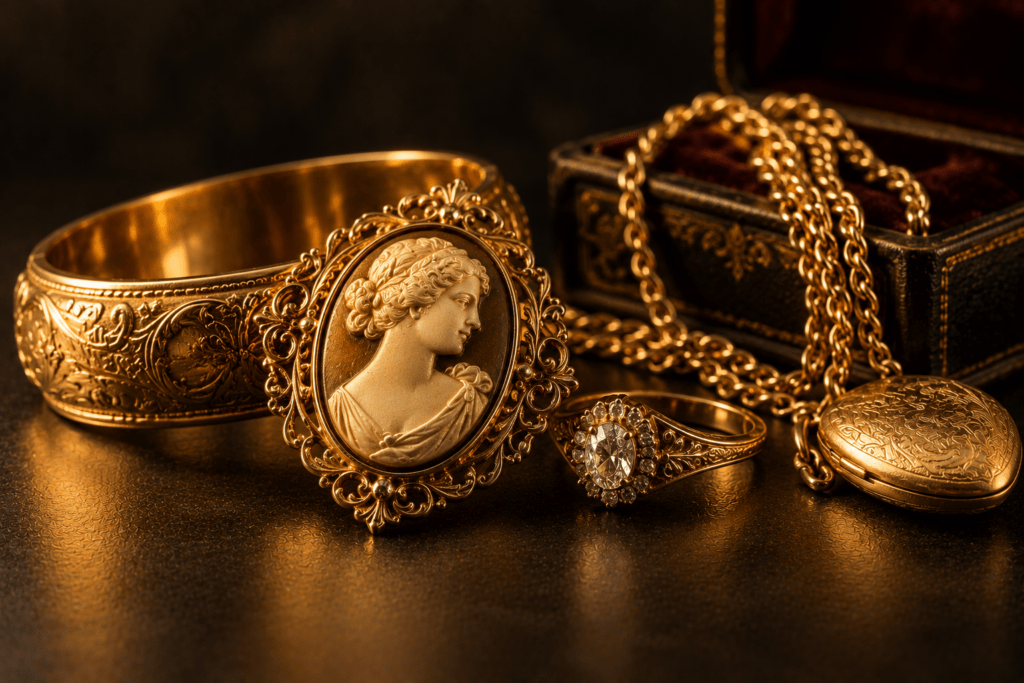
Yes, sometimes—and this is an important question to answer before selling old gold jewelry for scrap.
Every piece of real gold jewelry has a basic precious-metal value based on its weight, purity, and the current price of gold. That is commonly called its melt value.
But vintage gold jewelry can sometimes be worth more than its gold content because of its maker, age, design, craftsmanship, gemstones, condition, rarity, or collector demand.
That means an old ring containing $500 worth of gold is not automatically a $500 piece of jewelry. It could be worth more as a complete piece.
On the other hand, being old does not automatically make jewelry collectible.
The safest approach is simple:
Determine the gold value first. Then determine whether the jewelry deserves a premium above that value before treating it as scrap.
At Gold Kings, we evaluate gold and estate jewelry at our Georgia locations in Snellville and Commerce. We can professionally test the precious-metal content, weigh the item, and help you understand its metal value before you decide whether to sell.
What Is Melt Value?
Melt value is the approximate value of the precious metal contained in a piece of jewelry.
For gold jewelry, the basic calculation is:
Gold price per gram × weight × gold purity = approximate melt value
| Gold Mark | Approximate Gold Content |
|---|---|
| 10K / 417 | 41.7% |
| 14K / 585 | 58.3%–58.5% |
| 18K / 750 | 75% |
| 22K / 916 | 91.6%–91.7% |
| 24K / 999 | 99.9% |
If a vintage 14K bracelet weighs 20 grams, it does not contain 20 grams of pure gold.
Approximately:
20 grams × .583 = 11.66 grams of pure gold
That amount can then be compared with the current market price of pure gold.
Read our complete guide to calculating how much your gold is worth to understand the math in more detail.
But melt value should often be viewed as a starting point, particularly with vintage and estate jewelry.
Think of Melt Value as the Floor—Not Always the Ceiling
Ordinary broken or unwanted jewelry is often valued primarily for the precious metal it contains. Vintage jewelry can be different.
Imagine two 14K rings containing approximately the same amount of gold.
One is an unbranded, heavily damaged ring with no stones and little resale demand. The second is a well-preserved period piece from a recognized jewelry maker with its original gemstones and identifiable hallmarks.
The gold content could be nearly identical. The value of the jewelry may not be.
That difference is why you should be careful about selling older jewelry strictly as scrap without first examining the complete piece. Learn more about when to have gold jewelry appraised instead of selling it for scrap.
The same principle can apply to unusual estate items. For example, certain old gold eyeglass frames may have meaningful precious-metal value even when they are no longer being worn.
7 Things That Can Make Vintage Gold Jewelry Worth More Than Melt
1. A Recognized Designer or Jewelry Maker
One of the first things to check is the maker.
Jewelry from a recognized designer or manufacturer may have a resale market far beyond its precious-metal value.
Look carefully for:
- Maker’s marks
- Logos
- Initials
- Hallmarks
- Serial numbers
- Model numbers
- Country-of-origin marks
- Unusual symbols
The gold-purity stamp and the maker’s mark are often different markings.
A stamp such as 14K, 585, 18K, or 750 tells you about the metal. Another tiny symbol beside it may identify who made the jewelry.
Do not assume an unfamiliar mark is meaningless.
Similar care should be taken with vintage and luxury watches. Brand, movement, condition, and collectibility can sometimes make an old gold watch worth more than its gold content.
2. Age and Period Design
Some styles of jewelry are strongly associated with particular periods.
Examples can include:
- Victorian
- Edwardian
- Art Nouveau
- Art Deco
- Mid-century
- Retro jewelry
Age by itself does not guarantee a premium.
However, authentic period jewelry with attractive styling and strong buyer demand can have value that cannot be determined simply by placing it on a scale.
3. Craftsmanship
Some older jewelry was made using techniques that are expensive or difficult to reproduce today.
Look at features such as:
- Hand engraving
- Filigree
- Milgrain
- Detailed metalwork
- Hand-cut stones
- Unusual settings
- Intricate links
- Custom construction
The more unusual and desirable the craftsmanship, the more important it becomes to evaluate the complete piece before thinking about scrap value.
4. Original Gemstones
A vintage gold ring may contain far more than gold.
Diamonds, sapphires, rubies, emeralds, and certain other gemstones can have value independent of the metal.
The mounting itself may also add value because of its design or maker.
For this reason, do not automatically remove stones before selling old jewelry.
Read our guide explaining whether you should remove diamonds and gemstones before selling gold.
In many situations, evaluating the complete piece first is the better approach.
5. Condition
Condition can matter much more for collectible jewelry than for scrap gold.
A broken 14K chain still contains 14K gold. But a vintage collectible necklace with damaged links, replaced components, or missing stones may lose part of its premium as jewelry.
Things that can affect vintage jewelry value include:
- Missing stones
- Damaged settings
- Broken clasps
- Heavy wear
- Poor repairs
- Replaced components
- Altered engravings
- Resizing
- Previous polishing
This creates an important difference between scrap value and jewelry value.
Damage may barely affect the gold’s melt value while significantly affecting the item’s collectible value.
6. Rarity and Collector Demand
An item does not have to contain an enormous amount of gold to be valuable.
Collectors may pay more for something because it is difficult to find. That could include:
- Unusual designs
- Discontinued collections
- Limited-production pieces
- Rare makers
- Certain historical periods
- Desirable motifs
- Scarce sizes or configurations
Ultimately, something is collectible only if buyers want to collect it.
Old does not automatically mean rare, and rare does not automatically mean valuable.
7. Provenance and Documentation
Information about where a piece came from can sometimes matter.
If you have documentation, keep it with the jewelry. That might include:
- Original box
- Original receipt
- Old appraisal
- Manufacturer paperwork
- Certificates
- Photographs
- Family records
- Service records
Do not throw these items away simply because you intend to sell the gold.
When Is Vintage Gold Jewelry Usually Worth Only Its Gold Value?
Not every old piece receives a collectible premium.
A piece may be valued primarily for its precious-metal content when it is:
- Mass-produced
- Heavily damaged
- Unbranded
- Missing important components
- Poorly repaired
- Out of demand
- A common design
- Broken beyond practical restoration
- Primarily useful as a source of gold
Even then, the piece can still be valuable.
A broken 18K necklace does not stop containing gold because it can no longer be worn. This is why it helps to understand its melt value first.
Don’t Melt Vintage Jewelry Before Having It Evaluated
If you think a piece might be vintage, antique, designer, or unusual, do not melt it simply to determine what the gold is worth.
Melting permanently destroys:
- Hallmarks
- Maker’s marks
- Design
- Original construction
- Historical characteristics
- Potential jewelry resale value
Melting the jewelry does not create additional gold.
If the item is ultimately worth only its precious-metal content, it can still be treated as scrap later. But once a potentially valuable piece has been melted, its identity as jewelry is gone.
For more information, see whether it is better to sell gold jewelry or melt it.
Don’t Aggressively Clean Vintage Gold Either
Another mistake is trying to make old jewelry look new before having it evaluated.
Routine dirt is one thing. Aggressive polishing is another.
Over-polishing can soften engravings, remove surface details, and alter the appearance of an older piece. Certain gemstones can also be damaged by inappropriate cleaners.
If you are unsure what you have, consider leaving it alone until someone examines it.
We explain this in more detail in our guide to cleaning gold jewelry before selling it.
How to Check Vintage Gold Jewelry Before Selling It
Before searching for a gold buyer near me or where to sell gold jewelry, spend a few minutes examining what you own.
Check the Hallmarks
Look inside rings, near necklace clasps, on bracelet ends, and on the backs of pendants.
Common gold markings include:
10K, 14K, 18K, 22K, 417, 585, 750, and 916.
Older or foreign jewelry may use markings you do not recognize.
Look for a Separate Maker’s Mark
A purity mark tells you what the metal is supposed to contain. A maker’s mark may tell you who created it. Both can matter.
Leave Stones in Place
Unless you specifically want to keep a gemstone, have the whole piece evaluated before taking it apart.
Keep Associated Paperwork
Boxes, receipts, certificates, and older appraisals may help identify the piece.
Don’t Rely Entirely on the Stamp
A hallmark is valuable information, but it is not a laboratory test.
Jewelry can be repaired, altered, plated, or incorrectly marked. Different parts of the same piece may even contain different metals.
Professional testing helps determine what the jewelry actually contains.
How XRF Testing Helps With Vintage Gold
Gold Kings uses professional precious-metals testing equipment, including XRF technology, when appropriate.
XRF can help identify the metals present in an item without requiring the jewelry to be melted.
This can be particularly useful with:
- Unmarked jewelry
- Foreign jewelry
- Worn hallmarks
- Inherited gold
- Estate jewelry
- Mixed-karat items
- Jewelry whose authenticity is uncertain
There is also an important limitation to understand:
An XRF analyzer can tell us about the metal. It cannot tell us whether collectors will pay a premium for a particular design.
Determining vintage jewelry value means considering both sides of the equation:
What is it made of?
And:
Is the complete piece worth more than the metal?
That distinction can prevent an interesting piece of jewelry from being treated automatically as scrap.
A Simple Way to Evaluate Old Gold Jewelry
When deciding what vintage gold jewelry is worth, think about the value in layers.
Layer 1: Precious-Metal Value
Determine:
Weight + actual purity + current gold price
This establishes the gold-value baseline.
Layer 2: Gemstone Value
Determine whether diamonds or other gemstones contribute meaningful additional value.
Layer 3: Jewelry Value
Consider:
Maker + design + age + condition + rarity + demand
Layer 4: Provenance
Determine whether documentation or history adds anything meaningful.
Only after considering these layers can you make an informed decision about whether the jewelry should be treated primarily as:
Scrap gold, wearable estate jewelry, designer jewelry, or a collectible piece.
Have Vintage and Estate Jewelry Tested at Gold Kings
If you have inherited a jewelry box, old rings, vintage necklaces, bracelets, brooches, earrings, or other gold pieces, you do not have to figure everything out yourself.
Begin by sorting the inherited jewelry box for real gold, silver, plated items, and costume jewelry. Keep unfamiliar or potentially valuable pieces separate until they can be examined.
When you are ready to have the collection evaluated, follow our step-by-step guide explaining how to sell inherited gold jewelry without rushing the decision.
Gold Kings can test your jewelry, weigh it, and explain what the metal contains before you decide whether you want to sell.
You can also see more of the items we evaluate on our What We Buy page or learn more about how selling your gold works at Gold Kings.
Most importantly, you remain in control of the decision.
If an item appears interesting, unusual, or potentially worth more than ordinary scrap gold, knowing that before it is destroyed matters.
Gold Kings of Snellville
For customers in Gwinnett County and surrounding areas, visit Gold Kings of Snellville.
Gold Kings of Snellville
3635 Stone Mountain Highway
Snellville, GA 30039
770-771-4650
The Snellville location evaluates gold jewelry, estate jewelry, broken gold, coins, bullion, silver, watches, and other qualifying valuables.
Your items can be professionally tested and weighed so you understand what you own before deciding whether to sell.
Gold Kings of Commerce
For customers in Commerce, Banks Crossing, and Northeast Georgia, visit Gold Kings of Commerce.
Gold Kings of Commerce
480 Banks Crossing Drive
Commerce, GA 30529
706-336-0043
The Commerce location evaluates gold jewelry, estate jewelry, coins, bullion, silver, watches, and other precious-metal items for customers throughout Northeast Georgia.
Frequently Asked Questions About Vintage Gold Jewelry Value
Is old gold jewelry always worth more than melt value?
No. Some vintage jewelry has additional value because of its maker, design, gemstones, rarity, or collector demand. Other pieces are worth primarily what their precious metal is worth.
Age alone does not guarantee a premium.
Is antique gold worth more than regular gold?
The gold itself is not worth more simply because it is old. An ounce of pure gold remains an ounce of pure gold.
The additional value comes from the jewelry surrounding that gold—the design, craftsmanship, maker, rarity, stones, history, and demand.
How do I know whether vintage jewelry is real gold?
Check for hallmarks such as 10K, 14K, 18K, 417, 585, or 750, but do not rely on the stamp alone.
Professional testing can determine the item’s actual precious-metal content.
Can vintage gold jewelry have no hallmark?
Yes. Older jewelry can have worn markings, unusual foreign hallmarks, or no obvious marking at all.
A missing stamp does not automatically mean the piece is fake.
Should I remove diamonds before selling vintage gold?
Usually not before the complete piece has been evaluated.
A gemstone may have value of its own, and removing it could damage a piece that has resale value as jewelry.
Should I repair vintage jewelry before selling it?
Usually, do not spend money on repairs until you know what the item is worth and how it is likely to be sold.
A repair that costs hundreds of dollars may not add hundreds of dollars to the selling price.
Should I polish antique or vintage jewelry?
Be cautious. Aggressive cleaning or polishing can alter details that are important to an older piece.
If you think something may be collectible, have it examined first.
What is the difference between melt value and selling price?
Melt value represents the approximate value of the precious metal contained in the jewelry. It is not automatically the amount someone will pay for the piece.
A buyer must consider the type of item, refining or resale costs, and other factors. Conversely, desirable vintage jewelry can potentially command more than its underlying gold value because buyers want the complete piece.
Where can I sell vintage gold jewelry near me?
If you are in Georgia, Gold Kings evaluates gold and estate jewelry at locations in Snellville and Commerce.
You can have the item tested and weighed and learn more about what you own before making a selling decision.
Before You Sell Vintage Gold for Scrap, Find Out What You Have
Vintage gold jewelry deserves one extra question:
Is this piece worth more intact than it is melted?
Sometimes the answer is no. A broken or ordinary piece may derive most of its value from the gold inside it.
Sometimes the answer is yes. A designer name, unusual hallmark, valuable gemstone, desirable period design, or rare piece can change the equation.
That is why the correct order matters:
Identify it. Test it. Weigh it. Evaluate it. Then decide whether to sell it.
If you have vintage, inherited, or estate jewelry sitting in a drawer, bring it to Gold Kings of Snellville or Gold Kings of Commerce.
We will help you understand the precious-metal value of what you have before you decide what happens to it next.
We test it. We weigh it. We explain it. You decide.