
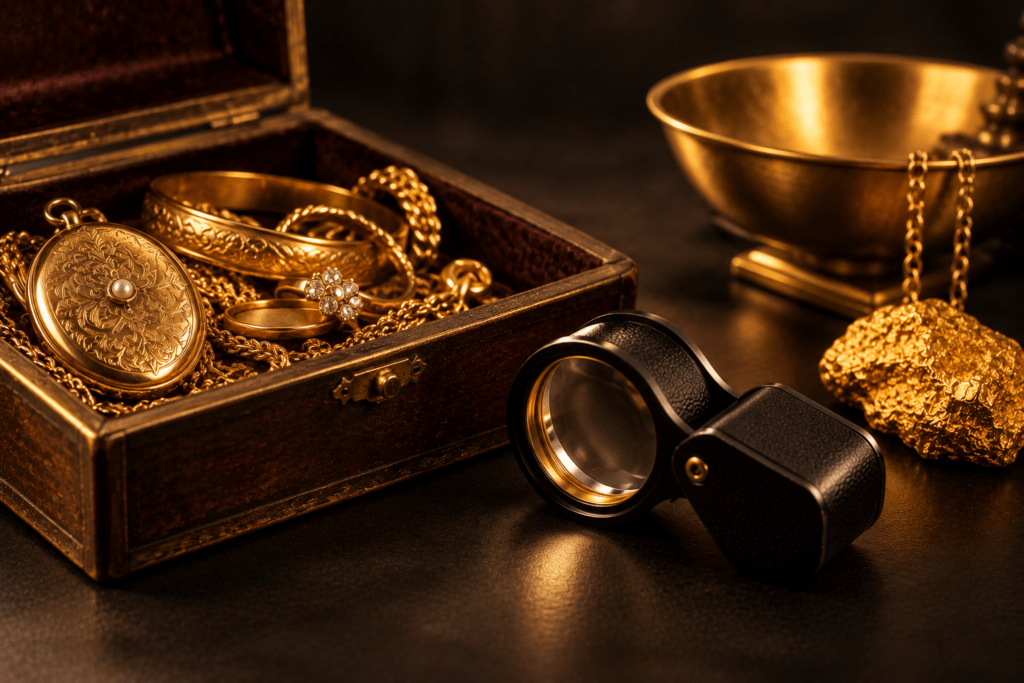
Inheriting gold jewelry can leave you with a strange combination of memories and questions.
Is the jewelry real gold? What karat is it? Are the diamonds valuable? Is an old ring worth more because of its age? And if you decide not to keep everything, how do you sell inherited gold jewelry without accidentally selling something valuable too cheaply?
The safest approach is not to rush.
First determine what you own. Then determine what it is worth. After that, decide what you want to keep and what makes sense to sell.
At Gold Kings, inherited and estate jewelry can be professionally tested and weighed at our locations in Gold Kings of Snellville and Gold Kings of Commerce. This can be especially helpful when you inherit an entire jewelry box containing a mixture of gold, silver, costume jewelry, coins, watches and pieces with markings you do not recognize.
Quick Answer: How Do You Sell Inherited Gold Jewelry?
Before selling inherited gold jewelry:
- Make sure you have the legal authority to sell it.
- Do not throw away broken, tangled or unmarked pieces.
- Look for gold hallmarks such as 10K, 14K, 18K, 22K, 417, 585, 750 and 916.
- Keep potentially valuable jewelry intact.
- Do not remove diamonds or gemstones before evaluation.
- Have the jewelry professionally tested.
- Have each piece accurately weighed.
- Determine its precious-metal value.
- Check whether certain pieces may be worth more as jewelry than as scrap.
- Understand exactly how a buyer calculated the offer before accepting it.
If you inherited a large collection, you do not need to figure everything out yourself. Gold Kings evaluates estate jewelry, gold, silver, coins, bullion, watches and other precious-metal items, and you can review what Gold Kings buys before bringing in the collection.
1. Make Sure the Jewelry Is Yours to Sell
Before discussing karats or gold prices, there is a more important question:
Do you have the authority to sell the jewelry?
If the estate has already been settled and the jewelry was distributed to you, this may be straightforward.
If the estate is still being administered, multiple heirs are involved, or there is disagreement about who owns particular pieces, resolve that issue before selling anything.
An executor, estate administrator or attorney can help when ownership is unclear.
Gold can be replaced.
A family heirloom sold during an estate dispute may be much harder to undo.
2. Don’t Throw Anything Away Just Because It Looks Broken or Old
One of the biggest mistakes you can make with inherited jewelry is deciding what is valuable based on appearance.
A jewelry box may contain:
- Broken chains
- Single earrings
- Bent rings
- Tangled necklaces
- Old class rings
- Dental gold
- Gold watches
- Foreign jewelry
- Pieces with missing stones
- Unmarked jewelry
- Sterling silver
- Gold and silver coins
- Costume jewelry mixed with real gold
A broken gold chain can still contain exactly the same amount of gold it contained before the clasp broke.
A single earring can still have precious-metal value.
And an old piece that looks dull or dirty could be considerably more valuable than a bright gold-colored piece that is only plated.
Do not sort inherited jewelry into “valuable” and “worthless” piles based on appearance alone.
3. Look for Gold Stamps and Hallmarks
Gold jewelry is often marked with a stamp indicating its approximate purity.
Common markings include:
| Mark | Approximate Gold Purity |
|---|---|
| 10K or 417 | 41.7% gold |
| 14K or 585 | 58.5% gold |
| 18K or 750 | 75% gold |
| 22K or 916 | 91.6% gold |
| 24K or 999 | About 99.9% gold |
You may find the stamp:
- Inside a ring
- On a necklace clasp
- Near the end of a bracelet
- On the post or back of an earring
- On the case of a watch
- On a small identification plate attached to the jewelry
But a stamp is a starting point—not a guarantee.
Old jewelry may have worn markings. Foreign jewelry may use unfamiliar purity numbers. Pieces may have been repaired with different metals. And occasionally jewelry does not test exactly at the purity indicated by its stamp.
That is why professional testing is useful when determining the value of inherited jewelry.
4. Don’t Clean or Repair the Jewelry Before You Know What It Is
Inherited jewelry does not need to look new to contain valuable gold.
If a piece is being valued primarily for its precious-metal content, polishing it does not create more gold.
More importantly, aggressive cleaning can sometimes:
- Loosen gemstones
- Damage delicate settings
- Remove patina from antique jewelry
- Scratch softer metals
- Damage finishes
- Reduce the appeal of collectible pieces
Before reaching for jewelry cleaner or paying someone to repair an old piece, identify it first.
Read more about whether you should clean gold jewelry before selling it.
5. Leave Diamonds and Gemstones in Place
If Grandma’s ring has a diamond in it, don’t grab a pair of pliers and remove the stone.
The gold may be valuable.
The diamond may be valuable.
And in some cases, the complete ring may be worth more than its gold alone.
The same applies to jewelry containing sapphires, rubies, emeralds and other gemstones.
Have the entire piece evaluated first.
You can then decide whether it makes more sense to:
- Sell the jewelry intact
- Sell the gold and keep the gemstone
- Have the stone evaluated separately
- Keep the entire piece
- Sell primarily for its precious-metal value
Gold Kings evaluates precious-metal jewelry containing diamonds and other stones, but gold and gemstones are valued differently. XRF testing can help analyze the metal; it does not grade a diamond.
Learn more about removing diamonds and gemstones before selling gold.
6. Separate Sentimental Value From Financial Value
This step has nothing to do with the gold market.
Inherited jewelry can carry memories that no gold price can measure.
Before selling the entire collection, consider making three groups:
Keep
Items you or another family member genuinely want because of their sentimental or family significance.
Evaluate
Pieces that appear unusual, antique, designer, diamond-set, particularly heavy or potentially collectible.
Possibly sell
Broken, unwanted, mismatched or ordinary pieces that nobody in the family wants to keep.
You can always sell something later.
You cannot always get an inherited family piece back after selling it.
7. Have the Gold Professionally Tested
This is where an inherited jewelry box can become interesting.
You may find:
- 10K rings
- 14K chains
- 18K foreign jewelry
- 22K Indian or Middle Eastern jewelry
- Gold-plated pieces
- Gold-filled jewelry
- Sterling silver
- Platinum
- Costume jewelry
- Items with no readable markings at all
Professional precious-metal testing helps separate those categories.
Gold Kings uses professional testing equipment, including XRF technology, when appropriate to help analyze metallic composition. Testing is useful for checking an item’s metal content rather than relying only on color or a tiny hallmark.
The jewelry can then be weighed so you can understand what you actually have.
For a large inherited collection, this can be far more useful than trying to identify dozens of pieces at home.
Inherited a Whole Jewelry Box?
You do not have to know which pieces are valuable before bringing them in.
Gold Kings can evaluate mixed collections containing gold jewelry, estate jewelry, silver, coins, bullion, watches and other qualifying valuables.
See the complete list of items Gold Kings buys, or visit Gold Kings in Snellville or Gold Kings in Commerce for an in-person evaluation.
8. Understand What Actually Determines Gold Jewelry Value
For ordinary gold jewelry, four factors usually matter most.
Gold Purity
Higher-karat jewelry contains more pure gold.
For example, 18K gold contains about 75% gold, while 10K contains about 41.7%.
If two pieces weigh exactly the same, the 18K piece normally contains substantially more gold.
Weight
Gold is valuable by weight.
That is why a heavy chain may be worth substantially more than a thin ring even when both are the same karat.
However, the total weight of jewelry is not always entirely gold.
Gemstones, watch movements, springs, steel components and other materials may need to be considered separately.
Current Gold Price
Gold trades internationally, and its market price changes.
An inherited necklace therefore does not have one permanent scrap value.
Its underlying gold value moves with the gold market.
The Buyer’s Offer
The theoretical precious-metal value and the amount a buyer offers are not necessarily the same number.
A reputable buyer should be able to explain:
- What purity the jewelry tested
- How much it weighs
- What gold price is being used
- Whether stone or non-gold weight was deducted
- How the final offer was calculated
Understanding those numbers makes it much easier to compare offers.
9. Don’t Confuse Original Retail Price With Today’s Resale Value
This can be surprising with inherited jewelry.
A receipt showing that a necklace originally cost $4,000 does not necessarily mean the necklace can be sold for $4,000 today.
Retail jewelry prices can include:
- Manufacturing
- Design
- Store overhead
- Marketing
- Brand premiums
- Wholesale and retail margins
- Gemstone setting
- Labor
When ordinary jewelry reaches the secondary market, much of the value may instead come from the underlying gold.
But there are important exceptions.
10. Some Inherited Jewelry May Be Worth More Than Scrap Gold
This is one reason inherited jewelry deserves a closer look before everything goes into one scrap pile.
Potential additional value can come from:
- Recognized designer names
- Antique or vintage design
- Rare jewelry
- Signed pieces
- Valuable diamonds
- Quality gemstones
- Exceptional craftsmanship
- Historic significance
- Collectible watches
- Unusual coins or bullion
Age alone does not make jewelry valuable.
An ordinary 60-year-old gold ring may still be worth primarily its gold content.
But an unusual designer or antique piece could deserve additional evaluation before it is treated purely as scrap.
If you inherited older pieces, read when vintage gold jewelry may be worth more than melt value.
11. Ask How the Buyer Tested and Weighed Your Jewelry
When searching online for terms such as “sell gold jewelry near me,” “gold buyer near me,” or “where to sell gold,” you may find many businesses offering to buy the same items.
Don’t compare buyers based only on advertising.
Ask questions.
You should understand:
What did my jewelry test?
If the necklace is marked 14K, did it actually test as approximately 14K gold?
What does it weigh?
You should know the weight being used to calculate the offer.
Can I see the weight?
Transparent weighing makes the transaction easier to understand.
How are stones being handled?
A diamond’s weight should not simply be counted as gold.
What gold price are you using?
The market price helps determine the underlying precious-metal value.
How did you arrive at the offer?
You should receive an explanation—not simply a dollar amount.
For a particularly valuable inheritance, it can also make sense to get more than one offer before selling gold.
12. Don’t Let a Big Dollar Offer Distract You From the Math
Imagine you inherited several pieces of jewelry and someone offers you $2,000.
That sounds like a lot of money.
But the important question isn’t:
“Is $2,000 a lot?”
It is:
“What is the jewelry actually worth?”
If the precious-metal value is $2,300, the offer looks very different than if the precious-metal value is $4,000.
Knowing the purity, weight and gold market value gives you a framework for judging an offer.
Read our guide on how to avoid getting lowballed when selling gold for more questions to ask before accepting an offer.
13. Bring Identification When Selling Gold in Georgia
Selling precious metals is different from selling an ordinary used household item.
Precious-metals dealers are subject to state and local requirements involving transactions and record keeping.
Gold Kings operates as a licensed Georgia precious-metals dealer and follows applicable transaction requirements.
If you are planning to sell inherited jewelry, bring valid identification and be prepared for the transaction to be properly documented.
You can learn more about Georgia gold-buying laws and precious-metals transactions.
Where Can I Sell Inherited Gold Jewelry in Georgia?
If you have inherited jewelry and live in or around Gwinnett County or Northeast Georgia, Gold Kings has two locations where you can bring the collection for evaluation.
Gold Kings of Snellville
3635 Stone Mountain Hwy
Snellville, GA 30039
770-771-4650
The Gold Kings of Snellville location evaluates gold jewelry, estate jewelry, coins, bullion, silver, watches and other qualifying valuables.
It is convenient for customers throughout Snellville, Loganville, Lawrenceville, Grayson, Lilburn, Stone Mountain and surrounding Gwinnett County communities.
Gold Kings of Commerce
480 Banks Crossing Dr
Commerce, GA 30529
706-336-0043
The Gold Kings of Commerce location serves Commerce, Banks Crossing and surrounding Northeast Georgia communities.
You can bring one inherited ring or an entire collection.
The purpose of the evaluation is to help determine what you actually own before you decide what you want to sell.
Why Professional Testing Matters With Estate Jewelry
Inherited collections are different from someone walking into a gold buyer with one recently purchased chain.
The original owner may have accumulated jewelry over 30, 40 or even 60 years.
That collection could include several generations of:
- American jewelry
- Foreign jewelry
- Different gold karats
- Gold-filled jewelry
- Sterling silver
- Coins
- Watches
- Diamonds
- Costume jewelry
- Unmarked pieces
- Repairs and altered jewelry
You may have no receipts and nobody left to explain where everything came from.
Testing turns that uncertainty into information.
At Gold Kings, jewelry can be tested, weighed and explained in front of you so you can better understand what you inherited before deciding whether to accept an offer.
Frequently Asked Questions About Selling Inherited Gold Jewelry
Can I sell jewelry that I inherited?
Yes, provided the jewelry legally belongs to you and you have the authority to sell it. If the estate is still being administered or ownership is disputed among heirs, resolve that issue first.
Do I need the original receipt?
Old inherited jewelry often no longer has its original paperwork. Receipts can be useful when identifying designer pieces or documenting gemstones, but precious-metal content can be tested independently.
Is inherited jewelry worth more because it is old?
Not automatically.
The gold itself does not become more valuable simply because the jewelry is old. Vintage, antique, designer, rare or historically significant pieces may have additional value beyond their gold content.
Can broken inherited jewelry still be sold?
Yes.
Broken chains, bent rings, damaged bracelets, single earrings and other damaged pieces can still contain valuable precious metal.
Should I repair inherited jewelry before selling it?
Usually not before having it evaluated.
If the piece is being purchased primarily for its gold content, repairing it may not increase its underlying precious-metal value.
Should I remove diamonds before selling inherited jewelry?
Usually no.
Have the entire piece evaluated first. You can decide afterward whether you want to sell the complete piece, sell the gold separately or keep the stone.
What if the jewelry has no gold stamp?
Do not automatically assume it is fake.
Hallmarks can wear away, become difficult to read or disappear during repairs and resizing. Professional testing can help determine what the metal actually contains.
What if the jewelry is stamped 14K or 18K?
Treat the stamp as useful information, but have the jewelry tested if value matters.
A hallmark indicates what the piece is supposed to contain. Testing provides additional verification of the metal.
Can I bring an entire inherited jewelry collection at once?
Yes.
Gold Kings evaluates estate and inherited collections as well as individual items. Mixed collections can include gold jewelry, silver, coins, bullion, watches and other precious-metal items.
Should I get multiple offers?
For a significant amount of gold or an especially valuable estate, comparing offers can be sensible.
Just make sure you compare the same information: tested purity, weight, current gold price, stone deductions and the actual amount being offered.
Before You Sell Inherited Gold, Find Out What You Actually Have
Inherited jewelry deserves more than a quick glance at its color.
Inside one old jewelry box could be a 10K class ring, an 18K necklace, sterling silver, a diamond ring, a broken 14K chain, costume jewelry and a vintage piece worth keeping intact.
You do not need to know the difference before asking for help.
Bring your inherited or estate jewelry to Gold Kings of Snellville or Gold Kings of Commerce.
We can help test the precious metals, weigh the items and explain what you have so you can make an informed decision about what to keep and what to sell.
Identify it. Test it. Understand its value. Then decide.