
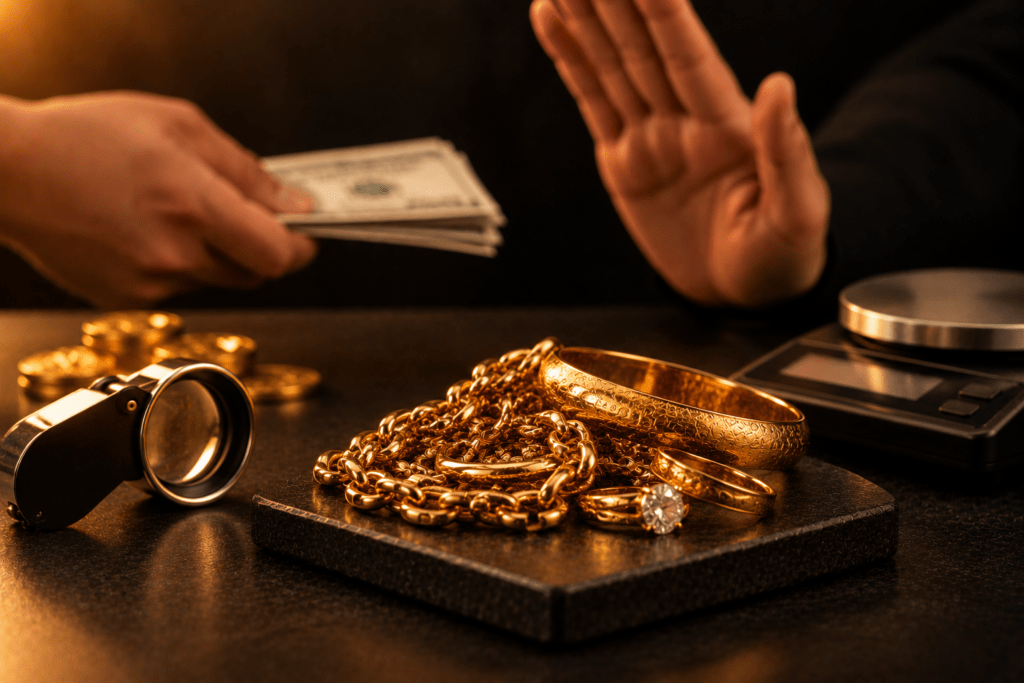
Before selling gold, know four things:
- How much your gold weighs
- Its actual purity or karat
- The current gold spot price
- How the buyer calculated your offer
Do not judge an offer simply by the dollar amount.
A $1,500 offer may sound great until you discover the gold contains $2,500 worth of precious metal.
A reputable gold buyer should be willing to explain the numbers.
At Gold Kings, the goal is to make the process understandable. Your precious metals can be tested and weighed in front of you, and you can ask questions before deciding whether you want to sell.
Gold Kings rule of thumb: If you don’t understand how a buyer arrived at the offer, don’t be afraid to ask.
What Does It Mean to Get Lowballed When Selling Gold?
Getting “lowballed” means receiving an offer significantly below what your gold reasonably justifies based on factors such as:
- Gold weight
- Actual purity
- Current gold price
- Type of item
- Resale or collectible value, when applicable
- The buyer’s normal margin and refining costs
No gold buyer can normally pay the full retail price of a piece of jewelry.
And an offer below the theoretical melt value is not automatically unfair. A buyer has processing, refining, operating, market, and resale costs.
The problem comes when you don’t know what your gold is worth and have no way to judge the offer.
Knowledge gives you leverage.
1. Know the Current Gold Price Before You Sell
The value of gold changes throughout the trading day.
Before searching for a gold buyer near me, check the current spot price of gold.
The spot price is generally quoted per troy ounce of pure gold.
That number is only the starting point.
Your 10K, 14K or 18K jewelry is not pure gold.
Common Gold Purities
| Gold Mark | Approximate Pure Gold Content |
|---|---|
| 10K / 417 | 41.7% |
| 14K / 585 | 58.5% |
| 18K / 750 | 75% |
| 22K / 916 | 91.6% |
| 24K / 999 | About 99.9% |
So if two necklaces both weigh 20 grams, an 18K necklace contains considerably more gold than a 10K necklace.
That is why weight alone doesn’t determine value.
2. Understand the Basic Gold Value Formula
You don’t have to become a precious-metals expert to understand the basic math.
A simplified calculation is:
Weight × Gold Purity × Current Gold Value = Approximate Melt Value
For example, 14K gold contains about 58.5% pure gold.
A professional buyer then evaluates the item and determines an offer based on the actual precious-metal content and other relevant factors.
The important point is this:
Melt value and the amount you are offered are not the same thing.
Knowing the approximate melt value gives you a benchmark.
If you have no idea what the underlying gold is worth, almost any cash offer can sound impressive.
3. Watch the Scale
When you’re selling gold jewelry, a few grams can represent real money.
You should know:
- What unit the buyer is using
- What the item weighs
- Whether stones or non-gold components affect the calculation
- Whether each karat is being weighed separately
Gold may be weighed in:
- Grams
- Pennyweights
- Troy ounces
Those units are not interchangeable.
For reference:
20 pennyweights = 1 troy ounce
and
1 troy ounce = approximately 31.1 grams
You don’t need to perform every conversion yourself.
You should, however, be able to see the weight and have the buyer explain what unit is being used.
A transparent transaction shouldn’t require you to guess what is happening on the scale.
Gold Kings weighs precious-metal items as part of the evaluation process and explains the results before you decide whether to sell.
4. Don’t Assume the Stamp Tells the Whole Story
See “14K” stamped inside a ring?
That’s useful information.
But it isn’t always the final answer.
Jewelry can be:
- Mismarked
- Worn
- Repaired with different metals
- Made from several components
- Gold-filled
- Gold-plated
- Counterfeit
- Made from a purity slightly different from the stamp
A stamp is evidence.
It isn’t a laboratory test.
At Gold Kings, professional precious-metal testing equipment, including XRF analysis when appropriate, can help determine the metal composition rather than relying only on the marking.
That matters because the value of your jewelry depends on how much actual gold it contains.
Gold Kings Tip
Don’t argue over what the stamp says before having the metal properly evaluated.
A professional test can tell you far more than simply reading “10K,” “14K,” “18K,” “585,” “750” or “916” inside the piece.
5. Separate Different Karats Before Comparing Offers
Imagine bringing in:
- A 10K class ring
- Two 14K necklaces
- An 18K bracelet
- A 22K bangle
Those pieces should not simply be treated as one pile of “gold.”
Each purity contains a different percentage of actual gold.
Ask whether the buyer is separating your items by purity.
You should be able to understand which pieces are being valued as:
- 10K
- 14K
- 18K
- 22K
- Other tested purities
The same applies to sterling silver, bullion and coins.
Clear separation makes it easier to understand your offer.
6. Ask the Buyer to Explain the Offer
This may be the single easiest way to avoid getting lowballed.
Ask:
“How did you calculate this offer?”
A knowledgeable buyer should be able to explain the basics.
You can also ask:
- What does my gold weigh?
- What purity did it test?
- What gold price are you using?
- What is the approximate melt value?
- Are the stones being deducted?
- Are there any fees?
- Are these pieces being priced separately?
- Does anything I have carry value beyond the gold content?
You don’t have to interrogate anyone.
You’re simply asking how your property is being valued.
If you’re selling thousands of dollars in gold, spending an extra few minutes understanding the calculation makes sense.
7. Don’t Automatically Sell Valuable Coins for Scrap
This is an important mistake to avoid.
A gold or silver coin can sometimes be worth more than its metal content.
For example, value may also depend on:
- Date
- Mint mark
- Rarity
- Condition
- Collector demand
- Certification
- Type of coin
Bullion is also different from ordinary scrap jewelry.
A recognized one-ounce gold bar or bullion coin should not necessarily be evaluated the same way as a broken 14K chain.
If you have coins or bullion, tell the buyer before everything is placed into a scrap pile.
Gold Kings evaluates multiple categories of precious metals, including gold and silver jewelry, coins and bullion.
Learn more about the types of property Gold Kings purchases here: What Gold Kings Buys
8. Don’t Forget About Diamonds, Watches and Designer Jewelry
Metal value isn’t always the only value.
Imagine selling an expensive designer bracelet solely for its gold content.
Or treating a collectible luxury watch like ordinary scrap gold.
That could leave money on the table.
Before accepting a melt-only offer, determine whether your item has potential additional value because of:
- Brand
- Design
- Condition
- Diamonds
- Gemstones
- Watch movement
- Collector demand
- Rarity
- Resale demand
This doesn’t mean every old piece of jewelry is collectible.
Most ordinary broken or unwanted jewelry is primarily evaluated for its precious-metal content.
The important thing is making sure you know what you have before selling it.
9. Compare Offers Using Percentages, Not Just Dollars
Suppose the precious-metal value of your items is $5,000.
One buyer’s offer is $3,250.
Another offer is $4,000.
That’s a $750 difference on exactly the same property.
This is why comparison shopping can matter when you have a substantial amount of gold.
A difference of only:
- 5% on $1,000 = $50
- 5% on $5,000 = $250
- 5% on $10,000 = $500
- 10% on $10,000 = $1,000
The larger your collection, the more important small percentage differences become.
If you are selling inherited jewelry, several gold chains, coins, bullion or an estate collection, understanding the numbers becomes especially important.
10. Don’t Let a High-Pressure Buyer Rush You
You own the gold until you agree to sell it.
Be cautious if someone tells you:
- “This offer is only good for the next five minutes.”
- “You need to decide right now.”
- “Gold is about to crash.”
- “Nobody else will pay you this much.”
- “Don’t worry about the weight.”
- “The math is complicated.”
Gold pricing does move.
But that doesn’t mean you should be pressured into making a financial decision you don’t understand.
A good transaction should leave you knowing:
What you had.
How much it weighed.
How pure it was.
How the offer was calculated.
And most importantly:
You should be free to say no.
Gold Kings provides evaluations without requiring you to accept the offer. More information about the selling process is available in the Gold Kings FAQs. Gold & Silver Selling FAQs
11. Be Careful With “We Pay the Most” Claims
When people search phrases such as best place to sell gold near me or who pays the most for scrap gold near me, they’re understandably looking for the strongest offer.
But marketing claims alone don’t tell you what you’ll actually receive.
Instead of choosing a buyer because an advertisement says:
“Highest prices!”
look at the actual transaction.
Ask:
- What is the tested purity?
- What is the weight?
- What market price is being used?
- What percentage of the underlying value does the offer represent?
- Are there deductions or fees?
Numbers are easier to compare than slogans.
12. Read Reviews—but Read the Actual Comments
Star ratings can help when researching gold buyers near me, but don’t stop at the number.
Read what customers actually say.
Look for repeated comments about:
- Transparent testing
- Offers being explained
- Professional treatment
- Accurate weighing
- No-pressure service
- Knowledge of precious metals
- Repeat customers
Also look at how the business responds to unhappy customers.
Reviews should be one part of your decision—not the only factor.
13. Know the Difference Between a Gold Buyer and a Pawn Loan
A pawn shop and a precious-metals buyer may serve different purposes.
A pawn shop often handles:
- Loans
- Electronics
- Tools
- Firearms
- Jewelry
- General merchandise
A precious-metals buyer focuses more specifically on determining the value of items such as:
- Gold
- Silver
- Platinum
- Jewelry
- Coins
- Bullion
Neither business model automatically guarantees a better offer.
The advantage of dealing with a precious-metals specialist is that the evaluation process is centered around metal purity, weight and precious-metal markets.
If you’re comparing places to sell, understand what type of business you’re dealing with.
Gold Kings specializes in precious metals and related valuables. You can read more about the company’s evaluation approach here: Why Choose Gold Kings
Red Flags When Selling Gold
Be cautious if a gold buyer:
- Won’t let you see the weight
- Won’t tell you the purity
- Mixes different karats together without explanation
- Refuses to explain the offer
- Uses confusing units without explaining them
- Pressures you to sell immediately
- Takes your items out of sight unnecessarily
- Won’t explain deductions
- Treats potentially collectible coins as scrap without examining them
- Gives you only a total dollar figure with no explanation
None of these automatically proves that someone is dishonest.
But they are good reasons to ask more questions before accepting an offer.
What Should a Good Gold Evaluation Look Like?
A strong evaluation should be easy for the customer to follow.
Step 1: Identify the items
Separate gold, silver, coins, bullion and other valuables.
Step 2: Determine purity
Check hallmarks and professionally test items when necessary.
Step 3: Weigh the items
Record the weight using an appropriate professional scale.
Step 4: Check the market price
Use the current precious-metal price as the starting point.
Step 5: Determine the offer
Account for purity, weight, item type and other relevant value.
Step 6: Explain it
The seller should understand what they own and what they are being offered.
Step 7: Let the seller decide
An evaluation should not mean you’re obligated to sell.
That final step matters.
Have Your Gold Tested at Gold Kings Before You Decide
If you’re not sure what your jewelry is made of—or you’re worried about getting lowballed—the first goal should be finding out what you actually own.
Gold Kings can evaluate gold, silver, jewelry, coins, bullion and other qualifying valuables.
Professional precious-metal testing can help verify purity. Items can be weighed, and the evaluation can be explained before you decide whether to sell.
Gold Kings currently has two Georgia locations:
Gold Kings of Snellville
3635 Stone Mountain Hwy
Snellville, GA 30039
770-771-4650
The Snellville location serves customers throughout Gwinnett County and surrounding communities.
More information: Gold Kings of Snellville
Gold Kings of Commerce
480 Banks Crossing Dr
Commerce, GA 30529
706-336-0043
The Commerce location provides another convenient option for customers in Northeast Georgia.
If you would rather provide some information about your items before visiting, Gold Kings also offers a quote page. Final values still require an in-person examination and testing of the property. Get a Gold & Silver Quote
Questions to Ask Before Selling Your Gold
Save this list before visiting a gold buyer:
- What karat did my gold test?
- Can I see the weight?
- What unit are you weighing it in?
- What gold price are you using?
- What is the approximate melt value?
- How did you calculate my offer?
- Are there any fees or deductions?
- Are my different karats being separated?
- Could any coins be worth more than melt value?
- Does any jewelry have value beyond its gold content?
- Am I free to take my items back if I don’t accept the offer?
If you can get clear answers to those questions, you’re in a much stronger position.
Frequently Asked Questions About Selling Gold Without Getting Lowballed
How do I know if a gold buyer is lowballing me?
Start by estimating the precious-metal value using the item’s weight, purity and current gold price. Then ask the buyer to explain the offer.
You can’t properly judge an offer if you don’t know the underlying value of your gold.
Should I get more than one offer for my gold?
For higher-value collections, getting another offer can be worthwhile.
Even a small percentage difference can equal hundreds or thousands of dollars when you’re selling a large amount of gold.
You aren’t obligated to sell simply because someone tested your jewelry.
Should I weigh my gold before selling it?
Yes, if possible.
A home scale may not match a professional trade scale exactly, but having an approximate weight can help you identify major discrepancies.
You should still ask to see the buyer’s weight during the professional evaluation.
Is 14K gold worth 58.5% of the gold spot price?
14K gold is approximately 58.5% pure gold.
That does not mean a 14K item is automatically worth exactly 58.5% of the quoted price of a troy ounce, because you must also account for the item’s weight and convert the spot price to the appropriate unit.
Your actual cash offer will normally be below the theoretical pure-metal value.
Do gold buyers pay full melt value?
Usually not for ordinary scrap jewelry.
The buyer must account for costs, market risk, processing, refining and a profit margin.
The better question is whether the offer is reasonable and whether the buyer clearly explains how it was determined.
Should I sell gold based only on the karat stamp?
No.
Hallmarks such as 10K, 14K, 18K, 417, 585, 750 and 916 are useful indicators, but testing can help verify actual metal content.
What if my gold has diamonds or stones?
Ask whether the stones have independent value and whether their weight is being deducted from the precious-metal calculation.
Diamonds, designer jewelry and certain finished pieces can sometimes have value beyond the gold itself.
Where can I sell gold near me without getting lowballed?
Look for a buyer who will show you the weight, explain the purity, tell you how the offer was calculated and let you make the final decision without pressure.
For customers in Georgia, Gold Kings offers in-person precious-metal evaluations at its Snellville and Commerce locations.
The Best Protection Against a Low Offer Is Understanding Your Gold
You don’t need to know everything about precious metals before selling.
You only need enough information to ask the right questions.
Know:
The weight.
The purity.
The current gold price.
The approximate underlying value.
And how the buyer calculated the offer.
Then compare your options.
If you have unwanted gold jewelry, broken chains, inherited jewelry, coins, bullion or silver and want help figuring out what you own, bring it to Gold Kings.
We’ll help identify and evaluate your precious metals, explain the numbers, and let you decide what to do next.
We test it. We weigh it. We explain it. You decide.