
Quick Answer: Yes—Especially If Your Gold Is Worth a Significant Amount
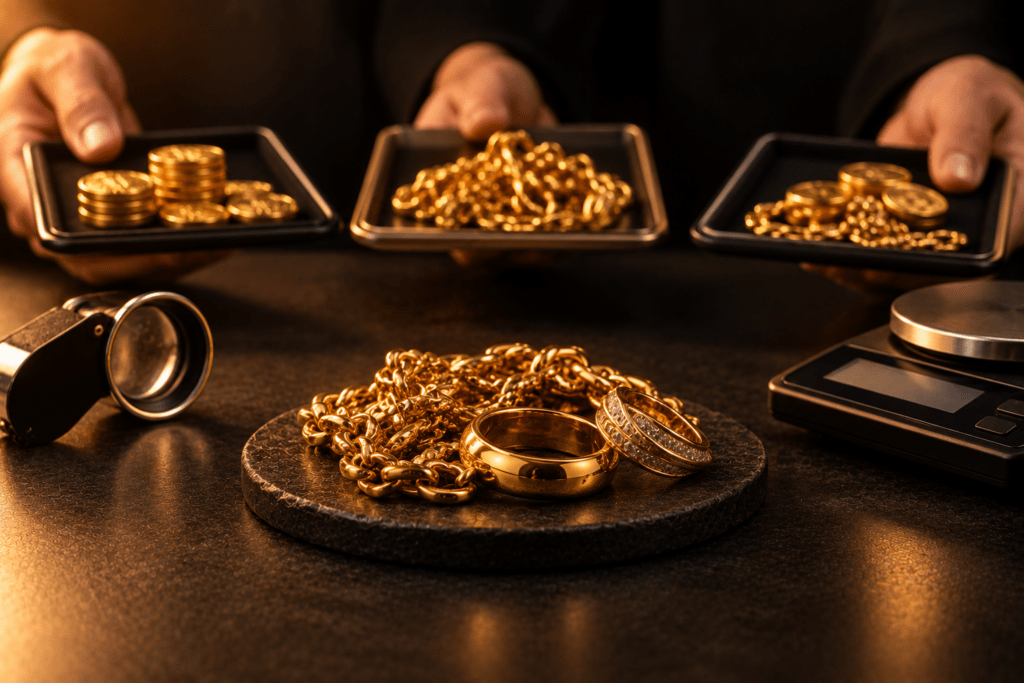
In most cases, getting more than one offer before selling gold is a smart idea.
Different gold buyers may offer different amounts for the exact same jewelry, coins, bullion, or scrap gold. Even a relatively small difference in the percentage a buyer pays can add up when you are selling hundreds or thousands of dollars in precious metals.
But getting multiple offers is only useful if you know what you are comparing.
The highest number is not automatically the best offer.
You should understand:
- How much your gold weighs
- What purity or karat the buyer determined
- How the gold was tested
- What gold price the buyer used
- Whether the item has value beyond its gold content
- Whether there are fees or deductions
- What you will actually receive
Consumer finance guidance also commonly recommends comparing more than one offer when selling gold, particularly when you have the flexibility to shop around.
At Gold Kings, we believe sellers should understand those numbers before deciding whether to sell. Our goal is not simply to give you an offer—we want you to understand how that offer was calculated.
Why Can Two Gold Buyers Offer Different Prices?
Gold has a publicly traded market price, commonly called the spot price.
So why don’t all gold buyers offer the same amount?
Because the spot price is only one part of the calculation.
1. The Buyer May Determine a Different Gold Purity
Jewelry might be stamped:
- 10K
- 14K
- 18K
- 22K
- 417
- 585
- 750
- 916
Those marks indicate the intended gold purity.
For example, 18K gold represents 18 parts gold out of 24, or approximately 75% pure gold. The Federal Trade Commission explains that karat markings describe how much pure gold a piece contains.
However, a stamp isn’t necessarily the end of the evaluation.
Professional testing can help determine the actual metal composition.
At Gold Kings, precious-metal testing equipment, including XRF testing when appropriate, can be used to help determine metal content. The testing and weighing process is performed transparently so customers can see what is being evaluated.
2. Buyers May Use Different Weights
Gold jewelry can be weighed in:
- Grams
- Pennyweights
- Troy ounces
The unit itself isn’t the problem—as long as the conversion is correct.
What matters is the actual precious-metal weight being used to calculate your offer.
If your jewelry contains stones, springs, watch movements, steel parts, or other non-gold components, those may also need to be considered.
When getting multiple offers, ask each buyer:
“What weight are you using to calculate my offer?”
A reputable buyer should be able to answer that clearly.
3. Buyers Pay Different Percentages of the Gold’s Value
A gold buyer normally cannot pay 100% of the theoretical melt value for ordinary scrap jewelry and still cover refining, operating costs, price fluctuations, and profit.
But buyers don’t all operate with the same margins.
Consider a simple hypothetical example.
If the precious-metal value of your jewelry were $5,000:
| Percentage Paid | Offer |
|---|---|
| 60% | $3,000 |
| 70% | $3,500 |
| 80% | $4,000 |
| 85% | $4,250 |
A difference of only five percentage points at this value equals $250.
A 20-point difference equals $1,000.
That is why getting another offer can matter considerably when you’re selling a large amount of gold.
How Many Gold Offers Should You Get?
You don’t necessarily need to spend an entire day visiting six different gold buyers.
For many sellers, two or three legitimate offers are enough to establish a reasonable range.
You should consider getting another offer when:
- You have several pieces of jewelry
- You’re selling a high-dollar collection
- You don’t know the karat or purity
- The buyer won’t explain the calculation
- You aren’t allowed to see the scale
- The testing process isn’t explained
- You have gold coins or bullion
- Your jewelry contains valuable diamonds
- You have estate or inherited jewelry
- You think an item may have collectible value
- The first offer simply doesn’t make sense
If the first buyer provides a transparent evaluation, clearly explains the purity and weight, and gives you an offer you can independently understand, you may only need one additional comparison.
The purpose isn’t to collect as many quotes as possible.
The purpose is to understand what you own and what the market is willing to pay for it.
Already Have a Gold Offer?
Bring the item—and the offer—to Gold Kings.
We can independently test and weigh your gold and explain how we arrive at our own valuation. There is no requirement to sell simply because you received an evaluation.
You can learn more about what Gold Kings buys or visit our Snellville gold-buying location.
Don’t Compare Offers Until You Know These Five Numbers
If you want to compare gold buyers fairly, write down these numbers from each evaluation.
1. Weight
How many grams or pennyweights of gold are being purchased?
2. Purity
Is the item being valued as 10K, 14K, 18K, 22K, or another purity?
3. Gold Spot Price
What market price is being used?
Gold prices move throughout the trading day, so two offers made at different times can vary slightly simply because the underlying gold price changed.
4. Melt Value
What is the approximate precious-metal value before the buyer’s margin?
5. Actual Offer
Most importantly:
How much money will you actually receive?
These five numbers allow you to compare buyers much more intelligently than simply hearing, “We’ll give you $1,200.”
Ask the Gold Buyer These Questions Before You Sell
You don’t need to be a precious-metals expert.
Just ask good questions.
“What karat did my gold test?”
You should know the purity being used in the calculation.
“How did you test it?”
Depending on the item, buyers may use electronic testing, acid testing, XRF analysis, or other methods.
“Can I see the weight?”
You should know how much metal is being purchased.
“What gold price are you using?”
The offer should have some relationship to the current precious-metals market.
“How did you calculate my offer?”
The buyer should be able to explain the math.
“Does this item have value beyond the gold?”
This question is particularly important for coins, diamonds, watches, signed jewelry, and collectible pieces.
“Are there any fees or deductions?”
Compare what you actually receive—not just the first number you hear.
The Highest Gold Offer Isn’t Always the Best Offer
Suppose one buyer says:
“I’ll pay you $2,100.”
Another says:
“I’ll pay $2,000.”
At first glance, the $2,100 offer appears better.
But what if the first buyer later adds fees, changes the offer after additional testing, requires shipping the item away, or cannot clearly explain how the valuation was reached?
A real comparison should consider:
- Final amount paid
- Transparency
- Testing process
- Security
- Payment method
- Reputation
- Whether the offer can change
- Whether your item remains in your possession during the evaluation
The best transaction is one where you understand what you are selling and exactly what you are receiving in return.
Gold Jewelry, Bullion and Coins Shouldn’t Always Be Compared the Same Way
Different types of gold require different evaluations.
Gold Jewelry
Most ordinary broken or unwanted gold jewelry is heavily influenced by:
weight × purity × current gold price
But designer jewelry, estate jewelry, larger diamonds, or unusual pieces may deserve additional consideration.
The Gemological Institute of America notes that jewelry valuation can involve factors beyond the raw materials, including gemstone quality, desirability, and the market for the piece.
Gold Bullion
Gold bars and widely traded bullion coins are much easier to compare directly with the current gold market.
When selling bullion, ask what percentage of the market value the buyer is paying.
Gold Coins
Be more careful with coins.
Some gold coins are worth more than their precious-metal content because of:
- Rarity
- Date
- Mint mark
- Condition
- Collector demand
A rare coin should not automatically be thrown onto a scale and purchased strictly for melt value.
Diamond Jewelry
A ring containing a meaningful diamond may have both:
- Precious-metal value
- Diamond or resale value
Make sure you know whether the buyer is paying anything for the stone.
When Getting a Second Offer Matters Most
Getting another offer becomes increasingly important as the value of the transaction increases.
A 5% difference on $200 is only $10.
A 5% difference on $2,000 is $100.
A 5% difference on $10,000 is $500.
A 5% difference on $20,000 is $1,000.
Spending a little extra time getting another professional evaluation can therefore make considerably more sense when you’re selling a substantial collection.
Should You Tell a Gold Buyer You’re Getting Other Offers?
Yes.
There is nothing wrong with saying:
“I’m getting a couple of offers before I decide.”
A professional buyer should understand.
You own the gold.
You have the right to understand its value and decide whether an offer makes sense.
Pressure to “sell right now or lose the deal” should make you more cautious—not less.
Do You Need an Appraisal Before Selling Gold?
Usually not for ordinary scrap gold jewelry.
If you have a broken 14K chain, old class ring, single earrings, or similar pieces being sold primarily for their metal value, professional gold testing and weighing may provide the information needed.
An appraisal becomes more useful when dealing with:
- Important diamonds
- High-end designer jewelry
- Antique jewelry
- Rare coins
- Significant gemstones
- Unusual estate pieces
- Jewelry you believe has substantial resale value
Remember that an insurance appraisal and a cash purchase offer are not the same thing.
An appraisal may estimate value for a particular purpose. An actual purchase offer represents what a buyer is willing to pay you today.
What Should You Look for in a Gold Buyer?
Before searching only for the highest advertised payout, look at the entire process.
If you are deciding which businesses to compare, start with our guide to where to sell gold and our comparison of gold buyers and pawn shops.
A strong gold-buying experience should provide:
Transparent Testing
You should understand how the purity was determined.
Visible Weighing
You should know the weight being used.
Market-Based Pricing
The buyer should be able to explain how the current gold market affects your offer.
Clear Explanations
You shouldn’t need a finance degree to understand how the buyer reached the number.
No-Pressure Decision
An evaluation should not force you to sell.
Local Accountability
A physical location and established local presence give you somewhere to return if you have questions.
Gold Kings operates physical precious-metals buying locations in Snellville and Commerce, Georgia, and its published process includes in-person testing, weighing, market-price explanations, and no-obligation evaluations.
Get a Second Gold Offer at Gold Kings
If you searched for “sell gold near me,” “gold buyer near me,” or “where to sell gold,” price should not be your only question.
A better question is:
“Will this buyer show me why my gold is worth what they say it is?”
Gold Kings specializes in evaluating gold, silver, jewelry, coins, bullion, and other precious-metal items. You can see more examples on our What We Buy page.
Already have an offer from another buyer?
That’s fine.
Bring your items to Gold Kings and let us provide another evaluation.
We aren’t asking you to assume another offer will be higher.
We’re giving you the opportunity to compare the testing, the weight, the explanation, and the final number for yourself.
Gold Kings Locations
Gold Kings of Snellville
3635 Stone Mountain Highway
Snellville, GA 30039
Gold Kings of Snellville serves customers throughout Snellville, Lawrenceville, Loganville, Stone Mountain, Lilburn, Grayson, Gwinnett County, and surrounding communities.
See more information about selling gold at Gold Kings of Snellville.
Gold Kings of Commerce
480 Banks Crossing Dr
Commerce, GA 30529
Gold Kings of Commerce serves customers throughout Commerce, Jackson County, Banks County, Northeast Georgia, and surrounding communities.
For either location, you can also review the Gold Kings evaluation and quote information before visiting.
Frequently Asked Questions
Should I get multiple offers before selling gold?
Usually, yes. Two or three professional evaluations can help you understand the range buyers are willing to pay and identify major differences in testing, purity, weight, or payout.
How many gold buyers should I visit?
For most ordinary transactions, two or three reputable buyers should provide enough information to make a comparison. High-value, rare, or unusual items may justify additional specialist opinions.
Is it rude to get an offer and not sell?
No. Receiving an evaluation does not mean you are obligated to sell your property.
Why did two gold buyers give me different offers?
The buyers may have determined different purity levels, used different weights, applied different margins, valued stones or collectible features differently, or calculated their offers at different gold prices.
Should I sell to the gold buyer offering the most money?
Not automatically. Compare the final amount you receive along with the buyer’s testing process, transparency, reputation, fees, security, and payment terms.
Can Gold Kings give me a second opinion on my gold?
Yes. Gold Kings evaluates precious-metal items at its Snellville and Commerce locations. Items can be tested and weighed, and the valuation process can be explained before you decide whether you want to sell.
Before You Sell, Know What You Have
Getting multiple offers isn’t about distrusting every gold buyer.
It’s about making an informed financial decision.
Know the weight.
Know the purity.
Know the current gold market.
Understand how the offer was calculated.
Then decide.
If you’ve already received an offer—or you’re simply wondering what your gold is worth—bring your gold, silver, jewelry, coins, or bullion to Gold Kings in Snellville or Commerce.
We’ll evaluate what you have, explain the numbers, and give you the information you need to decide whether selling makes sense.
The final decision is yours.