
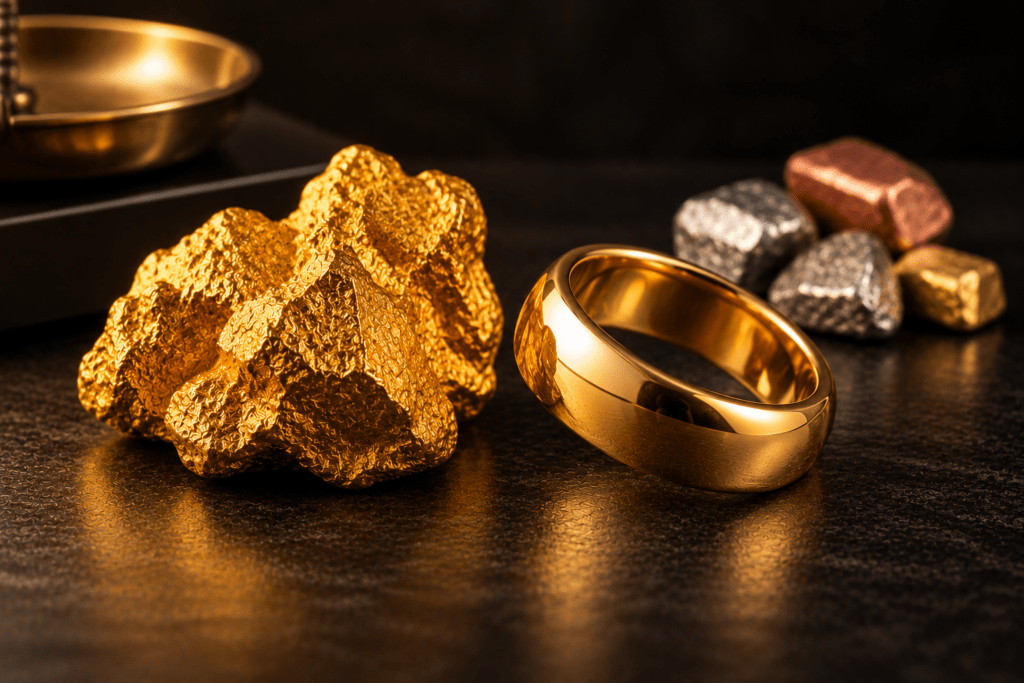
A gold karat measures how much pure gold is contained in an item.
Gold purity is measured on a 24-part scale:
- 24K gold = essentially pure gold
- 18K gold = 18 parts gold out of 24, or 75% gold
- 14K gold = 14 parts gold out of 24, or about 58.3% gold
- 10K gold = 10 parts gold out of 24, or about 41.7% gold
The higher the karat, the more pure gold the item contains.
That does not automatically mean higher-karat jewelry is always better. Pure gold is relatively soft, so jewelry manufacturers commonly mix gold with silver, copper, zinc and other metals to make it stronger, change its color and improve durability.
If you are trying to determine what a ring, chain, bracelet or other piece of jewelry is worth, karat is one of the most important numbers to know.
At Gold Kings, determining the actual purity is part of evaluating gold jewelry. A stamp can give you a good starting point, but professional testing can help determine what the metal actually contains.
Gold Karat and Purity Chart
Here is the easiest way to compare common gold karats:
| Gold Karat | Approximate Gold Purity | Common Fineness Mark |
|---|---|---|
| 24K | 99.9%+ | 999, 999.9 |
| 22K | 91.7% | 916, 917 |
| 21K | 87.5% | 875 |
| 18K | 75.0% | 750 |
| 14K | about 58.3%–58.5% | 583, 585 |
| 10K | 41.7% | 417 |
| 9K | 37.5% | 375 |
Comparing lower-karat jewelry? See how 9K and 10K gold differ.
A simple formula works for almost any karat:
Karat ÷ 24 × 100 = percentage of pure gold
For example:
18 ÷ 24 = 0.75
So 18K gold is 75% pure gold.
Why Isn’t Most Gold Jewelry 24K?
Pure gold has some unusual properties.
It is beautiful, resistant to corrosion and extremely workable—but it is also relatively soft.
That can be a problem for jewelry worn every day.
A 24K ring, for example, may scratch, dent or bend more easily than a similar 14K or 18K ring.
Manufacturers therefore create gold alloys by mixing pure gold with other metals.
The result can be:
- Greater hardness
- Better resistance to everyday wear
- Different colors
- Lower manufacturing cost
- Different working characteristics for jewelers
The amount of pure gold remaining in the alloy determines its karat.
What Does 24K Gold Mean?
24K is the highest commonly used gold karat.
In theory:
24 ÷ 24 = 100% gold
In actual precious-metals markets, you will often see very high-purity gold described as:
999 gold = 99.9% pure
or
999.9 gold = 99.99% pure
Both are generally considered 24K gold for practical purposes.
High-purity gold is especially common in:
- Gold bullion bars
- Investment gold
- Some bullion coins
- Certain Asian and Middle Eastern jewelry
- High-purity specialty jewelry
Because 24K contains more actual gold per gram than lower karats, its precious-metal value per gram is normally higher.
Read more about what 999 means on gold.
What Does 22K Gold Mean?
22K gold contains approximately 91.7% pure gold.
The calculation is:
22 ÷ 24 = 91.67%
You may also see 22K jewelry marked:
916
That means approximately 916 parts out of every 1,000 are gold.
22K jewelry contains much more pure gold than 10K, 14K or 18K jewelry while still containing a small amount of alloy metal.
It is commonly encountered in jewelry from countries and regions where higher-purity gold jewelry is traditional.
For a deeper explanation, see What Does 916 Mean on Gold?.
What Does 18K Gold Mean?
18K gold is 75% pure gold.
The remaining 25% consists of other metals.
The calculation is simple:
18 ÷ 24 = 75%
You may also find the number:
750
stamped inside an 18K ring or on another piece of jewelry.
That means 750 parts per thousand are gold.
18K is popular in fine jewelry because it offers a relatively high gold content while remaining more durable than nearly pure 24K gold.
Learn more in the Gold Kings guide to 750 and 18K gold.
What Does 14K Gold Mean?
14K is one of the most common gold purities used in American jewelry.
Mathematically:
14 ÷ 24 = 58.33%
You will frequently see 14K jewelry stamped:
- 14K
- 14KT
- 583
- 585
A 585 mark represents 58.5% gold and is commonly associated with 14K jewelry.
The remainder of the metal may contain combinations of copper, silver, zinc or other alloy metals.
Because 14K contains less pure gold than 18K, it is normally worth less per gram when the items are otherwise comparable.
However, its greater alloy content can make it well suited to rings, bracelets and other jewelry exposed to frequent wear.
See the complete Gold Kings explanation of 585 and 14K gold.
What Does 10K Gold Mean?
10K gold contains approximately 41.7% pure gold.
The calculation is:
10 ÷ 24 = 41.67%
That is why 10K jewelry may carry the number:
417
The other approximately 58.3% consists of alloy metals.
10K still contains real gold—it simply contains substantially less pure gold than 14K, 18K, 22K or 24K.
Compare 10K vs. 14K gold for a closer look at purity and value.
This difference becomes important when you are calculating what jewelry is worth.
A 20-gram 18K bracelet contains much more actual gold than a 20-gram 10K bracelet.
For more detail, read What Does 417 Mean on Gold?.
Karat vs. Carat: What’s the Difference?
The difference between karat and carat is what each term measures.
Karat, usually abbreviated K, measures gold purity.
Examples:
- 10K gold
- 14K gold
- 18K gold
- 24K gold
Carat, usually abbreviated ct, measures the weight of diamonds and other gemstones.
So an 18K gold ring containing a 1-carat diamond is describing two completely different measurements:
18K = purity of the gold
1 carat = weight of the diamond
What Do Numbers Like 417, 585, 750 and 916 Mean?
Not every piece of gold jewelry uses the familiar K system.
Many pieces are stamped with a three-digit fineness number instead.
Fineness measures gold in parts per thousand.
For example:
417 = 41.7% gold = approximately 10K
585 = 58.5% gold = approximately 14K
750 = 75% gold = 18K
916 = 91.6% gold = approximately 22K
999 = 99.9% gold = approximately 24K
This is why a necklace marked 750 can be real 18K gold even though there is no “18K” anywhere on it.
If you regularly come across unfamiliar numbers on jewelry, see the Gold Kings Gold Hallmarks & Stamps guide.
Does a Gold Stamp Guarantee the Karat?
No.
A gold hallmark is useful information, but it should not automatically be treated as proof of purity.
A piece marked 14K may test somewhat differently from exactly 58.3% gold.
Several things can affect the result:
- Manufacturing tolerances
- Solder used during assembly
- Previous repairs
- Different components in the same piece
- Surface plating
- Wear
- Incorrect markings
- Counterfeit stamps
This is especially important if you are evaluating jewelry worth hundreds or thousands of dollars.
At Gold Kings, professional precious-metal testing can be used to help determine the actual metal content instead of relying only on the stamp.
How Gold Kings Tests Gold Purity
One of the professional tools used by Gold Kings is an XRF analyzer.
XRF stands for X-ray fluorescence.
Rather than simply reading the marking stamped into a piece of jewelry, an XRF analyzer examines the elemental composition of the metal.
It can help identify metals such as:
- Gold
- Silver
- Copper
- Zinc
- Platinum
- Palladium
- Other metals present in an alloy
An XRF test can therefore provide much more information than simply seeing “14K” stamped inside a ring.
There is an important limitation: XRF primarily evaluates the surface and near-surface composition of an item. Plating, unusual construction or suspicious pieces may require additional evaluation.
You can learn more about how XRF gold testing works.
Why Karat Matters When Determining Gold Value
If you are asking what is a gold karat because you are trying to figure out what your jewelry is worth, this is where purity becomes especially important.
The basic precious-metal calculation is:
Weight × Gold Purity × Current Pure-Gold Value
Imagine two chains that both weigh 20 grams.
20 grams of 10K gold
10K is approximately 41.7% pure.
20 × .417 = 8.34 grams of pure gold
20 grams of 18K gold
18K is 75% pure.
20 × .750 = 15 grams of pure gold
Both chains weigh exactly the same amount.
But the 18K chain contains almost twice as much actual gold.
That is why a professional evaluation should consider both weight and purity.
The current market price of gold is the third major part of the equation. Because that price changes throughout the trading day, use the current Gold Kings Gold & Silver Prices page rather than relying on an old price quoted in an article.
Is Higher-Karat Gold Always Worth More?
Per gram of metal, higher-karat gold generally contains more gold and therefore has a higher precious-metal value.
But an entire piece of jewelry can be more complicated.
Value may also be affected by:
- Total weight
- Brand
- Designer
- Age
- Condition
- Gemstones
- Rarity
- Collector demand
- Whether the item is jewelry, bullion or a collectible coin
For ordinary broken or unwanted gold jewelry, precious-metal content may represent a large part of its value.
But a rare gold coin, desirable watch or collectible piece of jewelry should not automatically be valued as scrap metal.
Yellow Gold, White Gold and Rose Gold Can Have the Same Karat
Gold color does not necessarily tell you purity.
For example, an 18K yellow-gold ring and an 18K white-gold ring are both 75% gold.
What changes is primarily the mixture of alloy metals.
Yellow Gold
Yellow gold is designed to retain the familiar warm appearance associated with gold.
White Gold
White gold contains alloy metals that give the jewelry a lighter appearance. Many white-gold pieces are also rhodium plated.
Rose Gold
Rose gold typically receives its reddish or pink appearance from a higher proportion of copper in the alloy.
An 18K rose-gold ring is still 75% gold.
A 14K white-gold ring is still approximately 58.3% gold.
Color and karat are two different characteristics.
Is Gold-Plated Jewelry Measured in Karats?
This is an important distinction.
You might see an item described as:
18K gold plated
That does not mean the entire item is 18K gold.
It means the layer of gold applied to the surface is described as 18K.
Underneath that layer may be a completely different metal.
Other terms you may encounter include:
- Gold plated
- Gold filled
- Gold overlay
- Rolled gold plate
- Gold vermeil
- Gold clad
These should not be confused with a piece made throughout from a gold alloy such as 10K, 14K or 18K.
If you are unsure what you own, professional testing is much more reliable than judging the item by color alone.
Not Sure What Karat Your Gold Really Is?
A tiny stamp can be difficult to read—and a stamp alone does not always tell the whole story.
Gold Kings can professionally test and weigh gold jewelry so you can better understand its purity and precious-metal value. There is no need to guess whether an unfamiliar mark means 10K, 14K, 18K, 22K or something else.
If you are considering selling, start by finding out what you actually have.
How to Estimate the Pure Gold in Your Jewelry
If you know the weight and karat, you can estimate how much pure gold your jewelry contains.
Example: 14K necklace weighing 30 grams
14K is approximately 58.3% gold.
30 × .5833 = approximately 17.5 grams of pure gold
Example: 18K bracelet weighing 30 grams
18K is 75% gold.
30 × .75 = 22.5 grams of pure gold
That does not mean a buyer will simply pay the retail spot value of 17.5 or 22.5 grams.
Refining, processing, resale considerations and the type of item can affect an offer.
But calculating the contained gold gives you a useful starting point for understanding the item.
If you are thinking about selling unwanted or broken jewelry, see Gold Kings’ guide to selling scrap gold.
Have Your Gold Tested at Gold Kings
If you have jewelry and do not know its karat—or you want to confirm whether the stamp is accurate—Gold Kings can evaluate it professionally.
The process focuses on three basic questions:
1. What is it?
The item and its markings are examined.
2. What is its actual purity?
Professional precious-metal testing can help determine how much gold is present.
3. What does it weigh?
The weight is combined with purity and the current gold price to determine the precious-metal value.
This is especially helpful for:
- Broken chains
- Rings
- Bracelets
- Earrings
- Class rings
- Dental gold
- Inherited jewelry
- Unmarked jewelry
- Foreign jewelry
- Gold coins
- Gold bullion
- Estate collections
You can also review what Gold Kings buys before visiting.
Gold Kings of Snellville
3635 Stone Mountain Hwy
Snellville, GA 30039
770-771-4650
Gold Kings of Snellville serves customers throughout Snellville and surrounding Gwinnett County communities.
Learn more about selling gold at Gold Kings of Snellville.
Gold Kings of Commerce
480 Banks Crossing Dr
Commerce, GA 30529
706-336-0043
The Commerce location provides a convenient option for customers throughout Commerce and surrounding Northeast Georgia communities.
Both locations can evaluate gold jewelry, coins, bullion and other precious-metal items.
Frequently Asked Questions About Gold Karats
What does karat mean in gold?
Karat measures the proportion of pure gold in a metal using a 24-part scale. For example, 18K gold contains 18 parts gold out of 24 total parts, making it 75% gold.
Is 24K gold 100% pure?
24K represents pure gold on the karat scale. In commercial precious metals, very high-purity gold is commonly marked 999 or 999.9, representing 99.9% or 99.99% purity.
What percentage of gold is 18K?
18K gold is 75% pure gold.
What percentage of gold is 14K?
14K gold is approximately 58.3% pure gold. The common 585 fineness mark represents 58.5% purity.
What percentage of gold is 10K?
10K gold is approximately 41.7% pure gold.
Is 10K real gold?
Yes. 10K is real gold. It simply contains a lower percentage of pure gold than 14K, 18K, 22K or 24K.
Is 14K or 18K better?
It depends on what you mean by better.
18K contains more pure gold and therefore generally has greater precious-metal value per gram.
14K contains more alloy metal and can be more resistant to everyday wear.
Neither is automatically the better choice for every person or every piece of jewelry.
Our 14K vs. 18K gold comparison explains the tradeoffs in purity, durability and value.
What does 585 mean on gold?
585 means the item is approximately 58.5% gold, corresponding to about 14K gold.
What does 750 mean on gold?
750 means 75% pure gold, which is 18K gold.
What does 916 mean on gold?
916 means approximately 91.6% pure gold, which corresponds to approximately 22K gold.
What does 417 mean on gold?
417 means approximately 41.7% pure gold, corresponding to 10K gold.
Does a karat stamp prove gold is real?
No. A hallmark is useful evidence, but markings can be inaccurate or counterfeit. Testing the metal is a better way to verify purity when authenticity or value matters.
Can real gold have no stamp?
Yes. Genuine gold can sometimes be unmarked because a stamp has worn away, the item was repaired or resized, or it was manufactured without an easily visible mark.
Which gold karat is worth the most?
Per gram, higher-karat gold generally has greater precious-metal value because it contains more pure gold. However, the overall value of a piece can also depend on its weight, design, brand, gemstones, rarity and collectibility.
Know Your Karat Before You Sell Your Gold
Understanding gold karats makes it much easier to understand what you own.
Remember the basic rule:
24K = essentially pure gold
22K = about 91.7%
18K = 75%
14K = about 58.3%–58.5%
10K = about 41.7%
The higher the karat, the more pure gold the item contains.
But the stamp is only the beginning. When real money is involved, purity, weight and the current gold price all matter.
If you have unwanted, inherited or broken gold jewelry and want to know what it actually contains, bring it to Gold Kings of Snellville or Gold Kings of Commerce. We can professionally test the metal, weigh the item and explain what you have before you decide whether selling makes sense.
We test it. We weigh it. We pay you.