
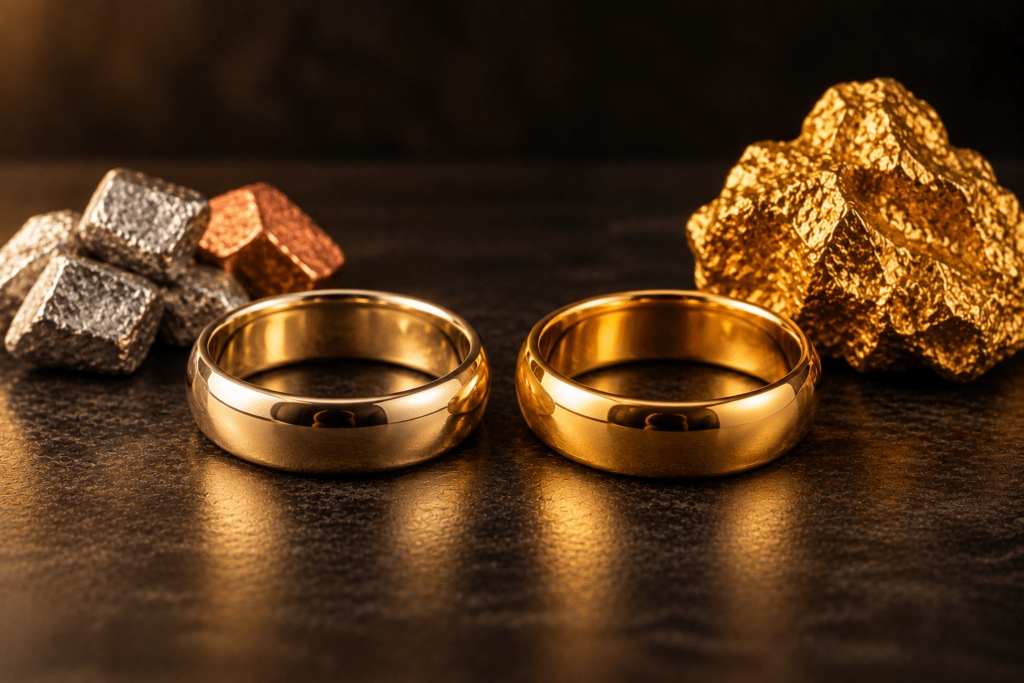
If you’re comparing 10K vs. 14K gold, the biggest difference is simple:
10K gold is approximately 41.7% pure gold, while 14K gold is approximately 58.3% pure gold.
That means 14K contains considerably more actual gold than 10K.
For two pieces that weigh exactly the same, 14K contains about 40% more pure gold than 10K and therefore has a higher precious-metal value.
But value isn’t the only difference.
10K gold is generally harder and less expensive.
14K gold has more gold, usually has a richer gold color, and is generally worth more.
Quick Comparison: 10K vs. 14K Gold
| Comparison | 10K Gold | 14K Gold |
|---|---|---|
| Pure gold | About 41.7% | About 58.3% |
| Other metals | About 58.3% | About 41.7% |
| Common hallmark | 10K / 417 | 14K / 585 |
| Gold content | Lower | Higher |
| Durability | Generally higher | Very good |
| Gold color | Usually lighter | Usually richer |
| Metal value by equal weight | Lower | Higher |
| Common in jewelry | Yes | Yes |
If you’re trying to determine whether a ring, chain, bracelet, or other piece is 10K or 14K, the stamp is a good place to start—but it shouldn’t always be the final answer.
At Gold Kings, we regularly evaluate gold jewelry based on its actual purity and weight rather than relying only on what appears to be stamped on the piece.
What Does the “K” in 10K and 14K Mean?
The K stands for karat, which measures gold purity.
Pure gold is considered 24 karat.
You can estimate the percentage of pure gold by dividing the karat number by 24.
10K Gold
10 ÷ 24 = approximately 41.7% pure gold
The remaining approximately 58.3% is made up of other metals.
14K Gold
14 ÷ 24 = approximately 58.3% pure gold
The remaining approximately 41.7% consists of other metals.
You may also see 14K jewelry marked 585. That is a fineness mark indicating approximately 58.5% gold. The two systems describe essentially the same 14K purity range but express it in slightly different ways.
Those alloy metals can include copper, silver, zinc, nickel, palladium, or other metals depending on the jewelry and its color.
How Much More Gold Is in 14K Than 10K?
This is where the difference becomes much easier to understand.
Imagine you have two chains that each weigh 10 grams.
A 10-gram piece of 10K gold contains approximately:
10 × .417 = 4.17 grams of pure gold
A 10-gram piece of 14K gold contains approximately:
10 × .583 = 5.83 grams of pure gold
That’s a difference of about:
1.66 grams of pure gold
Even though both pieces weigh 10 grams, the 14K piece contains substantially more actual gold.
Another Way to Look at It
14K isn’t simply 16.6% more valuable than 10K.
The purity difference is approximately 16.6 percentage points, but compared directly with the gold contained in 10K, 14K contains roughly 40% more pure gold per gram.
That’s why the difference between 10K and 14K can become significant when you’re selling a heavy chain, bracelet, class ring, or a large quantity of scrap gold.
Is 14K Gold Worth More Than 10K Gold?
Yes—assuming the pieces weigh the same and you’re comparing their precious-metal content.
Gold value is primarily determined by:
Weight × Gold Purity × Current Gold Price
Because 14K is approximately 58.3% gold while 10K is approximately 41.7%, every gram of 14K contains more pure gold.
For example, if you had:
20 grams of 10K gold
it would contain approximately:
8.34 grams of pure gold
But:
20 grams of 14K gold
would contain approximately:
11.66 grams of pure gold
That’s about 3.32 additional grams of pure gold in the 14K jewelry.
As the weight increases, the dollar difference between the two can increase quickly.
Thinking About Selling 10K or 14K Gold?
Knowing the karat is only part of determining what your jewelry is worth.
Gold Kings can evaluate the purity, weight, and precious-metal content of gold jewelry and explain how those numbers affect its value.
This can be especially useful for inherited jewelry, broken pieces, old class rings, chains, bracelets, and items with unclear or worn hallmarks.
10K vs. 14K Gold Value
If you’re wondering how much 10K or 14K gold is worth today, there isn’t one permanent dollar amount.
Gold prices fluctuate.
Instead, think about value as a percentage of pure gold.
| Karat | Approximate Gold Purity | Pure Gold in 1 Gram |
|---|---|---|
| 10K | 41.7% | 0.417 gram |
| 14K | 58.3% | 0.583 gram |
| 18K | 75.0% | 0.750 gram |
| 22K | 91.7% | 0.917 gram |
| 24K | Nearly 100% | Nearly 1.000 gram |
So if the market value of pure gold rises, both 10K and 14K become more valuable.
But because 14K contains more gold, its metal value rises more per gram.
For current valuation information, see Gold Kings’ How Much Is Gold Worth? resource.
Is 10K Gold Real Gold?
Yes. 10K is real gold.
A 10K piece contains approximately 41.7% pure gold.
The other approximately 58.3% consists of alloy metals that give the jewelry additional hardness, modify its color, and reduce its cost compared with higher-karat gold.
Because more than half of a 10K alloy consists of metals other than gold, its appearance can sometimes be noticeably different from 14K, 18K, or 22K gold.
But properly made 10K jewelry is still genuine gold jewelry.
Is 14K Gold Real Gold?
Absolutely.
14K gold contains approximately 58.3% pure gold by the karat calculation. Jewelry may also be marked 585, representing 58.5% fineness.
It is one of the most common choices for jewelry because it provides a balance between:
Gold content, durability, appearance, and cost.
It contains enough alloy metal to make it practical for everyday jewelry while retaining considerably more pure gold than 10K.
10K vs. 14K Gold Color
The difference can sometimes be visible.
10K Yellow Gold
Because 10K contains less gold and more alloy metal, it may appear:
- Lighter yellow
- Less intensely golden
- Slightly different in tone depending on the alloy
14K Yellow Gold
14K usually has a:
- Warmer yellow appearance
- Richer gold color
- More traditional gold appearance
But color alone cannot reliably determine karat.
Manufacturers can change the combination of alloy metals to create different shades.
That’s why you shouldn’t assume a piece is 10K, 14K, or even real gold based only on its color.
Which Is Stronger: 10K or 14K Gold?
Generally, 10K gold is more resistant to everyday wear because it contains a higher percentage of alloy metals.
Pure gold itself is relatively soft.
Adding other metals makes jewelry more practical for rings, bracelets, and chains that may experience daily wear.
That gives 10K an advantage for someone whose main priorities are:
Durability and lower purchase price.
However, 14K is still durable enough for most everyday jewelry and offers considerably more gold content.
For many buyers, that makes 14K a good middle ground between durability and precious-metal value.
Does 14K Gold Scratch More Easily Than 10K?
Potentially, but the difference isn’t always dramatic.
Gold becomes softer as purity increases, so all else being equal, 14K can be somewhat softer than 10K.
However, actual durability also depends on:
- The metals used in the alloy
- Thickness of the jewelry
- Construction
- How the item is worn
- Whether the piece is hollow or solid
- The type of jewelry
A thick 14K ring can be far more durable than a very thin or hollow 10K piece.
Karat is only one factor.
What Does 417 Mean on Gold?
If you find 417 stamped inside a ring, on a chain clasp, or on another piece of jewelry, it usually indicates 10K gold.
The number represents the approximate percentage of pure gold:
417 = 41.7% gold
You might see markings such as:
10K, 10KT, 417, or 416
These generally point to approximately 10-karat gold.
What Does 585 Mean on Gold?
A 585 hallmark normally identifies jewelry in the 14K purity range.
The number means:
585 parts gold per 1,000 parts metal
or:
58.5% gold
By comparison, dividing 14 karats by 24 gives approximately 58.3%. That small difference comes from the way karat purity and millesimal fineness are expressed.
Common 14K-range markings include:
14K, 14KT, 585, and sometimes 583
So if you’re comparing a piece stamped 417 with one stamped 585, you’re essentially comparing 10K with 14K-range gold.
Can a 14K Stamp Be Wrong?
It can happen.
A hallmark is useful evidence, but a stamp alone does not scientifically verify the metal.
Jewelry can also contain:
- Solder
- Repairs
- Replacement parts
- Different metals in clasps or components
- Plated sections
- Worn areas
Older, imported, altered, or incorrectly marked pieces can also produce results that don’t perfectly match the stamp.
This is one reason professional testing matters when the value of the item is important.
Don’t Rely Only on the Stamp
At Gold Kings, precious metals can be professionally evaluated using testing methods that include XRF analysis when appropriate, along with accurate weighing.
An XRF analyzer can help identify the metallic composition of an item instead of simply assuming that a piece stamped “14K” contains exactly the expected amount of gold.
If you’re considering selling jewelry, knowing what the item actually tests as can be more useful than simply reading its hallmark.
Which Is Better: 10K or 14K Gold?
Neither is automatically “better.”
It depends on what matters most to you.
Choose 10K if you prioritize:
Greater resistance to wear, a lower purchase price, and you don’t mind having less actual gold in the jewelry.
Choose 14K if you prioritize:
Higher gold content, greater precious-metal value, and a richer gold appearance while still retaining good everyday durability.
For many everyday jewelry buyers, 14K offers a strong balance between gold purity and durability.
For someone mainly concerned with durability and price, 10K can make sense.
For someone selling jewelry rather than buying it, however, the higher gold content in 14K is especially important because it directly affects metal value.
10K vs. 14K Gold When Selling Jewelry
This is where understanding the percentages becomes especially important.
Suppose you bring in two identical-weight bracelets.
One tests as 10K.
The other tests as 14K.
The 14K bracelet contains roughly 40% more pure gold, so its precious-metal value should be significantly higher.
But a professional evaluation should look at more than the stamp.
Important factors include:
Actual tested purity, total weight, non-gold components, stones or other materials, and the current gold market price.
Large stones, watch movements, steel springs, clasps, or other non-gold components may also affect the amount of precious metal actually present.
For this reason, estimating value by simply putting the entire item on a household scale can produce misleading results.
Does Broken 10K or 14K Gold Still Have Value?
Yes.
If you’re selling jewelry based primarily on its gold content, a broken clasp or damaged chain doesn’t make the gold disappear.
Examples can include:
- Broken necklaces
- Single earrings
- Damaged bracelets
- Old rings
- Bent jewelry
- Outdated jewelry
- Tangled chains
- Class rings
- Unwanted inherited jewelry
The gold content can still have value even if the jewelry is no longer wearable. Learn more about selling broken gold jewelry.
This is one reason searches for scrap gold buyers and places to sell gold jewelry are common—people often don’t realize that damaged jewelry can still contain significant precious-metal value.
Gold Kings evaluates both wearable and scrap gold jewelry.
How Can You Tell Whether Gold Is 10K or 14K?
Start with the hallmark.
Look for:
| If You See | It Usually Means |
|---|---|
| 10K | 10-karat gold |
| 417 | Approximately 10K |
| 416 | Approximately 10K |
| 14K | 14-karat gold |
| 585 | 14K purity range |
| 583 | 14K purity range |
But don’t stop there if the item’s value matters.
Professional testing can provide much more information than visual inspection alone.
This is especially important when the stamp is missing, difficult to read, suspicious, worn away, or doesn’t seem consistent with the item.
Have Your 10K or 14K Gold Tested at Gold Kings
If you have jewelry marked 10K, 14K, 417, 585, or a hallmark you don’t recognize, Gold Kings can help determine what you actually have.
Gold Kings evaluates precious metals by looking at factors such as purity and weight, and professional testing equipment including XRF can be used when appropriate.
You can bring in gold rings, chains, bracelets, earrings, broken jewelry, inherited jewelry, coins, bullion, and other qualifying precious-metal items for evaluation.
Gold Kings has locations serving customers in Snellville and Commerce, Georgia.
You can also review Gold Kings’ What We Buy page to see the types of gold, silver, jewelry, coins, bullion, and other valuables that can be evaluated.
Frequently Asked Questions About 10K vs. 14K Gold
Is 14K gold more valuable than 10K?
Yes, by precious-metal content. 14K contains approximately 58.3% gold by the karat calculation compared with approximately 41.7% in 10K. If two pieces have the same gold-bearing weight, the 14K piece contains about 40% more pure gold.
Is 10K gold fake?
No. 10K is genuine gold jewelry when the alloy actually contains the expected approximately 41.7% gold.
Is 14K better than 10K?
14K contains more gold and is generally more valuable. 10K usually provides greater hardness and costs less. Which is better depends on your priorities.
Is 10K or 14K better for everyday wear?
Both can work well. 10K is generally more resistant to wear because it contains more alloy metals, while 14K balances durability with higher gold content.
What number means 10K gold?
The most common numerical hallmark is 417, representing approximately 41.7% gold.
What number means 14K gold?
A common fineness hallmark for 14K-range jewelry is 585, representing 58.5% gold.
How much more gold is in 14K than 10K?
When comparing equal weights using the standard karat calculation, 14K contains about 40% more pure gold than 10K. Actual purchase offers depend on tested purity, precious-metal weight, current gold prices, and the buyer’s purchasing terms.
Can jewelry stamped 14K test lower than 14K?
Yes. A stamp shouldn’t always be treated as definitive proof of exact purity. Repairs, solder, mixed components, inaccurate markings, or other factors can affect testing. Professional testing helps determine the actual metal composition.
Do you have to know whether jewelry is 10K or 14K before selling it?
No. If you’re unsure what you have, Gold Kings can evaluate the jewelry and help determine its precious-metal content.
The Bottom Line: 10K vs. 14K Gold
The most important difference is purity.
10K gold = approximately 41.7% pure gold.
14K gold = approximately 58.3% pure gold by the karat calculation.
14K jewelry may also carry a 585 fineness mark, which represents 58.5% gold.
That means an equal weight of 14K contains roughly 40% more pure gold than 10K.
10K usually wins on hardness and affordability.
14K generally wins on gold content, precious-metal value, and richer gold appearance.
And if you’re trying to determine what an old ring, chain, bracelet, class ring, or inherited piece is actually worth, don’t rely on the stamp alone.
Gold Kings can professionally test and weigh your gold and explain what you have before you decide what to do with it.
Visit Gold Kings in Snellville or Commerce, Georgia, or review the Gold Kings website to learn more about selling gold jewelry, scrap gold, coins, bullion, silver, and other precious metals.
Know the purity. Know the weight. Know what your gold is worth.