
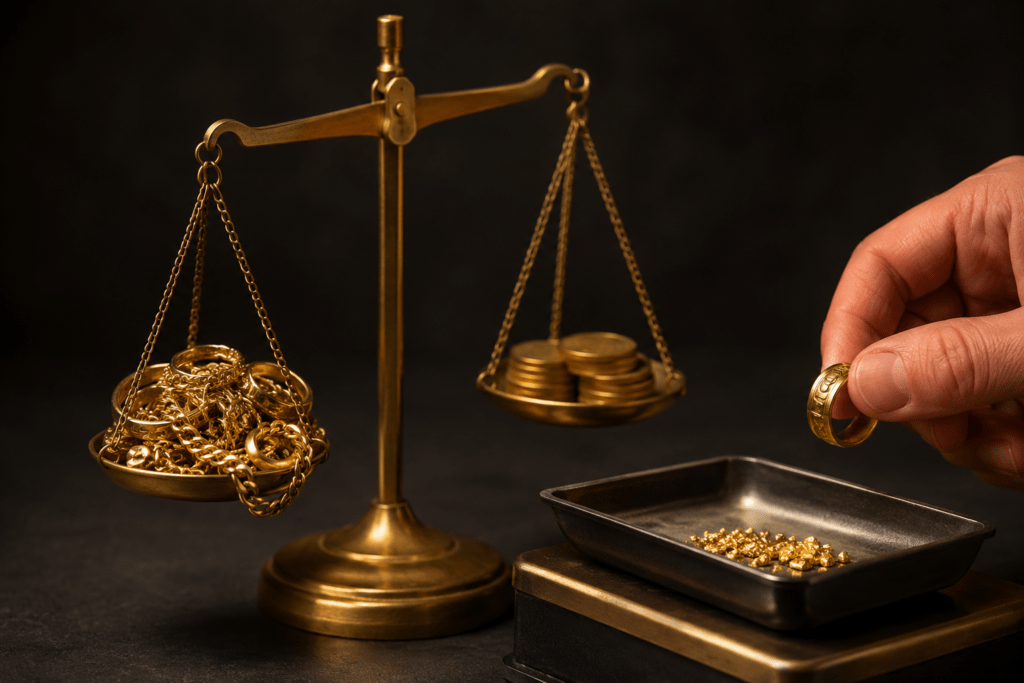
If you have checked the gold price online before selling jewelry, you may have wondered:
Why don’t gold buyers pay 100% of spot price for scrap jewelry?
The simple answer is that spot price, melt value, and the amount a gold buyer offers you are three different numbers.
The spot price represents the market value of pure gold. Most jewelry is not pure gold, and scrap jewelry must usually be tested, weighed, sorted, processed, and ultimately resold or refined before a buyer recovers its precious-metal value.
That does not mean you should accept just any offer.
Understanding how scrap gold is priced can help you compare buyers and determine whether an offer makes sense.
At Gold Kings, we believe you should understand what you own before deciding whether to sell. If you have gold jewelry you are considering selling, you can see how the Gold Kings evaluation process works or request a free gold quote.
Quick Answer: Why Gold Buyers Pay Less Than Melt Value
A professional gold buyer needs a margin between what is paid for scrap jewelry and the amount ultimately recovered from the gold.
That margin may help cover:
- Precious-metal testing
- Accurate weighing and sorting
- Refining or processing costs
- Assay and settlement charges
- Market-price fluctuations
- Shipping, security, and handling
- Employee and operating expenses
- Business profit
There is also an even more important factor:
Your jewelry’s total weight is not the same as its pure-gold weight.
For example, a 10-gram 14K gold ring does not contain 10 grams of pure gold.
14K gold is approximately 58.3% gold, so 10 grams of 14K jewelry theoretically contains about:
10 grams × 58.3% = 5.83 grams of pure gold
That difference is essential to understanding what scrap gold is worth.
Spot Price vs. Melt Value vs. Cash Offer
These three terms are often confused.
Gold Spot Price
The spot price of gold is the current market price of pure gold, generally quoted per troy ounce.
One troy ounce equals approximately 31.1035 grams.
For example, if gold were hypothetically trading at $4,000 per troy ounce:
$4,000 ÷ 31.1035 = approximately $128.60 per gram of pure gold
But 10K, 14K, 18K, and 22K jewelry are not pure gold.
You can check current precious-metal market information on the Gold Kings Gold & Silver Prices page.
Melt Value
Melt value is the theoretical precious-metal value contained in the item.
The karat tells you approximately how much of the jewelry is gold.
| Gold Purity | Approximate Gold Content |
|---|---|
| 10K | 41.7% |
| 14K | 58.3% |
| 18K | 75.0% |
| 22K | 91.7% |
| 24K | Approximately pure gold |
A 10-gram piece of 18K jewelry, for example, theoretically contains:
10 × 75% = 7.5 grams of gold
The Gold Buyer’s Offer
The offer is the amount a buyer is willing to pay for the item after accounting for its tested purity, precious-metal weight, current market value, processing costs, market risk, and required business margin.
This is why simply asking:
“What percentage of spot do you pay?”
does not always tell the whole story.
A better question is:
“What is the melt value of my gold, and how much of that value are you offering me?”
If you want help understanding those numbers, Gold Kings can test and evaluate your gold jewelry before you decide whether to sell.
Example: What Is 10 Grams of 14K Gold Worth?
Let’s use an easy hypothetical example with gold trading at $4,000 per troy ounce.
Pure gold would be worth approximately:
$128.60 per gram
Ten grams of 14K gold theoretically contains:
10 × 58.3% = 5.83 grams of gold
The approximate melt value would therefore be:
5.83 × $128.60 = about $750
If a buyer offered 80% of that theoretical melt value:
$750 × 80% = $600
The roughly $150 difference is not necessarily $150 of profit.
The buyer may still have refining, processing, labor, security, compliance, market-risk, and other expenses before recovering the value of the metal.
This is why the actual cash offer matters more than an advertising percentage by itself.
Why You Cannot Apply the Pure-Gold Price to the Total Jewelry Weight
Suppose you have a 10-gram 14K bracelet.
If pure gold is worth $128.60 per gram, it would be incorrect to multiply:
10 grams × $128.60
because the bracelet is not 10 grams of pure gold.
Only about 58.3% of standard 14K gold is gold.
The remaining portion consists primarily of alloy metals such as copper, silver, zinc, nickel, or other metals used to change the jewelry’s strength, appearance, or color.
So when someone asks:
“Gold is worth $X per gram. Why aren’t I getting $X for every gram of my jewelry?”
the answer is simple:
Because every gram of the jewelry is not gold.
A Gold Stamp Does Not Always Tell the Whole Story
A hallmark such as 10K, 14K, 18K, 585, 750, or 916 is an important clue about an item’s purity.
But a professional evaluation should not necessarily rely on the stamp alone.
Jewelry can sometimes be:
- Incorrectly marked
- Counterfeit
- Gold plated rather than solid gold
- Repaired with lower-purity solder
- Constructed from components of different metals
- Under-karat
- Missing its original hallmark
That is why professional testing can matter.
Gold Kings uses professional precious-metal testing methods, including XRF testing when appropriate, to help determine metallic composition. Testing can then be combined with accurate weighing and current market prices to determine the item’s precious-metal value.
If you are unsure whether a piece marked 10K, 14K, 18K, or another purity is genuine, Gold Kings can test your jewelry and explain what you have.
Stones and Non-Gold Parts Can Affect the Weight
The number on the scale may also include materials that are not gold.
Jewelry can contain:
- Diamonds
- Gemstones
- Springs
- Steel components
- Watch movements
- Clasps
- Pins
- Non-gold findings
- Other materials
For example, a 15-gram ring with a large gemstone should not automatically be valued as 15 grams of gold.
The gemstone and other non-gold materials may need to be accounted for when determining the actual gold weight.
However, valuable diamonds, gemstones, designer jewelry, collectible pieces, luxury watches, and certain coins may have value beyond their precious-metal content.
That is why evaluating what the item actually is can sometimes be more important than simply putting it on a scale.
Gold Kings evaluates several categories of valuables. You can see what Gold Kings buys before bringing your items in.
Refining Scrap Gold Costs Money
A broken chain or mixed collection of jewelry is different from a standardized investment-grade gold bar.
A batch of scrap jewelry may contain:
- 10K gold
- 14K gold
- 18K gold
- White gold
- Solder
- Clasps
- Stones
- Mixed-metal components
- Dental alloys
Before the gold can return to a highly refined form, the material may need to be sorted, assayed, processed, and refined.
Depending on how the buyer handles the material, additional costs can include:
- Refining charges
- Assay fees
- Shipping
- Insurance
- Settlement costs
- Security and handling
If a buyer paid the full recoverable value of the metal with no spread whatsoever, there would be nothing left to cover those costs or operate the business.
Gold Prices Can Change After the Buyer Purchases Your Jewelry
Gold prices move throughout the trading day.
A gold buyer may purchase jewelry from a customer today but not receive final payment for that metal immediately.
If gold prices decline before the material is sold or settled, the buyer can receive less than expected.
That market exposure is another reason businesses need a margin between their purchase price and the theoretical metal value.
Why Bullion May Sell Much Closer to Spot
Scrap jewelry and bullion are not the same product.
A recognized one-ounce .9999 fine gold bar has several advantages:
- Standardized weight
- Known purity
- Strong market liquidity
- Easier verification
- Little or no refining required before resale
Because of this, bullion can often trade much closer to spot price than scrap jewelry.
Depending on the specific coin or bar and current demand, some bullion products can even trade at a premium to their raw gold content.
A broken 10K chain, therefore, should not necessarily be expected to receive the same percentage of spot as a widely recognized investment-grade gold coin or bar.
Is It Unfair for a Gold Buyer to Pay Less Than 100% of Melt?
No — not automatically.
A legitimate business needs a margin.
What matters is whether the offer is clear, understandable, and competitive.
Before selling your gold, ask:
- What does my item weigh?
- What purity did it test?
- How was the purity determined?
- What gold price are you using?
- What is the approximate melt value?
- What are you offering me?
- What percentage of the metal value does that represent?
A buyer should be able to explain the calculation.
If the numbers do not make sense, you are free to decline the offer.
Small Percentage Differences Can Mean Hundreds of Dollars
The larger your gold collection, the more important payout percentage becomes.
Suppose your jewelry contains $5,000 worth of gold.
A 5-percentage-point difference equals:
$250
A 10-percentage-point difference equals:
$500
If your collection contains $10,000 worth of gold, a 10-percentage-point difference becomes:
$1,000
That is why people selling estate jewelry, inherited gold, or larger collections may benefit from getting a professional evaluation before accepting an offer.
If you have a significant amount of gold to sell, request a Gold Kings quote and compare the actual dollar amount you would receive.
How Gold Kings Evaluates Scrap Gold
Gold Kings focuses on helping customers understand the transaction.
We Test It
Your jewelry can be checked to determine whether it contains genuine precious metal and what purity it appears to be.
We Weigh It
The item is accurately weighed so you can understand how much material is being evaluated.
We Check the Market
Current precious-metal prices provide the starting point for calculating value.
We Calculate the Offer
Purity, weight, current gold prices, item type, and other relevant factors are considered.
You Decide
You receive the offer and decide whether selling makes sense for you.
You can learn more about the process by reading How Selling Your Gold Works at Gold Kings.
Have Your Gold Tested at Gold Kings
If you have broken chains, old rings, single earrings, class rings, inherited jewelry, dental gold, coins, bullion, or other precious-metal items, you do not have to calculate everything yourself.
Gold Kings can test and weigh your items and help you understand what you have before you decide whether to sell.
Gold Kings of Snellville
Customers throughout Gwinnett County can visit Gold Kings of Snellville at:
3635 Stone Mountain Hwy
Snellville, GA 30039
The Snellville location is convenient for customers coming from Snellville, Lawrenceville, Loganville, Stone Mountain, Lilburn, Grayson, and surrounding communities.
Gold Kings of Commerce
Customers in Northeast Georgia can visit Gold Kings of Commerce at:
480 Banks Crossing Dr
Commerce, GA 30529
Bring your gold, silver, jewelry, coins, bullion, watches, diamonds, and other qualifying valuables for an evaluation.
Frequently Asked Questions
Do Gold Buyers Ever Pay 100% of Spot?
It depends on the item and what someone means by “100% of spot.”
Highly liquid bullion may sometimes trade extremely close to the gold spot price. Scrap jewelry normally sells below its theoretical melt value because additional testing, processing, handling, and business costs may be involved.
How Much Pure Gold Is in 14K Jewelry?
14K gold is approximately 58.3% pure gold.
Another common hallmark is 585, which represents approximately 58.5% gold and corresponds closely to the 14K standard.
How Much Gold Is in 18K Jewelry?
18K gold is 75% gold.
Jewelry marked 750 normally indicates the same 75% gold purity.
Does a 14K Stamp Guarantee My Jewelry Is Really 14K?
No stamp should be treated as an absolute guarantee without considering the item itself.
Counterfeit markings, repairs, plating, mixed components, and purity differences can occur.
Professional testing can help determine the item’s actual composition.
Should I Choose the Gold Buyer Advertising the Highest Percentage?
Not necessarily.
Always compare the actual amount of money offered.
Ask what weight, purity, and gold price the buyer used when calculating the percentage.
A high advertised percentage means little if it is being applied to the wrong weight, purity, or market value.
Are Broken Gold Chains Worth Less?
If a chain is being purchased purely for its precious-metal content, being broken may have little effect on the underlying gold value.
However, an intact designer, collectible, antique, or desirable piece could potentially have value beyond its melt value.
Where Can I Sell Scrap Gold Near Me in Georgia?
Gold Kings buys gold and other qualifying valuables at locations in Snellville and Commerce, Georgia.
You can visit Gold Kings of Snellville, visit Gold Kings of Commerce, or request a free Gold Kings quote.
Before You Sell Gold, Understand the Numbers
A gold buyer offering less than 100% of theoretical melt value is not automatically taking advantage of the seller.
The more useful question is:
How much of my gold’s actual value am I receiving?
Before selling, understand:
The weight.
The purity.
The current gold price.
The approximate melt value.
The actual cash offer.
Then compare your options.
At Gold Kings, we can test your gold, weigh it, explain how its value is calculated, and give you an offer. The decision to sell remains yours.
If you have unwanted, broken, inherited, or outdated jewelry, find out what your gold is worth at Gold Kings.
You can also see everything Gold Kings buys before your visit.