Quick Answer: Is Dental Gold Real Gold?
Yes, dental gold can contain real gold. But a gold crown, bridge, inlay, or other dental restoration is usually not pure 24K gold.
Gold is naturally soft, so dental gold is normally mixed with other metals to make it harder and strong enough to withstand years of chewing.
Depending on the restoration, a dental alloy may contain:
- Gold
- Platinum
- Palladium
- Silver
- Copper
- Other metals
Some dental work contains a large percentage of gold. Other pieces contain considerably less. And some gold-colored dental restorations may contain little or no gold at all.
That is why appearance alone cannot tell you what dental gold is worth.
If you already have an old crown, bridge, or other dental restoration that was removed, Gold Kings can professionally test the metal and help determine what it actually contains. You can also see what Gold Kings buys before visiting.
What Is Dental Gold?
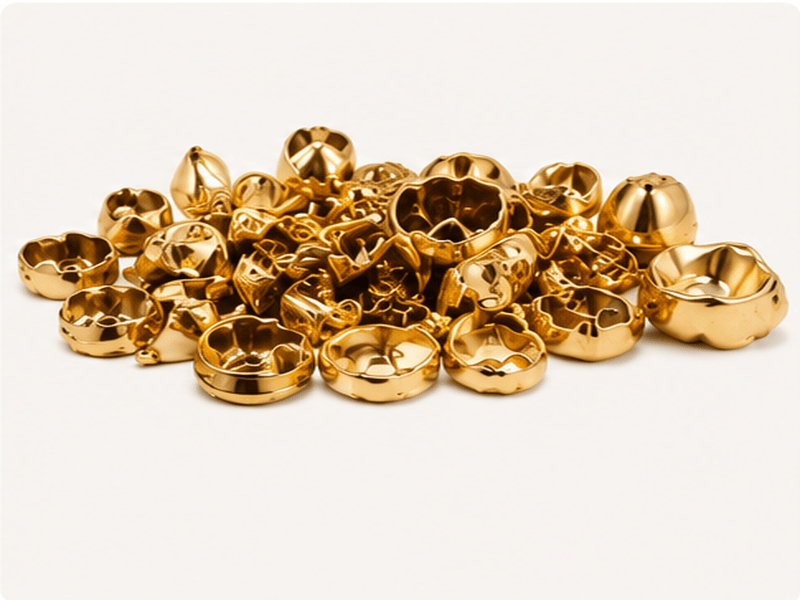
“Dental gold” is a general term used for gold-containing alloys that have been used to make dental restorations such as:
- Crowns
- Bridges
- Inlays
- Onlays
- Dental caps
- Other cast dental restorations
Pure gold is too soft for many dental applications, so gold is traditionally combined with stronger metals.
The American Dental Association explains that gold and other noble metals have a long history in dentistry. It also notes that gold is commonly combined with metals such as copper, silver, platinum, and others to improve its strength.
So when someone calls a crown a “gold crown,” it does not necessarily mean the crown is made entirely from gold.
It usually means the restoration is made from a metal alloy that may contain gold.
How Much Gold Is in a Gold Crown?
There is no single percentage that applies to every dental crown.
Dental alloys are made in many different formulations.
The ADA classifies dental alloys based on their noble-metal content:
| Dental Alloy Classification | Noble-Metal Content |
|---|---|
| High noble | At least 60% gold + platinum-group metals, with at least 40% gold |
| Noble | At least 25% gold + platinum-group metals |
| Predominantly base metal | Less than 25% noble metals |
This distinction is important.
A high-noble crown contains substantial precious metal.
A crown classified simply as a noble alloy may contain less gold and more palladium or other metals.
A base-metal crown may contain almost no gold.
Some Traditional Dental Gold Was Very High in Gold
Older dental gold can sometimes contain a surprisingly high percentage of gold.
For example, one published study of a Type III dental gold alloy measured approximately 72.4% to 75.7% gold, along with palladium, silver, copper, and zinc.
Historical dental references also describe traditional gold-based dental casting alloys containing large amounts of gold, with silver, copper, platinum, palladium, zinc, and other metals added to change strength and casting properties.
That does not mean every old gold crown is 75% gold.
It means dental gold can vary substantially, which is why professional testing is more useful than guessing.
Is Dental Gold 10K, 14K or 18K?
Dental gold normally is not evaluated the same way jewelry is.
Jewelry commonly carries familiar markings such as:
- 10K — about 41.7% gold
- 14K — about 58.3% gold
- 18K — 75% gold
- 22K — about 91.7% gold
Dental alloys are generally identified by their actual metal composition rather than relying on a jewelry-style karat stamp.
For comparison, a dental alloy that tested approximately 75% gold would contain roughly the same percentage of pure gold as 18K jewelry.
But you should not assume an old crown is 18K just because it looks like one.
Test the metal.
Can a Gold-Colored Crown Be Fake Gold?
Yes.
A yellow or gold-colored dental restoration is not proof that it contains significant gold.
Dental restorations have also been made from base-metal alloys.
One scientific reference even describes a copper-based dental alloy marketed under the name “Non Precious Gold” because of its gold-colored appearance despite having very little intrinsic precious-metal value.
That is an important lesson:
Color tells you what the metal looks like. Testing tells you what the metal actually is.
This is similar to jewelry. Gold-plated jewelry can look almost identical to solid gold until it is properly tested.
Can Dental Gold Be White or Silver-Colored?
Yes.
Not all dental gold looks yellow.
Gold may be combined with significant amounts of palladium, platinum, silver, or other metals. The final alloy can appear lighter, duller, or more silver-colored than traditional yellow gold.
Porcelain may also cover much of the metal in porcelain-fused-to-metal dental work.
So you should not throw away an old dental restoration simply because it does not look like bright yellow gold.
If you are unsure what it contains, testing is the better answer.
How Do You Test Dental Gold?
Dental gold is difficult to identify reliably by eye.
Unlike a necklace or ring, you also may not find a convenient 10K, 14K, 18K, 585, or 750 hallmark.
Professional precious-metal testing can help determine the composition of the exposed metal.
At Gold Kings, we use professional XRF testing to analyze precious metals. The item can also be weighed so its precious-metal content can be evaluated more accurately.
This can help answer the questions that actually matter:
- Does it contain real gold?
- What percentage of gold does it contain?
- Does it contain palladium or other valuable metals?
- How much metal is present?
- How much of the total weight is actually precious metal?
- What are those metals currently worth?
If you have several old dental pieces, they should not automatically be treated as though they are all the same alloy.
Testing them individually can reveal significant differences.
Is Dental Gold Worth Money?
Yes, dental gold can be worth money if it contains recoverable precious metals.
Its value usually depends on four main factors.
1. Weight
The amount of actual metal matters.
A large bridge may contain considerably more metal than a small crown or inlay.
2. Gold Purity
A piece containing 70% gold has much more gold value per gram than one containing 30% gold.
That is why simply weighing a crown does not tell you its value.
You also need to know what percentage of that weight is actually gold.
3. Other Precious Metals
Gold is not always the only valuable metal.
Dental alloys can also contain precious metals such as:
- Palladium
- Platinum
- Silver
A proper evaluation should consider the actual composition rather than looking only for gold.
4. Non-Metal Material
A dental restoration may still have:
- Porcelain
- Cement
- Tooth material
- Other non-precious components
Those materials add weight but do not add gold value.
That is one reason simply putting an entire dental crown on a scale and multiplying by the gold price can produce a misleading number.
Simple Dental Gold Value Example
Suppose the actual metal portion of a dental crown weighs 3 grams and testing shows that it contains 70% gold.
The approximate pure-gold content would be:
3 grams × 70% = 2.1 grams of gold
The crown may also contain other valuable metals.
Its final value would depend on the current market prices for those metals and the buyer’s refining and processing considerations.
This is why the best order is:
Test it → weigh it → identify the metal → calculate the value.
Does an Old Gold Crown Still Have Value?
Potentially, yes.
Age by itself does not destroy the precious-metal content.
An old crown may be:
- Scratched
- Worn
- Bent
- Broken
- Covered with porcelain
- No longer usable as dental work
Yet the precious metal inside may still have value.
Unlike collectible jewelry, dental gold usually does not need to look attractive to retain its underlying metal value.
If the restoration contains real gold or other valuable precious metals, those metals can still be valuable as scrap.
Can You Sell Dental Gold?
Yes.
Removed dental gold can be sold as precious-metal scrap.
Gold Kings specifically evaluates dental gold along with scrap gold, jewelry, coins, bullion, silver, watches, and other precious-metal items.
A single crown may be worth evaluating, but several crowns, bridges, or other pieces can add up to considerably more metal.
This is especially worth remembering when going through:
- An estate
- Inherited belongings
- Old jewelry boxes
- Family keepsakes
- Removed dental work that has been stored for years
What looks like a small piece of metal could contain real gold.
Where Can I Sell Dental Gold Near Me?
If you are searching for a gold buyer near me, sell gold near me, or a place that buys scrap gold, look for someone who will explain how your dental gold is being evaluated.
You should be able to understand:
- What the item tested
- Its approximate precious-metal composition
- Its weight
- Which portions are non-precious material
- The market price being used
- How the offer was calculated
Gold Kings uses professional testing and transparent weighing to help customers understand what they have before deciding whether to sell.
You can review the Gold Kings frequently asked questions or request a Gold Kings quote before visiting.
Have Your Dental Gold Tested at Gold Kings
If you have an old crown, bridge, inlay, or other removed dental restoration and do not know whether it contains real gold, you do not have to guess.
Gold Kings can evaluate the precious-metal content and explain what the testing shows.
Gold Kings of Snellville
3635 Stone Mountain Hwy
Snellville, GA 30039
770-771-4650
The Snellville location serves customers throughout Gwinnett County and surrounding communities and evaluates dental gold along with jewelry, scrap gold, coins, bullion, silver, watches, and other qualifying precious-metal items.
Gold Kings of Commerce
Gold Kings Commerce location and quote information
480 Banks Crossing Dr
Commerce, GA 30529
706-336-0043
The Commerce location is convenient for customers throughout Commerce, Banks Crossing, Banks County, Jackson County, and surrounding Northeast Georgia communities. Gold Kings’ current location information lists both Commerce and Snellville as physical locations.
No jewelry-style hallmark is required to find out what dental metal contains.
Have it tested first.
Frequently Asked Questions About Dental Gold
Is dental gold pure gold?
Usually not.
Dental gold is normally an alloy containing gold along with other metals that improve strength and durability.
Pure 24K gold is very soft, which is one reason gold used for dental restorations is commonly alloyed with stronger metals.
Are all gold crowns made from real gold?
No.
Some crowns contain substantial amounts of gold. Others use lower-gold noble alloys, palladium-based alloys, or predominantly base-metal alloys.
Gold color alone does not prove gold content.
How much gold is usually in a dental crown?
There is no universal percentage.
The ADA’s classifications range from high-noble alloys containing at least 40% gold to noble and predominantly base-metal alloys with much lower precious-metal content.
Older traditional dental gold alloys can sometimes contain much higher percentages.
Is a gold crown 18K gold?
Sometimes a dental alloy may contain a percentage of gold similar to 18K jewelry, but dental restorations should not automatically be classified as 18K.
Testing the actual metal composition is more reliable.
Can dental gold contain platinum or palladium?
Yes.
Platinum and palladium are among the noble metals used in dental alloys. Depending on the alloy, these metals may contribute additional precious-metal value.
Is white dental metal valuable?
Possibly.
Color does not reliably identify metal content.
A white or silver-colored restoration could contain palladium or other valuable metals—or it could be primarily base metal.
Testing is necessary to know.
Is porcelain on a gold crown worth money?
The porcelain itself does not have gold melt value.
A buyer is primarily interested in the valuable metal underneath it.
This is why the total weight of a porcelain-covered crown cannot simply be treated as gold weight.
Can I sell one dental crown?
Yes, a single already-removed crown containing precious metal can have value.
If you have several crowns, bridges, or other pieces, bring them together so each can be evaluated.
Where can I sell dental gold in Georgia?
Gold Kings evaluates dental gold and other precious metals at its physical locations in Snellville and Commerce, Georgia.
You can also review what Gold Kings buys before making the trip.
Don’t Guess What Your Dental Gold Is Worth
That small crown sitting in an envelope or jewelry box may contain real gold.
Or it may contain another valuable dental alloy.
The only reliable way to know is to determine what the metal actually contains and how much of it you have.
Gold Kings can professionally test and weigh removed dental gold at our Snellville and Commerce, Georgia locations, explain the results, and give you an offer if you decide you want to sell.
There is no need to assume a yellow crown is valuable—or throw away a silver-colored one because it does not look like gold.
Find out what you actually have first.
Visit Gold Kings of Snellville, see the Commerce location information, or review everything Gold Kings buys.
We test it. We weigh it. We explain what you have. Then you decide whether to sell.