
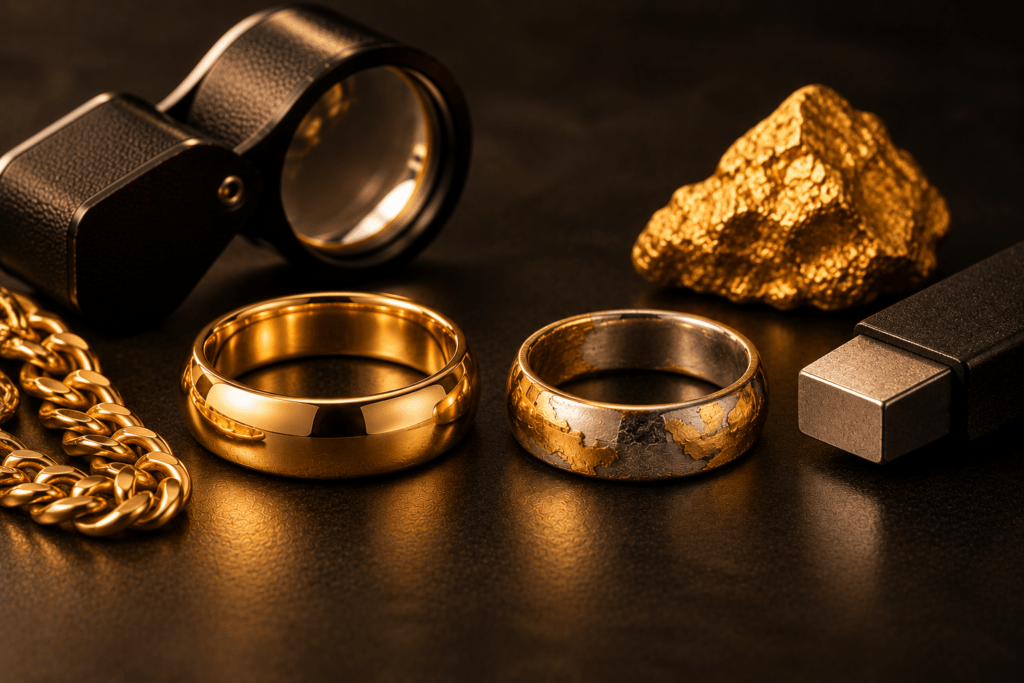
Gold can be valuable, easy to carry, and difficult for an inexperienced buyer to authenticate. Those qualities also make it an attractive target for counterfeiters and scammers.
Fake gold is not always an obviously cheap chain that sticks to a magnet. Some counterfeit items have convincing hallmarks, realistic weight, professional-looking packaging, or a genuine layer of gold covering another metal.
The safest rule is simple:
Never assume an item is real gold because of its color, stamp, packaging, or the seller’s story.
At Gold Kings, we evaluate gold jewelry and other precious-metal items that people may not be able to identify themselves. Professional testing can often tell you much more than appearance alone.
If you are unsure about an item, you can also review our guide on how to tell if gold is real before buying or selling it.
Quick Answer: What Are the Most Common Fake Gold Scams?
Some of the most common fake-gold schemes involve:
- Fake 10K, 14K, 18K, 22K or 24K stamps
- Gold-plated jewelry sold as solid gold
- Gold-filled or gold-clad items misrepresented as solid gold
- Heavy plating intended to fool simple testing
- Counterfeit gold bars
- Counterfeit gold coins
- Fake designer jewelry
- Fake certificates, assay cards and packaging
- Extremely cheap “gold” offered through private or street transactions
- Jewelry made from several metals but represented as entirely gold
The good news is that most of these scams become much harder to pull off when the item is properly examined, weighed and tested.
1. The Fake Karat Stamp Scam
One of the easiest mistakes to make is believing a stamp automatically proves that jewelry is real.
Common legitimate gold markings include:
- 10K
- 14K
- 18K
- 22K
- 24K
- 417
- 585
- 750
- 916
- 999
Unfortunately, a stamp can be copied.
A counterfeit piece of jewelry can be stamped 14K, 18K, 750, or even 999 without containing the amount of gold that the mark claims.
That is why a hallmark should be treated as a clue—not proof.
Even genuine jewelry can also test differently from its stamp because it may have been repaired, soldered, altered, plated or made with components of different metals.
How to protect yourself
Look at the hallmark, but do not stop there.
If meaningful money is involved, have the metal tested.
Gold Kings uses professional testing methods, including XRF testing where appropriate, to help determine the metal composition of jewelry. You can learn more in our Gold Testing & Authenticity guides.
2. Gold-Plated Jewelry Sold as Solid Gold
This is probably one of the most familiar forms of fake gold.
Gold-plated jewelry contains a thin exterior layer of real gold over another metal.
The item may look excellent when it is new. It may even have the same bright yellow appearance as solid gold.
But its precious-metal value can be dramatically different.
For example, a large chain that appears to contain several ounces of gold may actually contain only a very small amount of gold on its surface.
Warning signs can include:
- Discoloration around worn areas
- A different metal showing at scratches
- Uneven color near clasps
- Green or dark areas
- An unusually low selling price
- Marks indicating plating rather than solid gold
However, appearance alone cannot always settle the question.
A well-made plated item can look very convincing.
Don’t confuse “real gold plating” with solid gold
The gold coating itself may genuinely be gold.
That does not make the entire object solid gold.
This distinction is extremely important when buying jewelry based on weight.
A 50-gram solid 18K chain and a 50-gram gold-plated chain may look similar but have completely different precious-metal values.
3. Gold-Filled or Gold-Clad Sold as Solid Gold
Gold-filled jewelry is different from ordinary electroplating.
It generally contains a thicker bonded layer of gold over a base-metal core. That can make gold-filled jewelry durable and attractive.
But it is still not the same thing as solid 10K, 14K or 18K gold.
The same problem occurs with products described as:
- Gold filled
- Gold clad
- Gold bonded
- Heavy gold electroplate
- Rolled gold plate
- Gold overlay
These descriptions do not automatically mean someone is running a scam. They describe legitimate types of products when labeled accurately.
The scam occurs when someone represents the item as solid gold or prices it as though the entire weight were gold.
If you want a deeper explanation, see our guide to gold-filled vs. solid gold.
4. Heavy Plating That Can Fool Simple Tests
This is where fake gold becomes more sophisticated.
Many people assume that one successful test proves an item is genuine.
It does not.
A magnet test, scratch test, acid test, electronic test or XRF reading can provide useful information, but every testing method has limitations.
XRF is especially useful because it can quickly identify metals in the area being tested without damaging the item. However, XRF primarily measures the surface layer.
The London Bullion Market Association specifically notes that XRF is a surface-analysis technique and that plating can potentially mislead a surface reading.
That matters more with sophisticated counterfeit bullion than with ordinary jewelry.
The lesson
Do not rely on one test when the value or risk justifies additional verification.
Professional evaluation may consider several factors together, including:
- Surface composition
- Weight
- Dimensions
- Construction
- Density
- Hallmarks
- Wear patterns
- Magnetic response
- Known specifications
- Additional testing when necessary
No single home test should be treated as absolute proof that an expensive gold item is genuine.
5. Counterfeit Gold Bars
Fake gold bars deserve special attention because a single bar can represent thousands of dollars.
A counterfeit bar may involve:
- Gold plating over another metal
- A foreign-metal core
- Fake refinery branding
- Counterfeit serial numbers
- Fake assay packaging
- Incorrect dimensions
- Incorrect weight
- Altered genuine packaging
One particularly concerning technique is using a dense substitute inside a bar.
Tungsten receives attention because its density is unusually close to gold’s. The LBMA has documented the use of ultrasound for detecting foreign material and tungsten-related concerns in bullion authentication.
Why the exterior can be misleading
A sophisticated fake may have a genuine gold surface.
That means the bar can:
- Look correct
- Feel heavy
- Show gold on a surface test
- Carry convincing markings
Yet still contain something different internally.
How to avoid a counterfeit gold bar
Before paying substantial money for bullion:
- Know exactly who you are buying from.
- Compare the weight with the manufacturer’s specification.
- Check dimensions.
- Inspect markings and serial numbers.
- Examine the packaging.
- Be suspicious of damaged or resealed assay cards.
- Do not let a low price pressure you into skipping authentication.
- Use additional professional testing when the circumstances justify it.
The larger the transaction, the less sense it makes to rely solely on appearance.
6. Counterfeit Gold Coins
Gold coins can also be counterfeited.
The scammer may copy:
- The design
- Date
- Mint mark
- Edge
- Lettering
- Diameter
- Color
- Packaging
Some fakes are easy to identify.
Others can be much more convincing.
The U.S. Mint advises bullion buyers to research the dealer, use caution with classified ads and online sources, and compare a coin’s weight, diameter and identifying features with official specifications.
The Mint also warns that some replicas can be difficult for consumers to distinguish from genuine coins.
A coin can have two different types of value
Remember that authentication is only the first question.
A genuine gold coin may be worth:
Gold value + possible numismatic or collector premium
That is why you should not automatically treat every gold coin as scrap.
Gold Kings evaluates both gold coins and gold bullion, allowing the item to be examined before you decide what to do with it.
7. Fake Designer Gold Jewelry
A designer name can make a counterfeit more profitable.
Instead of simply producing a fake gold bracelet, a counterfeiter may add markings associated with a luxury jewelry brand.
The buyer then believes they are purchasing both:
- Real precious metal
- A valuable designer item
Both claims may be false.
Look for:
- Incorrect logo spacing
- Poor engraving
- Unusual fonts
- Low-quality clasps
- Rough finishing
- Incorrect weight
- Missing serial numbers
- Packaging that doesn’t match the item
- A price far below the normal market
But again, a convincing logo is not proof of metal content.
The jewelry itself should be evaluated separately from the brand name.
8. Fake Assay Cards, Certificates and Packaging
Packaging creates trust.
Scammers know that.
A sealed-looking card with a refinery logo, serial number and words such as 999.9 FINE GOLD can make an item appear legitimate before the buyer has even examined the metal.
But packaging can also be counterfeited.
Do not make the mistake of thinking:
“It’s sealed, so it must be real.”
Treat the packaging as supporting information—not independent proof of authenticity.
For a high-value purchase, authenticate the metal, not just the plastic surrounding it.
9. The “Emergency Gold Sale” Scam
Another version of the scam relies less on technology and more on pressure.
Someone offers jewelry for sale and gives you a story:
- They need gas money.
- They lost their wallet.
- They need money immediately.
- They are traveling.
- They have an emergency.
- The jewelry is worth thousands, but they will take a few hundred dollars.
The seller may show you a heavy yellow chain or ring stamped 18K or 22K.
The offer appears irresistible.
That is exactly the point.
The biggest warning sign is urgency
A legitimate piece of valuable gold does not suddenly become worth a tiny fraction of its precious-metal value simply because the owner needs cash quickly.
When someone is willing to sell supposedly valuable gold far below its obvious melt value to a stranger, slow down.
Do not allow an emotional story to replace authentication.
10. The “Too Cheap to Be Real” Online Gold Deal
Online marketplaces make it possible to buy jewelry and bullion from people hundreds or thousands of miles away.
They also make it easier to sell counterfeit items.
Be especially careful when the seller:
- Has little selling history
- Uses stock photographs
- Refuses additional photos
- Will not show weight
- Avoids showing hallmarks
- Wants payment outside the platform
- Pressures you to buy immediately
- Offers gold dramatically below its metal value
Gold trades in a global market.
That makes genuine bullion surprisingly difficult to sell at a huge discount without a reason.
If someone supposedly has $3,000 of easily marketable gold but urgently wants $1,000 from you, your first question should be why?
Does a Magnet Test Prove Gold Is Real?
No.
Gold itself is not strongly attracted to a normal magnet, so a magnet can help identify certain obvious fakes.
But many non-gold metals are also nonmagnetic.
Therefore:
Sticks strongly to a magnet → suspicious.
Doesn’t stick to a magnet → still not proof of gold.
Gold Kings has a detailed explanation of this in our guide to the magnet test for gold.
Does an 18K or 14K Stamp Prove Gold Is Real?
No.
A stamp is useful evidence, but it can be:
- Counterfeit
- Incorrect
- Applied to plated jewelry
- Left over from a genuine component
- Inconsistent with repaired sections of a piece
This is why we separate two questions:
What does the stamp say?
and
What does the metal actually test?
Those answers are not always identical.
Can Fake Gold Pass an Acid Test?
Some counterfeit items can produce confusing results, particularly when an exterior layer is genuine gold.
Acid testing is useful, but proper technique matters.
Testing a superficial area without getting through plating may tell you more about the coating than the metal underneath.
This is another reason professional evaluation is valuable when significant money is involved.
Can Fake Gold Pass an XRF Test?
A surface-plated item can potentially produce a gold-rich XRF reading because XRF analyzes the outer surface rather than the entire interior of an object. The LBMA specifically cautions against treating surface XRF alone as proof of the fineness of a non-homogeneous item.
That does not make XRF ineffective.
It makes understanding the tool important.
For ordinary jewelry evaluation, XRF is an extremely useful way to analyze metal composition without damaging the item.
For high-value bullion where an internal substitution is suspected, additional authentication methods may be appropriate.
That distinction is important.
7 Rules That Can Help You Avoid Fake Gold
Before buying an expensive gold item, remember these seven rules.
1. Never trust a stamp by itself
A 14K, 18K, 750, 916 or 999 stamp can be copied.
2. Know what the item should weigh
This is especially important for bullion coins and bars.
3. Be suspicious of huge discounts
Gold has an easily tracked worldwide market value.
4. Inspect more than the surface
Plating can hide another metal underneath.
5. Buy expensive bullion from sources you can identify
Know who is standing behind the transaction.
6. Do not let urgency control the purchase
Scammers frequently need you to make a decision before you can investigate.
7. When enough money is involved, pay for certainty
Professional authentication can be much cheaper than buying a convincing fake.
Buying Gold? Separate the Story From the Metal
One of the most useful habits you can develop is separating what the seller says from what you can verify.
The seller may say:
“It’s 18K.”
The test should determine whether that is true.
They may say:
“This is a one-ounce gold bar.”
The weight and authentication should support that statement.
They may say:
“This belonged to my grandfather.”
That may be completely true—but it says nothing about the gold content.
They may say:
“I paid $5,000 for it.”
That also does not determine what the item contains today.
Evaluate the item, not the story.
Selling Gold? Testing Protects You Too
Fake-gold awareness is not just for buyers.
It also matters when you are selling jewelry you already own.
You may have inherited jewelry, found an old chain in a jewelry box, purchased something years ago, or received an item as a gift.
You might genuinely have no idea whether it is:
- 10K
- 14K
- 18K
- 22K
- Gold filled
- Gold plated
- Costume jewelry
- Something more valuable than you expected
That is normal.
You do not have to authenticate everything yourself before visiting a buyer.
Gold Kings can test and weigh qualifying items so you can better understand what you own before deciding whether you want to sell.
You can also see the full list of items Gold Kings buys.
Have Your Gold Tested at Gold Kings
If you have jewelry, coins or bullion and are unsure whether it is real, professional evaluation can remove much of the guesswork.
At Gold Kings, customers can watch their precious metals being tested and weighed, and the results can be explained before they decide whether to sell. Our current location pages confirm XRF testing and transparent weighing as part of the evaluation process.
Gold Kings of Snellville
3635 Stone Mountain Hwy
Snellville, GA 30039
770-771-4650
The Snellville location serves customers throughout Gwinnett County and surrounding communities.
Learn more about Gold Kings of Snellville.
Bring in gold jewelry, broken chains, rings, coins, bullion, silver or other qualifying precious-metal items if you want to understand what you actually have before selling.
Gold Kings of Commerce
480 Banks Crossing Dr
Commerce, GA 30529
706-336-0043
The Commerce location serves Commerce, Banks Crossing and surrounding Northeast Georgia communities.
Learn more about Gold Kings of Commerce.
Both locations can evaluate precious-metal items without requiring you to guess the purity from the color or stamp alone.
Frequently Asked Questions About Fake Gold
What is the easiest way to tell if gold is fake?
There is no single home test that identifies every fake.
Checking the hallmark, magnet response, weight, color and wear can help identify obvious problems, but professional testing is preferable for valuable items.
Does fake gold have 14K stamped on it?
It can.
A 14K stamp does not guarantee that an item contains 14-karat gold.
Does fake gold turn green?
Some base-metal jewelry can cause discoloration or develop greenish areas, but the absence of discoloration does not prove that an item is gold.
Can real gold be plated?
Yes.
An item can have genuine gold plating over a non-gold core. The surface is technically real gold while the object itself is not solid gold.
Is gold-filled jewelry fake?
No—not when it is accurately represented as gold filled.
Gold-filled is a legitimate jewelry construction.
It becomes misleading when someone sells it as though the entire item were solid gold.
Can a fake gold bar weigh the correct amount?
Potentially.
Sophisticated counterfeiters can select materials and dimensions intended to approximate the weight of genuine bullion. That is why weight should be considered alongside other authentication methods.
Are gold coins commonly copied?
Counterfeit and replica coins do exist. The U.S. Mint warns that some replicas can be difficult for consumers to distinguish from genuine coins and recommends checking specifications and buying carefully.
Should I test gold before selling it?
You do not necessarily need to test it yourself.
A reputable buyer should be able to explain how the item is tested, what purity it shows, what it weighs and how those factors affect its value.
Don’t Guess About Gold—Verify It
The best fake gold can fool your eyes.
It can have the right color.
It can carry the right stamp.
It can arrive in professional packaging.
It can even contain real gold on the surface.
That is why the most important lesson is not memorizing every possible counterfeit.
It is learning when not to guess.
If you already own jewelry, coins, bullion or other precious-metal items and are unsure what they are, Gold Kings can help you determine what you actually have.
Visit Gold Kings of Snellville or Gold Kings of Commerce for professional evaluation and transparent testing.
We test it. We weigh it. We explain what you have—then you decide what to do with it.