
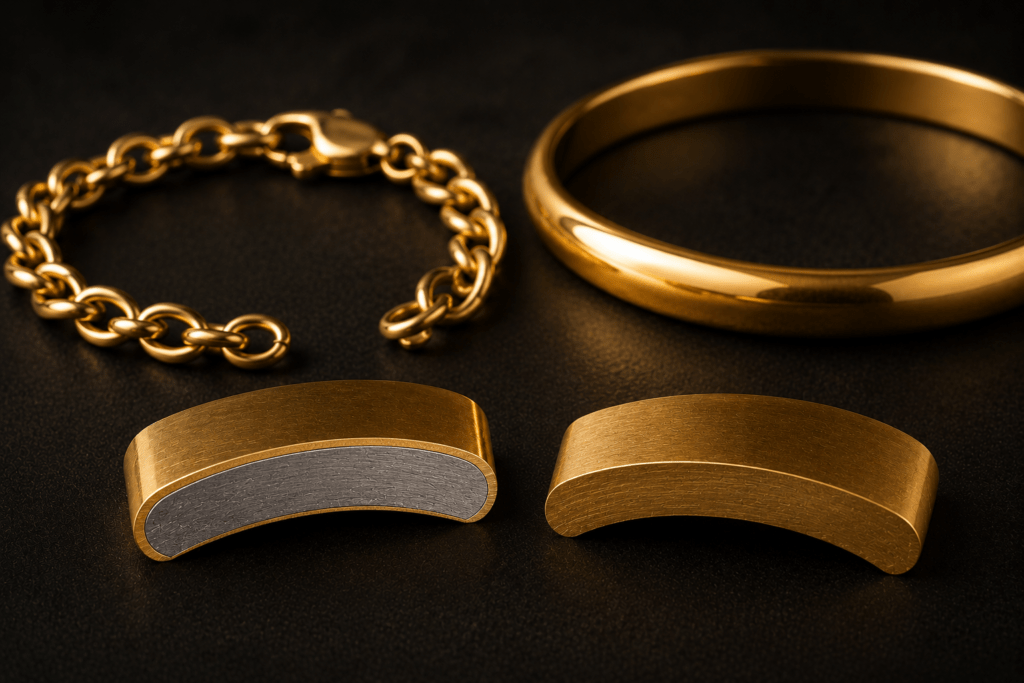
Two gold chains can look almost identical and still have very different values.
One may be solid 14K gold worth hundreds or even thousands of dollars. The other may be gold filled, with most of its weight coming from a less valuable base metal.
So what is the difference between gold filled vs solid gold?
The simple answer is this:
Solid gold jewelry is made from a gold alloy throughout the piece. Gold-filled jewelry has a layer of real karat gold bonded over a base metal.
Gold filled contains real gold, but it is not the same as solid gold.
Gold Filled vs. Solid Gold at a Glance
| Solid Gold | Gold Filled | Gold Plated | |
| Gold throughout the item? | Yes | No | No |
| Contains real gold? | Yes | Yes, on the exterior | Yes, on the exterior |
| Typical markings | 10K, 14K, 18K, 585, 750 | 1/20 14K GF, 14K GF | GP, GEP, HGE |
| Base metal inside? | No | Yes | Yes |
| Gold content | High | Much lower | Very low |
| Durability | Excellent | Good | Usually lower |
| Scrap gold value | High | Limited | Usually very little |
| Best for long-term value | Yes | No | No |
What Is Solid Gold?
Solid gold jewelry is made from a gold alloy throughout the metal, rather than having gold applied only to the outside.
But solid gold does not necessarily mean pure gold.
For example:
10K gold is about 41.7% pure gold.
14K gold is about 58.3% pure gold.
18K gold is 75% pure gold.
22K gold is about 91.7% pure gold.
24K gold is essentially pure gold.
That means the answer to another common question — “Is 14K solid gold real gold?” — is absolutely yes.
14K jewelry contains real gold mixed with other metals that make the jewelry harder and more durable.
The FTC also distinguishes truly solid jewelry from hollow gold construction. A gold item may still be genuine karat gold while being hollow, but it should not be represented as “solid gold” if it has a hollow center.
What Is Gold Filled?
The name can be confusing.
Gold-filled jewelry isn’t a hollow piece that has been “filled” with gold.
It is almost the opposite.
The center is normally a base metal, such as brass, and a layer of real gold alloy is mechanically bonded to the outside.
Under federal jewelry guidance, jewelry represented as Gold Filled has a mechanically applied gold-alloy layer with specific requirements for durability and gold content.
For the Gold Filled designation, the gold-alloy portion can represent at least 1/20 of the metal weight of the item.
That makes gold filled substantially different from ordinary gold plating.
What Does 1/20 14K GF Mean?
This is one of the most common gold-filled markings.
Suppose you see:
1/20 14K GF
Here’s what it means.
The 14K tells you that the outer gold alloy is 14-karat gold.
The GF means Gold Filled.
The 1/20 means the gold-alloy layer represents at least one twentieth, or 5%, of the applicable metal weight.
But there is an important detail.
It does not mean the entire piece is 5% pure gold.
Since 14K itself is only about 58.3% pure gold, a 1/20 14K gold-filled item has a fine-gold equivalent of roughly 2.9% of its metal weight at that minimum ratio.
That is dramatically less gold than a solid 14K piece.
Is Gold Filled Real Gold?
Gold-filled jewelry contains real gold.
But it is not solid gold.
The outside layer is made from a genuine gold alloy, while the majority of the item is normally made from another metal.
This is similar to asking whether gold-plated jewelry contains real gold.
Technically, it can.
The important question is how much gold is actually there?
That difference becomes extremely important when you are trying to determine what jewelry is worth.
Gold Filled vs. Gold Plated
Gold filled and gold plated are also frequently confused.
Both have gold on the outside and another metal underneath.
The difference is primarily the amount of gold and the way it is applied.
Gold-filled jewelry normally has a substantially heavier mechanically bonded layer of gold than ordinary electroplated jewelry.
Gold plating can be extremely thin.
That means gold-filled jewelry generally lasts longer before the underlying metal begins showing through.
But neither should be valued as though the entire item’s weight were gold.
A 20-gram solid 14K chain and a 20-gram 14K gold-filled chain are not remotely equal in gold value.
How Can You Tell If Jewelry Is Solid Gold or Gold Filled?
Start with the markings.
| Marking | What It Usually Indicates |
| 10K or 417 | 10-karat gold |
| 14K or 585 | 14-karat gold |
| 18K or 750 | 18-karat gold |
| 22K or 916 | 22-karat gold |
| 24K or 999 | Very high-purity gold |
| 1/20 14K GF | 14K gold-filled |
| 14K GF | Gold-filled using 14K gold alloy |
| 12K GF | Gold-filled using 12K gold alloy |
| GP | Gold plate |
| GEP | Gold electroplate |
| HGE | Heavy gold electroplate |
| RGP | Rolled gold plate |
The letters after the karat mark matter.
For example:
14K and 14K GF do not mean the same thing.
A piece marked 14K is represented as 14-karat gold alloy.
A piece marked 14K GF is represented as gold filled with a 14K gold-alloy exterior.
But Don’t Trust a Stamp Alone
A stamp is an important clue, but it is not proof that a piece is genuine.
Jewelry can be incorrectly marked, altered or even intentionally stamped with a fake karat mark.
That’s why professional testing matters.
If you’re trying to determine whether something is real gold, see our guide: How to Tell If Gold Is Real With Five Simple Gold Tests.
You can also learn more about common stamps in our Guide to Reading Jewelry Hallmarks.
Can Gold-Filled Jewelry Fool a Gold Test?
Sometimes.
This is one reason testing plated and gold-filled jewelry requires experience.
A surface test may encounter the real gold layer first.
Even electronic or X-ray testing methods primarily analyze the area being tested. If the tester does not recognize that an item may be plated or gold filled, the surface can produce a misleading impression about what is underneath.
A professional evaluation may therefore involve examining markings, testing multiple locations and, when appropriate, exposing a tiny area beneath the surface layer.
The goal is to determine whether the entire piece is gold alloy or only the exterior.
Does Gold Filled Tarnish?
Gold-filled jewelry is generally more resistant to wear than inexpensive gold-plated jewelry.
But it isn’t indestructible.
Over time, friction, chemicals, perspiration and repeated polishing can wear through the outer gold layer.
Once enough of that layer is removed, the underlying base metal may become visible.
Solid gold does not have this problem because the gold alloy continues throughout the piece.
Scratching a solid 14K item still exposes 14K gold alloy underneath.
Scratching deeply through a gold-filled item can eventually expose the base metal.
Is Gold-Filled Jewelry Worth Anything?
Yes, but usually far less than solid gold jewelry of the same weight.
Gold-filled jewelry does contain recoverable gold.
However, most of the item’s total weight is base metal.
The refining process can also be more complicated than refining ordinary solid-karat scrap jewelry.
Because of that, buyers and refiners may calculate gold-filled jewelry differently, and some may not purchase small quantities at all.
Vintage, designer or collectible gold-filled jewelry may also have value beyond its gold content.
So don’t assume that scrap value is automatically the best value for every piece.
Which Is Better: Gold Filled or Solid Gold?
It depends on what you want.
If you’re buying jewelry primarily for appearance at a lower price, quality gold-filled jewelry can be a reasonable choice.
If you want jewelry that can last for generations and retain meaningful precious-metal value, solid karat gold is usually the better choice.
The higher upfront price reflects the fact that you’re actually buying much more gold.
What If My Jewelry Says 14K?
Look closely.
There is a major difference between:
14K
and
14K GF
There is also a difference between:
14K
and
14K GP
Those extra letters can completely change the amount of gold in the item and therefore its value.
This is why jewelry markings should always be read carefully before assuming something is solid gold.
Want to Know What Your Gold Jewelry Really Is?
If you have old chains, rings, bracelets, earrings or other jewelry and aren’t sure whether they are solid gold, gold filled or gold plated, don’t guess based on color alone.
Gold Kings can help determine what you actually have before you decide whether to sell it.
Visit Gold Kings of Snellville or our Commerce location with your jewelry.
We test it. We weigh it. We pay you.
Frequently Asked Questions
Is gold filled the same as solid gold?
No. Solid gold jewelry is made from gold alloy throughout the piece. Gold-filled jewelry has a real gold-alloy layer over a base-metal interior.
Is 14K gold real gold?
Yes. 14K gold is genuine gold alloy containing approximately 58.3% pure gold.
Is 14K GF real gold?
The exterior gold layer is genuine 14K gold alloy, but the entire piece is not 14K gold. Most of the item’s weight is normally base metal.
What does 1/20 14K GF mean?
It identifies a gold-filled item whose gold-alloy layer is 14K and represents at least 1/20 of the applicable metal weight. At that minimum ratio, the fine-gold equivalent is roughly 2.9% of the metal weight.
Is gold filled better than gold plated?
Generally, yes, if durability is the goal. Gold-filled jewelry usually contains substantially more gold than ordinary gold-plated jewelry and typically takes longer to wear through.
Can you sell gold-filled jewelry?
Sometimes. Gold-filled jewelry contains recoverable gold, but its precious-metal value is much lower than solid gold of the same weight. Buyer and refinery policies vary.
How do I know if my jewelry is solid gold?
Check the markings first, but don’t rely on them alone. Professional testing can determine whether the piece is gold alloy throughout or has only a gold surface layer.
Does a 14K stamp guarantee that jewelry is real?
No. A stamp is evidence, not absolute proof. Incorrect and counterfeit markings exist, which is why testing is important when value matters.