
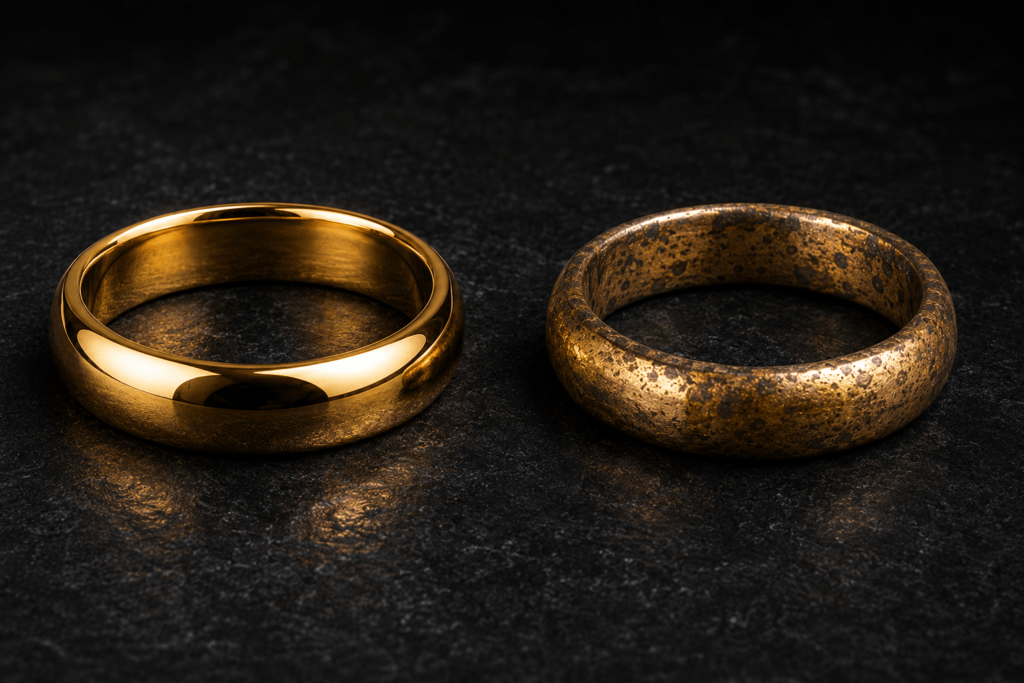
If your gold ring, chain, bracelet, or earrings have started looking dull, dark, or slightly discolored, you may be wondering:
Does real gold tarnish?
The answer is yes—but with an important distinction.
Pure 24K gold is extremely resistant to tarnish. But most real gold jewelry is not pure gold. Jewelry made from 10K, 14K, 18K, or 22K gold contains other metals that can react with air, moisture, sweat, and chemicals.
That means real gold jewelry can sometimes tarnish or change color without being fake.
At Gold Kings, we do not determine whether jewelry is real simply by looking at its color. Gold purity, markings, construction, weight, and professional testing can provide much better answers.
Quick Answer: Does Real Gold Tarnish?
Pure 24K gold normally does not tarnish because gold is highly resistant to chemical reaction.
However, most real gold jewelry contains other metals.
For example:
| Gold Purity | Approx. Gold Content | Tarnish Potential |
|---|---|---|
| 24K | 99.9%+ | Extremely low |
| 22K | 91.7% | Very low |
| 18K | 75% | Low |
| 14K | 58.3% | Possible |
| 10K | 41.7% | More likely |
The lower the karat, the more non-gold metal is present.
Those additional metals—not usually the gold itself—are what can cause tarnish and discoloration.
Why Doesn’t Pure Gold Tarnish?
Gold is what chemists call a noble metal.
It is unusually resistant to reactions with oxygen, water, and many common chemicals.
The Royal Society of Chemistry’s reference on gold describes gold as chemically unreactive and notes that it is widely used in jewelry both in pure form and as an alloy.
This chemical stability is one reason gold has been valued for thousands of years.
A piece of pure gold can remain recognizable for an extremely long time without rusting the way iron does or developing the heavy tarnish commonly associated with silver.
But Even High-Purity Gold Can Occasionally Develop Spots
There is an interesting exception.
Researchers at GIA have studied tarnish spots appearing even on jewelry testing above 99.9% gold. Their analysis linked the discoloration to trace contaminants such as silver and sulfur rather than oxidation of the gold itself.
So the most accurate statement is:
Pure gold itself is highly resistant to tarnish, but contamination or other metals associated with the jewelry can sometimes create surface discoloration.
Why Can Real Gold Jewelry Tarnish?
Most jewelry is made from a gold alloy.
An alloy combines gold with other metals to change its:
- Strength
- Hardness
- Color
- Durability
- Cost
- Workability
Common metals mixed with gold include:
- Copper
- Silver
- Zinc
- Nickel
- Palladium
These metals are much more chemically reactive than gold.
If they react with moisture, oxygen, sulfur compounds, perspiration, or chemicals, the surface of the jewelry may become darker or duller.
The jewelry can still contain exactly the amount of gold its karat indicates.
Does 14K Gold Tarnish?
Yes, 14K gold can tarnish.
14-karat gold contains approximately:
58.3% gold + 41.7% other metals
Those other metals give 14K jewelry much of its strength, but they also make surface discoloration possible.
You may notice:
- Slight dulling
- Dark areas
- Brownish discoloration
- Discoloration around the inside of a ring
- Changes around solder joints or repaired areas
Tarnishing does not automatically mean your 14K jewelry is fake.
If you are unsure whether a piece marked 14K is genuine, read our guide explaining whether real gold has to be stamped.
Does 18K Gold Tarnish?
18K gold can tarnish, but it is generally less susceptible than 10K or 14K gold.
18K contains:
75% gold + 25% other metals
Because a larger percentage of the alloy is gold, there is less reactive metal available to cause discoloration.
A quality 18K yellow-gold piece may maintain its appearance for many years with normal care.
Still, its exact behavior depends on the particular alloy, how it is worn, and what chemicals it encounters.
Does 10K Gold Tarnish?
Yes. Of the common U.S. solid-gold jewelry purities, 10K has the greatest potential for tarnishing.
10K gold is approximately:
41.7% gold + 58.3% other metals
In other words, more than half of the alloy consists of metals other than gold.
That does not make 10K fake.
10K is real karat gold.
It simply contains a larger proportion of metals that can react with the surrounding environment.
Does 22K Gold Tarnish?
22K gold contains approximately 91.7% gold, leaving only about 8.3% for other metals.
Because the gold content is so high, noticeable tarnish is generally uncommon.
22K gold is frequently used in jewelry from India, the Middle East, and other parts of the world where higher-purity jewelry is popular.
Its higher gold content also makes it softer than 10K or 14K jewelry.
Does 24K Gold Tarnish?
Under normal conditions, 24K gold is extremely resistant to tarnishing.
Fine gold is generally around 99.9% or greater purity.
There simply is not much reactive alloy metal present.
If a supposedly 24K item develops major black, green, or heavily corroded areas, it is worth investigating what the item actually contains.
Do not assume from appearance alone, however.
Professional testing provides much better evidence.
Can Real Gold Turn Black?
Sometimes.
A dark area on gold jewelry does not automatically mean the piece is fake.
Possible causes include:
- Tarnishing of metals within the gold alloy
- Dirt and oils
- Cosmetics
- Soap residue
- Chemical exposure
- Solder used during jewelry repair
- Surface contamination
- Reaction involving copper or silver in the alloy
If the discoloration is severe or the metal underneath appears to be a completely different color, the item could also be plated rather than solid karat gold.
That is when testing becomes especially useful.
Can Real Gold Turn Your Skin Green?
It can happen, particularly with lower-karat gold containing significant amounts of copper.
Copper can react with moisture, perspiration, lotions, or skin chemistry and leave greenish discoloration behind.
A green mark therefore does not automatically prove that jewelry is fake.
However, green discoloration is also common when gold plating wears away and exposes a copper-containing base metal underneath.
The distinction between solid gold and plated jewelry can dramatically affect value.
If you are unsure what you own, our guide to gold-filled versus solid gold explains the difference.
Does White Gold Tarnish?
White gold requires a slightly different explanation.
Many white-gold pieces are coated with rhodium, which gives them the bright white appearance people associate with new white-gold jewelry.
Over time, that rhodium coating can wear.
The warmer-colored gold alloy underneath may begin showing through.
That can make the jewelry look yellowish or dull.
This is not necessarily tarnish.
It may simply mean the rhodium finish has worn away.
Does Rose Gold Tarnish?
Rose gold contains a relatively high amount of copper.
Copper gives rose gold its pink or reddish color.
Because copper is more reactive than pure gold, rose gold can develop changes in its surface color or patina over time.
Again, that does not mean the gold is fake.
The color itself comes from the metal intentionally mixed with the gold.
Does Gold-Plated Jewelry Tarnish?
Yes, and generally much more easily than solid karat gold.
Gold-plated jewelry usually consists of a base metal covered by a thin layer of gold.
As the gold coating wears:
- The base metal can become exposed.
- The jewelry can darken.
- Green discoloration may appear.
- The original gold color may fade.
A gold-colored chain can therefore look almost identical to solid gold when new and behave very differently after months or years of wear.
Read our complete comparison of gold-filled versus gold-plated jewelry if you are trying to identify an older piece.
Does Tarnish Mean Gold Is Fake?
No.
This is one of the biggest misconceptions about gold jewelry.
Real 10K, 14K, and 18K jewelry can develop surface discoloration because these metals are alloys.
At the same time, fake and plated jewelry can also tarnish.
Therefore:
Tarnish alone cannot tell you whether gold is real or fake.
The same applies to color, stamps, magnets, and other simple clues.
If authenticity matters, use several pieces of evidence.
Our guide on how to tell if gold is real explains the limitations of common at-home gold tests.
How Professionals Determine Whether Tarnished Gold Is Real
A professional evaluation can involve several steps.
1. Examine the Markings
Common real-gold markings include:
- 10K
- 14K
- 18K
- 22K
- 24K
- 417
- 585
- 750
- 916
- 999
But a hallmark is only one clue.
Stamps can be worn, incorrect, altered, or counterfeit.
2. Examine the Construction
Certain areas deserve close attention, including:
- Clasps
- Solder joints
- Worn edges
- Interior surfaces
- Broken sections
- Areas where another color is showing underneath
These clues can help distinguish solid karat gold from plated or filled jewelry.
3. Test the Metal
Professional precious-metal testing can provide much more information than appearance alone.
At Gold Kings, testing may include professional precious-metal analysis such as XRF testing where appropriate, along with inspection and other evaluation methods.
XRF can measure the elemental composition near the surface of an item.
That is useful when determining whether jewelry contains gold and what other metals may be present.
No single surface test should be treated as infallible in every situation, particularly when thick plating or unusual construction is involved.
4. Weigh the Item
When gold is being evaluated for its precious-metal value, weight matters.
The basic calculation depends heavily on:
Weight × tested purity × current gold value
A little tarnish on the surface does not make the gold inside disappear.
Does Tarnish Lower the Value of Gold?
If the jewelry is being valued primarily for its gold content, ordinary tarnish generally does not materially change how much gold the item contains.
A tarnished 14K chain still contains gold.
A scratched 18K ring still contains gold.
A broken 10K bracelet still contains gold.
What matters most for precious-metal value is:
- Actual gold purity
- Actual precious-metal weight
- Current gold price
Condition becomes more important when the jewelry could be worth more as a wearable, designer, antique, or collectible piece rather than simply for its gold content.
That is why it is smart to have valuable jewelry evaluated before aggressively cleaning, repairing, or altering it.
Gold Kings purchases qualifying gold jewelry, broken gold, coins, bullion, silver, estate jewelry, and other precious-metal items. See what Gold Kings buys before bringing in a collection.
How to Clean Tarnished Gold Safely
For basic solid-gold jewelry without delicate materials, gentle cleaning is usually best.
You can often start with:
- Warm water
- A small amount of mild dish soap
- A soft cloth or very soft brush
- Gentle rinsing
- Careful drying with a soft cloth
Avoid aggressive home remedies.
Do not automatically use:
- Toothpaste
- Abrasive powders
- Bleach
- Chlorine cleaners
- Strong acids
- Rough brushes
These can scratch gold, affect alloy metals, damage finishes, or harm gemstones.
If a piece contains diamonds, pearls, opals, emeralds, glued stones, antique components, or an unfamiliar finish, professional advice is safer than experimenting.
And if you are considering selling the jewelry, you usually do not need to polish it first.
Testing and weighing matter more than making scrap gold look shiny.
Have Tarnished or Questionable Gold Tested at Gold Kings
If you have an old chain, ring, bracelet, earrings, class ring, inherited jewelry, or another piece and you are wondering:
“Is this actually real gold?”
You do not have to determine that from tarnish alone.
Gold Kings can examine, test, and weigh qualifying precious-metal items and explain what the results mean before you decide whether you want to sell.
That can be especially useful for:
- Tarnished jewelry
- Unmarked gold
- Jewelry with difficult-to-read stamps
- 10K, 14K, 18K, and 22K gold
- Foreign gold
- Broken jewelry
- Inherited jewelry
- Mixed jewelry boxes
- Pieces that may be plated or gold filled
Gold Kings of Snellville
3635 Stone Mountain Hwy
Snellville, GA 30039
770-771-4650
Gold Kings of Snellville serves customers throughout Gwinnett County and surrounding communities.
Learn more about professional gold evaluation and selling jewelry at Gold Kings of Snellville.
Gold Kings of Commerce
480 Banks Crossing Dr
Commerce, GA 30529
706-336-0043
Our Commerce location serves Commerce, Banks Crossing, Banks County, Jackson County, and surrounding Northeast Georgia communities.
Learn more about selling and evaluating gold at Gold Kings of Commerce.
We test it. We weigh it. We explain what you have. You decide whether selling makes sense.
Frequently Asked Questions About Gold Tarnish
Does real gold tarnish?
Pure 24K gold is extremely resistant to tarnishing. However, real 10K, 14K, 18K, and 22K jewelry contains other metals such as copper or silver. Those metals can react with moisture, chemicals, or the environment and cause surface discoloration.
Does 14K gold tarnish?
Yes. Genuine 14K gold can tarnish because approximately 41.7% of the alloy consists of metals other than gold. Tarnishing does not by itself mean a 14K item is fake.
Does 18K gold tarnish?
It can, although it is generally less prone to tarnish than 10K or 14K gold because 18K contains 75% pure gold and less alloy metal.
Does 24K gold tarnish?
Pure or nearly pure 24K gold is highly resistant to normal tarnishing. Rare discoloration can result from trace contaminants or material deposited on the surface rather than corrosion of the gold itself.
Can real gold turn black?
Yes, a real gold alloy can sometimes develop dark areas from its alloy metals, residue, chemicals, solder, or surface contamination. A black area alone cannot determine whether jewelry is genuine.
Can real gold turn skin green?
It can. Copper contained in lower-karat gold alloys can sometimes react with moisture or skin chemistry. Gold-plated jewelry can also leave green marks after the coating wears and exposes copper-containing metal underneath.
Does tarnish reduce the scrap value of gold?
Usually not in any major way. Precious-metal value is primarily determined by gold purity, weight, and the current gold market. Tarnish is normally a surface issue. Condition can matter more when a piece has collectible, designer, antique, or resale value beyond its gold content.
Should I clean gold before selling it?
Usually, there is no need. Avoid harsh chemicals or aggressive polishing simply to prepare gold for an evaluation. A professional buyer can test and weigh the jewelry without it looking brand new.
Tarnished Gold? Find Out What You Actually Have
Do not throw away or dismiss jewelry simply because it has changed color.
Tarnish does not prove that gold is fake, and a bright yellow finish does not prove that something is solid gold.
The important questions are:
What is it made from?
What purity is it?
How much does it weigh?
What is the gold worth?
If you are in the greater Gwinnett County area, visit Gold Kings of Snellville.
If you are in Commerce or Northeast Georgia, visit Gold Kings of Commerce.
Have the jewelry tested first. Then you can make an informed decision about what to do with it.