
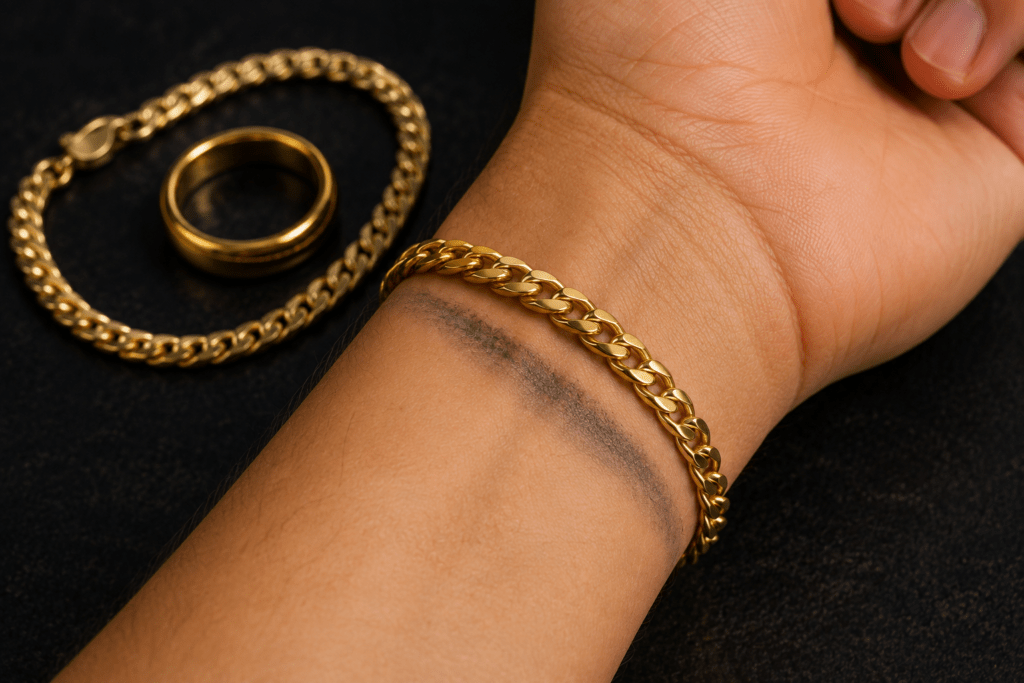
If your gold ring, necklace, bracelet, or other jewelry leaves a black or gray mark on your skin, you may immediately wonder:
Is my gold fake?
Not necessarily.
Real gold jewelry can sometimes leave dark marks on your skin. The cause may be the other metals mixed with the gold, perspiration, lotions or cosmetics, or extremely small metal particles rubbing from the jewelry onto your skin.
In fact, medical literature describes a staining effect called black dermographism, in which certain metals—including some gold alloys—can leave dark particles on the skin through friction and abrasion. Read the PubMed review on skin contact with gold and gold alloys
So a black mark by itself does not prove that your jewelry is fake.
At Gold Kings, we see another important lesson in situations like this: appearance alone cannot reliably tell you what a piece of jewelry contains. If you really want to know whether your jewelry is gold and what its purity is, professional testing is far more useful than judging it by what it does to your skin.
Quick Answer: Why Does Gold Turn My Skin Black?
Gold jewelry may leave a black mark because:
- Most gold jewelry contains metals other than pure gold.
- Tiny metal particles can rub onto the skin.
- Sweat and natural skin secretions can interact with the jewelry.
- Makeup, sunscreen, lotion, soap, powder, or other products can contribute to the reaction.
- Alloy metals in the jewelry can tarnish or react with the environment.
- In some cases, a metal allergy may cause skin irritation—but an allergy usually causes symptoms such as itching or a rash rather than only a removable black smudge.
The most important point is simple:
A black mark is not a reliable test for whether gold is real.
If you are questioning a piece because it leaves marks, learn more about how to tell if gold is real or have the jewelry professionally tested.
Real Gold Jewelry Usually Isn’t Pure Gold
One reason for the confusion is that people often use the words “real gold” and “pure gold” as though they mean the same thing.
They don’t.
A piece of 10K, 14K, or 18K jewelry can be completely legitimate gold jewelry while still containing substantial amounts of other metals.
| Gold Purity | Approximate Gold Content | Other Metals |
|---|---|---|
| 10K | 41.7% | 58.3% |
| 14K | 58.3% | 41.7% |
| 18K | 75% | 25% |
| 22K | 91.7% | 8.3% |
| 24K | Nearly pure gold | Very little |
Those additional metals are used because pure 24K gold is relatively soft.
Depending on the color and formula of the jewelry, manufacturers may alloy gold with metals such as copper, silver, zinc, nickel, or palladium.
That means two pieces stamped 14K can both contain the correct amount of gold but have different combinations of alloy metals.
Your skin may react differently to those different mixtures.
1. Tiny Metal Particles Can Rub Onto Your Skin
One of the most interesting explanations for black marks is metallic abrasion.
The dark material may actually consist of extremely tiny particles rubbed from the jewelry.
Medical literature refers to this as black dermographism. Research has found that certain metals can produce black markings when friction causes microscopic metal particles to transfer to the skin. See the medical discussion of black dermographism
Because the particles are extremely small, they can appear dark or black rather than looking like shiny yellow gold.
The effect can become more noticeable when something slightly abrasive is present between your jewelry and skin.
That can include:
- Makeup
- Face powder
- Sunscreen
- Lotion
- Dust
- Soap residue
- Household products
- Other particles on the skin
This is one reason someone might wear the same ring for months without a problem and then suddenly start noticing black marks.
The jewelry may not have changed at all.
Something touching the jewelry may have changed.
2. Makeup, Lotion, and Sunscreen Can Contribute
If your gold ring leaves a black streak when rubbed against your face, cosmetics should be one of the first things you consider.
Some powders and cosmetic ingredients are hard enough to increase friction against jewelry and help produce microscopic metal particles.
That can explain the strange situation where:
- A ring normally leaves no mark on your finger.
- You rub that same ring across skin with makeup or sunscreen.
- A dark line suddenly appears.
It doesn’t automatically mean the ring became fake.
If you suddenly notice black marks, think about whether you recently changed:
- Sunscreen
- Foundation
- Face powder
- Hand cream
- Moisturizer
- Soap
- Cleaning products
Try cleaning both the jewelry and your skin before drawing conclusions about the metal itself.
3. Sweat and Skin Secretions May Play a Role
Your jewelry spends hours pressed against a warm surface containing moisture, natural oils, salts, and other substances.
Perspiration and skin secretions can interact with metals in jewelry under certain conditions. Researchers studying black dermographism have discussed both mechanical abrasion and possible reactions involving substances found in perspiration. Read the published medical discussion
This helps explain why one person may wear a particular ring with no discoloration while another person wearing similar jewelry notices dark marks.
It can also explain why discoloration may become worse:
- During hot weather
- While exercising
- When your hands remain wet
- Under a tight ring
- When soap or lotion becomes trapped beneath jewelry
The reaction does not provide a useful measurement of your gold’s purity.
For that, the metal itself needs to be evaluated.
4. The Other Metals in Gold Jewelry Can React
Pure gold is highly resistant to oxidation and corrosion.
The alloy metals mixed with it may be more reactive.
That distinction becomes increasingly important as gold purity decreases.
Consider 10K gold.
Only about 41.7% of the alloy is gold. The remainder consists of other metals.
A 14K piece contains about 58.3% gold.
An 18K piece contains 75% gold.
All three can be genuine gold jewelry, but their metal compositions are very different.
Under the right conditions, metals within an alloy can develop surface compounds or residue that transfers to the skin.
This is also why the karat number can matter—but it isn’t a perfect predictor.
Higher-karat jewelry contains more gold and less alloy metal, yet even genuine higher-karat jewelry can sometimes produce a dark mark because metallic abrasion can occur independently of whether the item is fake.
Not Sure What Your Jewelry Is Made Of?
A skin mark cannot tell you whether a ring is 10K, 14K, 18K—or merely gold-colored. Gold Kings can professionally test and weigh your jewelry so you can understand what you actually own. Learn more about how Gold Kings evaluates gold or see the items Gold Kings buys.
5. A Black Mark Does Not Automatically Mean an Allergy
A removable black or gray smudge is different from an allergic skin reaction.
A metal allergy is more likely to cause symptoms such as:
- Itching
- Redness
- Rash
- Bumps
- Dry or cracked skin
- Blistering
- Persistent irritation
Nickel is a well-known cause of allergic contact dermatitis and can be present in some jewelry. The American Academy of Dermatology specifically identifies jewelry as a common source of nickel exposure. Read the American Academy of Dermatology’s nickel allergy guidance
If the only symptom is a dark mark that washes away, metallic residue or abrasion may be a more likely explanation than an allergy.
If you develop persistent itching, swelling, blistering, pain, or a rash, however, stop wearing the jewelry and consider speaking with a healthcare professional or dermatologist.
Gold testing can tell you more about the metal.
A medical professional is the appropriate person to evaluate your skin.
Does a Black Mark Mean My Gold Is Fake?
No.
This is probably the most important misconception to clear up.
A black mark can occur with genuine gold alloys.
At the same time, gold-plated and base-metal jewelry can also discolor your skin.
That means the skin test fails in both directions:
A mark does not prove the jewelry is fake, and no mark does not prove the jewelry is real.
If authenticity matters, use more reliable evidence.
Start by checking for hallmarks such as:
- 10K or 417
- 14K or 585
- 18K or 750
- 22K or 916
- 24K or 999
But remember that a stamp isn’t proof either.
A false item can carry a convincing hallmark, while genuine older or repaired jewelry may have a worn or missing stamp.
Professional testing gives you much more information.
Can 14K Gold Turn Your Skin Black?
Yes.
A legitimate 14K piece contains approximately 58.3% gold and 41.7% other metals.
Those alloy metals, combined with friction, perspiration, cosmetics, or environmental contaminants, can contribute to discoloration.
A black mark therefore does not automatically mean your 14K ring is counterfeit.
If you are unsure, have the piece tested rather than relying on the skin reaction.
Can 18K Gold Leave Black Marks?
It can.
Because 18K gold contains 75% gold, it contains considerably less alloy metal than 10K or 14K gold.
That may reduce some types of reactions, but it does not eliminate the possibility of metallic abrasion.
A genuine 18K ring rubbing against cosmetic products, powders, or other abrasive material can still produce a dark mark.
What About Green Marks?
Green discoloration is somewhat different.
It often points toward interaction involving copper-containing metal.
Copper is commonly used in jewelry alloys and can produce green compounds under certain environmental conditions.
Because genuine gold alloys may contain copper, even this does not automatically establish whether the item is real or fake.
However, strong or repeated discoloration from a supposedly high-purity gold item is a reasonable reason to have it professionally checked.
Does Rubbing Gold on Your Skin Test for Iron Deficiency?
No.
You may have seen a social media claim that rubbing a gold ring across your forehead or cheek can reveal low iron or anemia if it produces a black line.
A gold ring is not a medical test for iron deficiency.
The much more plausible explanation for the black streak is the interaction between the jewelry, friction, cosmetics, substances on the skin, and microscopic metal particles.
If you are concerned about iron deficiency, a healthcare professional can evaluate it using appropriate medical testing.
Do not use jewelry as a diagnostic tool.
Why Did My Ring Suddenly Start Turning My Finger Black?
This question is common because people sometimes wear a ring for years before discoloration appears.
If the ring hasn’t changed, something else may have.
Think about recent changes such as:
- New hand lotion
- New sunscreen
- Different makeup
- Increased sweating
- Hotter weather
- Frequent handwashing
- Cleaning chemicals
- Soap trapped beneath the ring
- Dirt or polishing residue on the jewelry
- Changes to the ring after repair or resizing
Start with a careful cleaning and see whether the problem continues.
If it does—and particularly if you have questions about the item’s purity—have the jewelry tested.
How to Reduce Black Marks From Gold Jewelry
A few simple habits may help.
Keep Your Jewelry Clean
Oil, soap, lotion, dirt, and other materials can accumulate in rings, chains, bracelets, and clasps.
Periodic cleaning can reduce residue.
For valuable, antique, delicate, or stone-set jewelry, ask a jeweler about the appropriate cleaning method before using chemicals or abrasive products.
Let Lotions and Cosmetics Dry
Apply lotion, sunscreen, makeup, or other products before putting on your jewelry.
Allow them to dry first.
This reduces the amount trapped directly between your jewelry and your skin.
Keep Rings Dry
Remove rings when using strong household cleaners or when your hands will remain wet for long periods.
Dry your hands thoroughly before putting rings back on.
Have Persistent Problems Checked
If only one particular piece repeatedly causes discoloration while all your other gold jewelry does not, its alloy composition may be different.
Professional precious-metal testing can help determine what the jewelry actually contains.
Can XRF Testing Tell Whether My Gold Is Real?
Professional X-ray fluorescence, or XRF, testing can provide useful information about the elemental composition of precious-metal jewelry.
Instead of assuming that a piece is 14K because it is stamped 14K, an XRF analyzer can help identify the metals present and estimate the gold content of the area being tested.
At Gold Kings, professional precious-metal testing—including XRF analysis when appropriate—helps us evaluate jewelry without relying only on:
- Color
- Appearance
- Skin discoloration
- A hallmark
- What a previous owner said
- What the item was sold as
Testing becomes especially useful with:
- Unmarked jewelry
- Inherited jewelry
- Foreign gold
- Repaired jewelry
- Questionable hallmarks
- Older pieces
- Jewelry that produces unexpected skin discoloration
If you are interested in selling the jewelry, testing also helps establish one of the most important parts of its value: actual gold purity.
What Determines the Value of Gold Jewelry?
If the black marks have you wondering whether an old ring, bracelet, or necklace is worth anything, the mark itself has very little to do with its value.
For gold sold primarily for its precious-metal content, the major factors are:
Purity
How much actual gold does the item contain?
A 10K and an 18K bracelet of identical weight have very different gold content.
Weight
Once purity is established, the amount of gold-bearing material matters.
Current Gold Price
The market price of gold changes throughout the trading day.
Non-Gold Components
Stones, clasps, springs, fillers, or other non-gold materials may affect the weight used when calculating precious-metal value.
Value Beyond the Gold
Some jewelry should not automatically be treated as scrap.
Designer pieces, desirable jewelry, diamonds, collectible items, and certain estate pieces may warrant additional consideration.
That’s why understanding what you own should come before deciding whether to sell it.
Have Your Gold Jewelry Tested at Gold Kings
If a black mark has you questioning whether your ring, necklace, bracelet, earrings, or other jewelry is actually gold, you don’t need to rely on home myths.
Gold Kings can test and weigh your jewelry and explain what the evaluation shows.
We evaluate gold jewelry as well as broken gold, scrap gold, silver, coins, bullion, watches, estate jewelry, and other qualifying valuables.
You can learn more about what Gold Kings buys before visiting.
Gold Kings of Snellville
For customers in Gwinnett County and surrounding communities, visit Gold Kings of Snellville.
3635 Stone Mountain Hwy
Snellville, GA 30039
770-771-4650
The Snellville location evaluates gold jewelry, scrap gold, coins, bullion, silver, watches, and other precious-metal items.
Your jewelry can be tested and weighed so you can better understand its purity and precious-metal value before deciding whether you want to sell it.
Gold Kings of Commerce
For customers in Commerce, Banks Crossing, Jackson County, Banks County, and surrounding Northeast Georgia communities, visit Gold Kings of Commerce.
480 Banks Crossing Dr
Commerce, GA 30529
706-336-0043
The Commerce location evaluates gold jewelry and other qualifying precious-metal items using the same goal: determine what you actually have before you make a decision about selling it.
Frequently Asked Questions
Does real gold leave black marks on skin?
It can. Genuine gold alloys can leave black or gray residue because of metallic abrasion, alloy metals, perspiration, cosmetics, lotions, or substances on the skin. A black mark alone does not prove the jewelry is fake.
Why does my gold ring turn my finger black but other rings don’t?
Different pieces of gold jewelry can contain different alloy mixtures even when they have the same karat. The fit of the ring, surface finish, accumulated residue, and products on your skin can also make one ring behave differently from another.
Does 14K gold turning my finger black mean it isn’t really 14K?
No. Genuine 14K jewelry can leave dark marks. If you want to confirm its purity, professional testing is much more reliable than using skin discoloration as a test.
Why does my gold ring leave a black mark on my face?
Cosmetics, sunscreen, powders, or other substances on your face can increase friction against the metal and contribute to black dermographism. The resulting microscopic particles can appear as a black streak.
Does gold turning my skin black mean I have anemia?
No. Rubbing gold on your skin is not a valid test for anemia or iron deficiency. Medical testing is needed to diagnose those conditions.
Is the black residue dangerous?
A simple removable dark smudge is generally different from an allergic rash. If you develop itching, redness, swelling, blisters, pain, or persistent irritation underneath jewelry, stop wearing it and consider seeking medical advice.
How do I know whether my gold is real?
Check the hallmark as a starting point, but do not rely on it alone. Professional testing, including XRF analysis when appropriate, can provide much better information about the jewelry’s actual metal composition. You can also read Gold Kings’ guide to five ways to tell if gold is real.
Don’t Let a Black Mark Decide What Your Gold Is Worth
A dark line on your finger or skin can be surprising, but it doesn’t tell you everything you need to know about the jewelry.
It doesn’t prove the piece is fake.
It doesn’t tell you its karat.
And it certainly doesn’t tell you what the jewelry is worth.
Those answers come from examining the jewelry itself.
If you have a questionable ring, inherited chain, broken bracelet, old earrings, or other gold jewelry, bring it to Gold Kings of Snellville or Gold Kings of Commerce.
We can test it, weigh it, explain what you have, and help you understand its value before you decide whether selling makes sense.
Know what you own before you decide what to do with it.