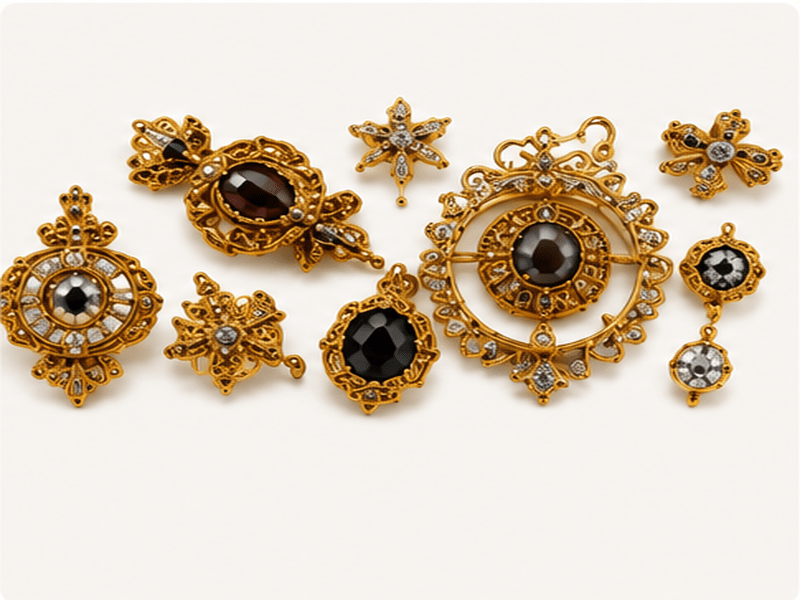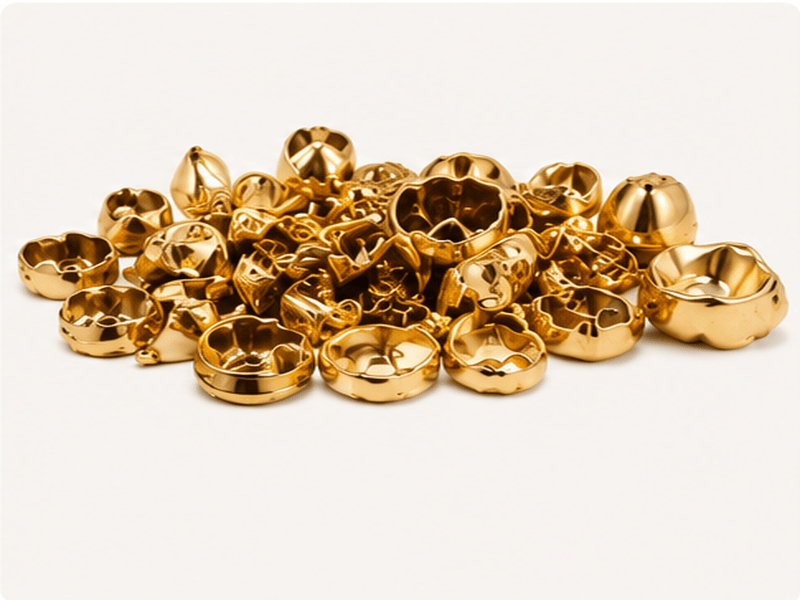
That old gold crown sitting in a drawer may be worth more than you think.
Dental gold can be valuable because many crowns, bridges, inlays, and other older dental restorations contain real gold along with other precious metals. However, there is no single price for a gold tooth or crown.
Its value depends primarily on:
- How much metal is actually present
- The percentage of gold in the alloy
- Whether it contains platinum, palladium, silver, or other valuable metals
- The current gold price
- How much porcelain, cement, tooth material, or other non-metal material is attached
A yellow dental crown should not automatically be treated like 10K, 14K, or 18K jewelry. Dental alloys are different, and professional testing is usually the best way to determine what you actually have.
At Gold Kings, dental gold is one of the types of scrap gold we evaluate. We can test the metal, weigh it, explain the results, and determine whether it contains valuable precious metals.
Quick Answer: What Is Dental Gold Worth?
The simplest answer is:
Dental gold is worth the value of the recoverable precious metals it contains.
A crown containing 70% gold will normally have considerably more gold value per gram than one containing 40% gold.
But dental work can be tricky because two crowns that look almost identical can contain very different alloys.
One may contain a high percentage of gold.
Another may contain gold plus palladium or platinum.
A third may look yellow but contain substantially less gold.
And some modern dental restorations contain little or no gold at all.
That is why weighing a dental crown by itself does not tell you its value.
You have to know what the metal actually contains.
Is Dental Gold Pure Gold?
Usually not.
Pure 24K gold is relatively soft. Dental restorations need enough strength to withstand years of biting and chewing, so gold has traditionally been mixed with other metals to create stronger dental alloys.
Depending on the restoration, those metals can include:
- Silver
- Copper
- Platinum
- Palladium
- Zinc
- Other metals
The American Dental Association’s information on dental restorative alloys explains that dental alloys may contain combinations of gold and platinum-group metals rather than pure gold.
This means calling something a “gold crown” does not mean it is 24K gold.
It may contain considerably less gold while still having meaningful precious-metal value.
How Much Gold Is in a Dental Crown?
There is no universal percentage.
Older dental gold alloys can contain substantial amounts of gold, while other dental alloys may rely more heavily on palladium, silver, platinum, or base metals.
For comparison, traditional jewelry purities are easy to understand:
| Gold Purity | Approximate Gold Content |
|---|---|
| 10K | 41.7% |
| 14K | 58.3% |
| 16K equivalent | 66.7% |
| 18K | 75.0% |
| 20K | 83.3% |
| 22K | 91.7% |
Dental gold does not necessarily follow these standard jewelry karats.
A crown could test somewhere between traditional jewelry grades—or have a composition that does not translate neatly into a familiar karat at all because other precious metals are present.
That is one reason dental gold should be tested rather than guessed at by color.
Dental Gold Value per Gram
To understand the basic value, start with the current value of pure gold per gram.
The formula is:
Gold spot price ÷ 31.1035 = value of one gram of pure gold
Then multiply that number by the percentage of gold in the dental alloy.
For example, imagine gold were trading at $4,500 per troy ounce.
Pure gold would be worth approximately $144.68 per gram.
The theoretical gold content would then look approximately like this:
| Gold Content | Approximate Gold Value per Gram* |
| 40% gold | $57.87 |
| 50% gold | $72.34 |
| 58.3% gold | $84.35 |
| 66.7% gold | $96.50 |
| 75% gold | $108.51 |
| 80% gold | $115.74 |
| 90% gold | $130.21 |
*Illustration only using a hypothetical $4,500 gold price. This represents theoretical gold content, not a guaranteed purchase price.
Gold prices change throughout the trading day, so check the current gold and silver prices when estimating your dental gold.
There is also another important point:
Gold may not be the only valuable metal in the crown.
If the alloy contains palladium, platinum, or other recoverable precious metals, those metals can also affect its total value.
Example: What Could a 4-Gram Gold Crown Be Worth?
Suppose you have four grams of clean dental metal.
If testing showed that it contained 70% gold:
4 grams × 70% = 2.8 grams of pure gold
Using the same hypothetical pure-gold price of approximately $144.68 per gram:
2.8 × $144.68 = about $405 in theoretical gold content
That does not automatically mean someone will pay $405.
A buyer or refiner still has to account for factors such as:
- Refining
- Processing
- Market movement
- Non-precious material
- Actual recoverable metal
- Other costs associated with processing dental scrap
The example simply shows why even a very small piece of dental gold can sometimes have meaningful value.
Why You Shouldn’t Estimate Dental Gold by Weight Alone
A common mistake is weighing an old crown and assuming the entire weight is gold.
It usually isn’t.
A dental restoration might still have:
- Tooth material
- Porcelain
- Ceramic
- Cement
- Base-metal components
- Other non-gold materials
If a crown weighs five grams, that does not necessarily mean you have five grams of dental metal.
And even if all five grams were metal, only a portion may be gold.
A proper evaluation separates three different questions:
- How much does the item weigh?
- How much of that weight is precious metal?
- What percentage of each precious metal is present?
Only then can its value be estimated accurately.
How Is Dental Gold Tested?
This is where professional precious-metal testing becomes particularly useful.
Dental gold often does not have an easy-to-read hallmark like:
- 10K
- 14K
- 18K
- 417
- 585
- 750
- 916
Instead, the composition has to be determined from the metal itself.
At Gold Kings, an XRF precious-metal analyzer can be used when appropriate to help identify metals in an alloy.
XRF stands for X-ray fluorescence.
Instead of relying on a stamp, the analyzer examines the metal and can identify elements such as:
- Gold
- Silver
- Copper
- Platinum
- Palladium
- Zinc
- Other detectable metals
You can read more about how an XRF gold tester works.
For dental gold, this can be especially useful because the metal’s appearance alone tells you very little about its true composition.
Does a Gold-Looking Crown Always Contain Gold?
No.
Color is a clue, but it is not proof.
A yellow-colored restoration may contain gold, but different metal combinations can create similar colors.
Likewise, some dental alloys that contain valuable precious metals may not look strongly yellow.
That is why Gold Kings does not determine value simply by looking at an item.
Testing + weight + current precious-metal prices provide much more useful information.
Are Old Gold Teeth Worth Anything?
Potentially, yes.
Older dental work can sometimes be particularly interesting because gold-based alloys were commonly used for crowns, bridges, inlays, and other restorations.
Items worth having evaluated can include:
- Gold crowns
- Gold teeth
- Dental bridges
- Gold inlays
- Gold onlays
- Broken dental restorations
- Old dental scrap
- Removed dental gold kept by a patient
- Inherited dental gold
Do not assume a small piece is worthless simply because it weighs only a few grams.
Gold is extremely valuable by weight, so relatively small pieces can still contain significant precious-metal value.
Can Porcelain Dental Crowns Contain Gold?
Yes.
Some crowns use a metal substructure covered by porcelain or ceramic.
These are commonly known as porcelain-fused-to-metal restorations.
Depending on the alloy used underneath the porcelain, that metal structure may contain gold or other precious metals.
Other crowns may use less valuable base-metal alloys.
From the outside, they can look very similar.
Again, testing matters.
Should I Remove Porcelain or Tooth Material Myself?
Usually, there is little reason to aggressively cut, grind, or break apart dental material yourself just to determine whether it contains gold.
You could injure yourself or lose small pieces of valuable metal.
Instead, have the item evaluated first.
If significant non-metal material remains attached, the buyer can explain how that affects the evaluation.
Is Dental Gold Worth the Same as Gold Jewelry?
Gold itself has the same underlying precious-metal value regardless of whether it came from a ring, necklace, coin, or dental crown.
What differs is the alloy and recoverable gold content.
For example, a gram of pure gold recovered from dental scrap has the same fundamental metal value as a gram of pure gold recovered from jewelry.
But the dental item may contain:
- More gold
- Less gold
- Palladium
- Platinum
- Silver
- Base metals
That makes dental gold somewhat different from ordinary jewelry evaluation.
If you want to understand the basic calculation used for jewelry and scrap gold, see our guide to how much gold is worth.
Where Can I Sell Dental Gold in Georgia?
If you have removed dental gold, an old gold crown, a bridge, or other dental scrap, Gold Kings can evaluate it at either of our Georgia locations.
Instead of guessing at a karat based on color, we can test the metal and explain what the analyzer detects.
Gold Kings of Snellville
Visit Gold Kings of Snellville at:
3635 Stone Mountain Hwy
Snellville, GA 30039
770-771-4650
The Snellville location serves customers throughout Gwinnett County and surrounding communities who are looking to sell dental gold, broken jewelry, scrap gold, coins, bullion, silver, watches, and other precious-metal items.
Gold Kings of Commerce
Customers in Northeast Georgia can visit Gold Kings of Commerce at:
480 Banks Crossing Dr
Commerce, GA 30529
706-336-0043
The Commerce location evaluates dental gold along with gold jewelry, scrap gold, silver, coins, bullion, watches, and estate jewelry.
What Should I Ask Before Selling Dental Gold?
Whether you visit Gold Kings or another precious-metals buyer, ask questions.
A transparent evaluation should help you understand:
- What does the dental gold weigh?
- How much of the weight is actually metal?
- What percentage of gold did it test?
- Were other precious metals detected?
- What current metal price is being used?
- How was the offer calculated?
You should not have to understand metallurgy to sell dental gold.
But you should be able to understand why an item is worth what the buyer says it is worth.
At Gold Kings, the goal is to make that process visible and understandable.
We test it. We weigh it. We pay you.
Frequently Asked Questions About Dental Gold Value
How much is one gold tooth worth?
There is no fixed price. The value depends on its metal weight, gold percentage, other precious metals, current gold prices, and the amount of non-metal material attached.
A small crown containing a high percentage of gold can potentially be worth considerably more than a larger crown containing very little gold.
What karat is dental gold?
Dental gold does not have one standard karat.
Some alloys may have gold content comparable to common jewelry purities such as 14K, 16K, or 18K, while others may be higher or lower.
Testing is the best way to know.
Is dental gold usually 16K?
You may see dental gold described as approximately 16K, and 16K equals roughly 66.7% gold.
However, you should not assume every dental crown is 16K.
Dental alloys vary substantially.
Are gold crowns really gold?
Some are.
Others contain mixtures of gold, platinum, palladium, silver, copper, and other metals.
Some dental restorations contain little or no gold.
Does dental gold have a hallmark?
Usually not in the same way jewelry does.
You generally will not find an easy-to-read 10K, 14K, 18K, 585, or 750 stamp on an old dental crown.
That makes professional testing especially valuable.
Can dental gold contain platinum or palladium?
Yes.
Dental noble-metal alloys can contain gold as well as platinum-group metals such as platinum and palladium.
Those metals can also contribute to the scrap value.
Can I sell a broken gold crown?
Potentially, yes.
Breaking or damage does not remove the precious metal contained in the crown.
The value is based primarily on the recoverable metals rather than whether the restoration can still be used as dental work.
Do I need several crowns before selling dental gold?
No.
Even a single piece may be worth testing.
Because gold is valuable by weight, a small amount of high-gold-content dental alloy can still have meaningful value.
Find Out What Your Dental Gold Is Actually Worth
The biggest mistake with dental gold is assuming you know its value by looking at it.
A tiny crown may contain a surprisingly high percentage of gold.
A large yellow restoration may contain much less.
And another piece may contain valuable palladium or platinum in addition to gold.
The only reliable way to move beyond guessing is to determine what metals are present, how much the item weighs, and what those metals are worth at current market prices.
If you have an old crown, gold tooth, bridge, inlay, or other dental scrap, bring it to Gold Kings of Snellville or Gold Kings of Commerce for an evaluation.
We can test the metal, weigh it, explain what you have, and give you an offer if you decide you want to sell.
We test it. We weigh it. We pay you.