
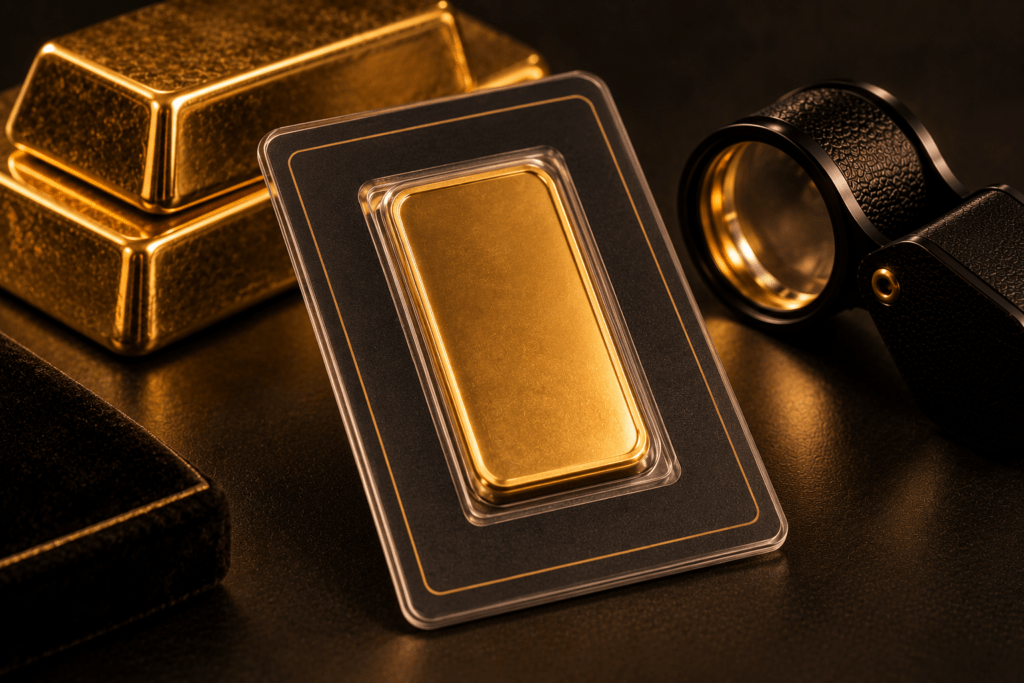
If you own a gold bar sealed inside a plastic card, the information printed around it can tell you a lot about what you have.
A typical gold bar assay card may identify the bar’s:
- Refiner or mint
- Weight
- Gold purity or fineness
- Serial or certificate number
- Assayer or certification information
- Security or authentication features
But an assay card should not be treated as automatic proof that a gold bar is genuine. Counterfeit bars, packaging and certificates exist, so the card is only one part of properly evaluating bullion.
At Gold Kings, we regularly evaluate gold coins, bars and other bullion. Understanding the information on the assay card is a good first step before having the actual bar evaluated.
Quick Answer: What Does a Gold Bar Assay Card Tell You?
Start with these four pieces of information:
Weight: How much the bar is supposed to weigh, such as 1 gram, 10 grams, 1 troy ounce or 100 grams.
Fineness: The stated percentage of the bar that is gold. For example, 999.9 means 99.99% pure gold.
Refiner or mint: The company that produced and certified the bar.
Serial or certificate number: A unique identifying number that may appear on the card, the bar itself, or both.
After checking those basics, inspect the packaging and any security features provided by the manufacturer.
If you are considering selling a bar and are unsure what you have, Gold Kings evaluates gold coins and bullion at our Snellville and Commerce locations.
What Is a Gold Bar Assay Card?
An assay is a determination of the purity or composition of a precious metal.
With many modern retail gold bars, the mint or refiner packages the bar inside a card that certifies important specifications such as its weight and purity.
Depending on the manufacturer, you may hear this packaging called an:
- Assay card
- Assay certificate
- Certificate card
- Certicard
- Certificate of authenticity
These terms are sometimes used interchangeably by sellers, but they do not always mean exactly the same thing.
For example, some small minted bars have the bar permanently sealed inside a card containing its certification information. Larger cast bars may instead have a separate certificate of analysis.
The LBMA’s kilobar standard, for example, specifies that a Certificate of Analysis accompanying qualifying kilobars should include the refiner, serial number, weight, fineness and an approved signature.
1. Find the Gold Bar Manufacturer or Refiner
The first thing to identify is who made the bar.
You may see the name or logo of a mint, refinery or precious-metals manufacturer printed on the card and stamped directly into the gold.
Recognizable examples include manufacturers such as PAMP, Valcambi, The Perth Mint and other established refiners.
The manufacturer matters because gold bullion is generally easier to evaluate when the producer, design and specifications can be identified.
Look for consistency between:
The card → the bar → the manufacturer’s known product specifications.
A professional-looking card surrounding a bar with incorrect markings should not automatically be trusted.
2. Read the Weight
Next, find the stated metal weight.
Common gold bar sizes include:
| Gold bar size | Approximate equivalent |
|---|---|
| 1 gram | 0.03215 troy oz |
| 5 grams | 0.16075 troy oz |
| 10 grams | 0.3215 troy oz |
| 20 grams | 0.6430 troy oz |
| 1 troy ounce | 31.1035 grams |
| 50 grams | 1.6075 troy oz |
| 100 grams | 3.2151 troy oz |
| 1 kilogram | 32.1507 troy oz |
One important detail:
A troy ounce is not the same as a regular household ounce.
Precious metals are normally measured using troy ounces.
One troy ounce equals approximately 31.1035 grams.
So if your assay card says:
Metal Weight: 1 oz
a normal one-ounce gold bullion bar should correspond to approximately 31.103 grams.
The stated weight is one of several specifications that can be checked when a bar is evaluated.
3. Read the Gold Purity or Fineness
One of the most important numbers on an assay card is the fineness.
You may see:
999.9 Fine Gold
This means the bar is represented as:
99.99% gold
It is commonly described as 24-karat or fine gold.
Other possible markings include:
999 = 99.9% gold
999.9 = 99.99% gold
995 = 99.5% gold
For investment bullion, 999 and 999.9 are common purity levels.
So if you see:
Au 999.9
the letters Au are the chemical symbol for gold, while 999.9 tells you the stated fineness.
A 100-gram bar marked Au 999.9 therefore represents approximately 99.99 grams of pure gold content.
You can learn more about high-purity markings in our guide to what 999 means on gold.
4. Find the Serial Number or Certificate Number
Many assay cards contain a unique identifying number.
It may be labeled:
Serial Number
Certificate Number
Bar Number
or something similar.
On many products, the same number is also engraved or stamped directly onto the gold bar.
The numbers should match when the manufacturer’s design requires them to match.
For example, an assay card showing:
Certificate Number: C123456
should not normally contain a bar marked with an entirely different identifier if that product is designed to use matching numbers.
A mismatch is a reason to stop and investigate further.
Serial numbers also help identify individual bars and provide traceability. The LBMA similarly requires serial-number identification on Good Delivery gold bars, along with refiner and fineness markings.
Can you look up a gold bar serial number online?
Sometimes—but not always.
There is no single universal database where consumers can enter every gold-bar serial number.
Some manufacturers have their own authentication systems. PAMP, for example, offers its VERISCAN system for registered PAMP products.
Do not assume that a serial number is fake simply because you cannot find it through Google.
Instead, check what verification system the actual manufacturer provides.
5. Look for the Assayer or Certification Information
Some cards contain the name, mark or signature of an assayer or authorized representative.
You might see wording such as:
Certified Assayer
Assayer
Certificate of Analysis
or an authorized signature.
This indicates that the manufacturer is certifying the stated specifications of the bullion product.
It does not necessarily mean that an independent laboratory recently tested your individual bar.
That distinction matters.
An assay card is generally manufacturer certification associated with the bullion product—not a replacement for evaluating a suspicious bar.
6. Inspect Security Features
Modern bullion manufacturers increasingly incorporate security features into bars and packaging.
Depending on the manufacturer and product, these may include:
- Tamper-evident packaging
- QR codes
- Holographic features
- Microprinting
- Specialized surface patterns
- Manufacturer-specific authentication technology
For example, The Perth Mint states that some of its minted bars use tamper-evident packaging that reveals VOID around the blister if the packaging has been opened.
PAMP uses VERISCAN technology on registered products to help identify bullion using microscopic surface characteristics.
Security features differ from one manufacturer and product generation to another.
Therefore, compare your bar against the manufacturer’s specifications for that exact product, rather than assuming every genuine gold bar should have the same security features.
Does an Assay Card Guarantee That a Gold Bar Is Real?
No.
This is probably the most important point in this entire guide.
A convincing assay card is evidence worth examining, but it is not absolute proof of authenticity.
Counterfeiters can imitate:
- Gold bars
- Serial numbers
- Manufacturer logos
- Assay cards
- Certificates
- Plastic packaging
- Purity markings
The LBMA has specifically discussed increasingly sophisticated counterfeit precious-metal products, including fabricated certificates and falsely represented assay information.
That is why a buyer should evaluate the entire bar, not simply read the card.
Our guide to spotting a fake gold bar explains the checks and their limitations.
How Can a Gold Bar Be Checked?
A professional bullion evaluation may consider several characteristics together, including:
Manufacturer and design
Does the bar match a genuine known product?
Weight
Does its measured weight correspond to the stated specifications?
Dimensions
Are the length, width and thickness correct?
Serial number
Does the identifier match the card and expected manufacturer format?
Packaging
Does the seal appear original and undisturbed?
Security features
Does the product contain the authentication features expected for that version?
Metal testing
When appropriate, professional precious-metal testing can provide additional information about the metal.
At Gold Kings, we use professional precious-metal testing equipment, including XRF, when appropriate, and we evaluate gold bars, coins, jewelry and other precious metals.
However, XRF should not be treated as a magic authenticity test for every gold bar.
XRF primarily analyzes the surface composition of the metal. The LBMA notes that X-ray penetration in gold is very shallow and that surface analysis can potentially be deceived by plating.
That is why evaluating bullion is about putting multiple pieces of evidence together rather than trusting one number from one test.
You can learn more about precious-metal verification in the Gold Kings Gold Testing & Authenticity guides.
Should You Remove a Gold Bar From Its Assay Card?
Usually, do not open a sealed assay card just because you want to inspect the gold more closely.
Original packaging can help:
- Protect the bar
- Preserve its presentation
- Show whether the package has been tampered with
- Make the bullion easier for a future buyer to recognize
- Preserve any retail premium associated with an intact product
Breaking the packaging does not change the amount of gold inside the bar, but it may affect marketability or premium, depending on the brand and buyer.
There are situations where a bar may need further examination or testing, especially when authenticity is uncertain.
If you plan to sell the bar, it often makes sense to let the prospective professional buyer examine it before you open the packaging yourself.
What If My Gold Bar Has No Assay Card?
A missing assay card does not automatically mean a gold bar is fake.
Many legitimate gold bars are sold without card-style packaging.
This is especially true with:
- Cast gold bars
- Older bullion
- Larger bars
- Bars removed from original packaging
- Certain refinery products
The bar itself may still contain important markings such as:
- Manufacturer
- Weight
- Purity
- Serial number
- Assay mark
A missing card may affect recognition or resale premium for some products, but the underlying gold does not disappear because the packaging is gone.
Professional evaluation becomes especially important when the original packaging or documentation is missing.
How Do You Calculate the Gold Value From an Assay Card?
The basic metal-value calculation is:
Gold weight × purity × current gold price
For example, consider a hypothetical:
100-gram gold bar
999.9 fineness
The estimated pure gold content is:
100 × 0.9999 = 99.99 grams of pure gold
A 1-troy-ounce 999.9 bar contains approximately:
0.9999 troy ounce of pure gold
Its market value then moves with the current gold price.
Because gold prices change throughout the trading day, use a current market price rather than an old number printed in an article.
You can check Gold Kings’ gold and silver price information before having your bullion evaluated.
Does the Assay Card Make a Gold Bar Worth More?
The card itself does not add additional gold.
A one-ounce gold bar is still a one-ounce gold bar based on its actual precious-metal content.
However, an original sealed assay package from a recognized manufacturer can potentially affect:
- Buyer confidence
- Market recognition
- Ease of resale
- Retail premium
That does not mean every assay-card bar deserves a large premium.
Ultimately, the value of a gold bar may depend on:
actual gold content + current gold price + manufacturer + condition + market demand + applicable premium
This is one reason gold coins and bars should not automatically be valued exactly the same way. Read our comparison of gold coins vs. gold bars for a deeper explanation.
Red Flags on a Gold Bar Assay Card
Be more cautious if you notice any of the following:
- Serial numbers that do not match
- Misspelled manufacturer names
- Incorrect logos
- Incorrect stated weight
- Unusual fonts or spacing
- Poor-quality printing
- Packaging that appears opened and resealed
- Missing security elements that should be present
- Bar dimensions that do not match known specifications
- A seller unwilling to allow reasonable verification
- A price dramatically below the gold’s underlying value
None of these clues alone proves a bar is counterfeit.
But several inconsistencies together are a strong reason to have the bullion professionally evaluated before buying, selling or accepting it as genuine.
Example: How to Read a 1 Oz Gold Bar Assay Card
Suppose a card reads:
PAMP SUISSE
1 OUNCE FINE GOLD
999.9
Certificate Number C123456
Metal Fineness Au 999.9
Metal Weight 31.103 g
Here is what that means:
PAMP SUISSE — the stated manufacturer.
1 OUNCE — the nominal bullion size.
999.9 — 99.99% stated gold purity.
C123456 — the identifying certificate or serial number.
Au — the chemical symbol for gold.
31.103 g — approximately one troy ounce by weight.
You would then compare the information with the markings on the bar, inspect the packaging and security features, and determine whether the entire product is consistent with an authentic example.
Reading the card is the beginning of authentication—not the end.
Have Your Gold Bar Evaluated at Gold Kings
If you inherited a gold bar, bought bullion years ago, received one as a gift or simply want to know what it is worth, you do not have to rely solely on what the assay card says.
Gold Kings evaluates gold bars and bullion along with gold coins, jewelry, silver and other precious-metal items.
We can examine what you have, verify relevant specifications, weigh your bullion and use professional testing methods when appropriate so you can better understand the item before deciding whether to sell.
Gold Kings of Snellville
Customers in Gwinnett County and surrounding communities can visit Gold Kings of Snellville at:
3635 Stone Mountain Hwy
Snellville, GA 30039
770-771-4650
Gold Kings of Snellville evaluates gold bars, bullion, coins and other precious metals. Testing and weighing are performed transparently so you can understand what you own before making a decision.
Gold Kings of Commerce
Customers in Northeast Georgia can visit Gold Kings of Commerce at:
480 Banks Crossing Dr
Commerce, GA 30529
706-336-0043
The Commerce location also evaluates gold coins, bullion and other precious-metal items for customers throughout Commerce, Banks Crossing and surrounding Northeast Georgia communities.
There is no need to open an assay card or damage the original packaging before bringing your bar in.
Let us look at it first.
Frequently Asked Questions About Gold Bar Assay Cards
What does 999.9 mean on a gold bar assay card?
It means the bar is represented as 99.99% pure gold. This level of fineness is commonly referred to as fine gold or 24-karat gold.
What does Au mean on an assay card?
Au is the chemical symbol for gold. A marking such as Au 999.9 means the stated metal is gold with a fineness of 999.9 parts per thousand.
Should the serial number on the card match the gold bar?
For products designed with matching bar and certificate numbers, yes. A mismatch should be investigated before assuming the bar is authentic.
Can a fake gold bar have a real-looking assay card?
Yes. Counterfeit bars can be accompanied by convincing packaging and certificates. The assay card should be considered along with the actual bar, security features, weight, dimensions and professional evaluation.
Can I sell a gold bar without an assay card?
Potentially, yes. A missing card does not eliminate the gold value of a genuine bar. However, authentication and evaluation may become more important, and missing original packaging may affect the premium or ease of resale for some products.
Should I open my gold bar assay card before selling it?
Usually not. If the bar is still sealed, leave it intact until a knowledgeable buyer evaluates it. Original packaging may contain tamper-evident or authentication features and can sometimes help preserve resale appeal.
How much is a gold bar worth?
The starting point is the bar’s weight, actual purity and current gold price. Manufacturer, market demand and applicable bullion premiums can also influence what someone is willing to pay.
Where can I sell a gold bar near me in Georgia?
Gold Kings buys and evaluates qualifying gold bars and other bullion at both our Snellville gold buyer location and our Commerce gold buyer location.
Before You Sell a Gold Bar, Know What You Have
An assay card gives you valuable information, but the most important lesson is simple:
Do not judge a gold bar by the card alone.
Check the manufacturer, weight, fineness, serial number, packaging and security features. If anything looks unusual—or if you simply want to know what your bullion is worth—have it evaluated before making a decision.
Gold Kings can evaluate gold bars, coins and bullion at both our Snellville and Commerce locations. We can help you understand what you have, how it is being evaluated and what factors affect its value before you decide whether you want to sell.
See everything Gold Kings buys or visit the Gold Kings location nearest you.
We test it. We weigh it. We pay you.