
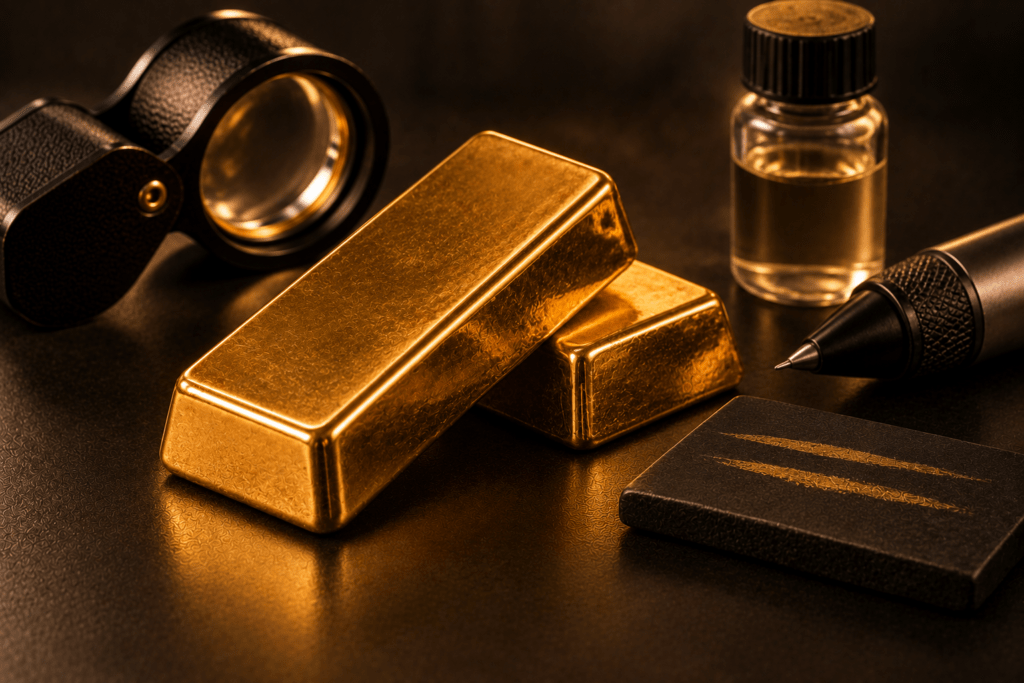
A gold bar can look perfect and still be fake.
Counterfeiters can copy logos, serial numbers, assay cards, packaging and even the approximate weight of a genuine bar. Some sophisticated counterfeits use a cheaper metal inside with a layer of real gold on the outside.
That means appearance alone is not enough to prove a gold bar is genuine.
The best way to spot a fake gold bar is to check several things together: its weight, dimensions, markings, packaging, density and metal composition. For higher-value bars, professional testing is the safer choice.
At Gold Kings, we regularly evaluate gold bullion along with coins, jewelry and other precious metals. If you are unfamiliar with a bar or are considering selling one, understanding what you own before completing a transaction can prevent an expensive mistake.
You can also learn more about gold coins and bullion and professional gold testing and authenticity on the Gold Kings website.
Quick Answer: How Can You Tell If a Gold Bar Is Fake?
Start by comparing the bar with the exact specifications published for that product.
A genuine bar should have the correct weight and physical dimensions for its manufacturer and size. Examine the logo, lettering, fineness mark and serial number carefully. Then check whether the bar reacts strongly to a magnet and, when practical, compare its density with the expected density of gold.
Professional metal testing can provide much more information, but even one testing method should not always be treated as absolute proof.
The London Bullion Market Association has documented increasingly sophisticated counterfeit precious metals, including products made with base-metal plating, altered alloys, dense internal cores and copied markings or packaging.
The important rule is simple: never trust only one test.
1. Check the Weight
Weight is one of the fastest places to start.
A bar marked 1 troy ounce should contain the amount of gold specified by its manufacturer. The same applies to bars marked:
1 gram, 5 grams, 10 grams, 20 grams, 1 ounce, 50 grams, 100 grams, 10 ounces or 1 kilogram.
Use a sufficiently accurate scale and compare your measurement with the official specifications for that exact bar.
A noticeable difference is a warning sign.
However, correct weight does not automatically prove the bar is real. Sophisticated counterfeiters may choose dense substitute metals specifically to make the finished bar weigh close to what buyers expect.
That is why weight should always be combined with other checks.
2. Measure the Bar
Next, measure the bar’s length, width and thickness with a caliper.
This is especially useful for common minted bullion bars because established manufacturers generally produce them to consistent specifications.
Suppose a counterfeit bar weighs almost exactly one troy ounce but is noticeably thicker or wider than the genuine version. That can indicate a different metal was used to achieve the required weight.
On the other hand, a bar matching both the expected weight and dimensions deserves further testing rather than automatic approval.
Modern counterfeits can be remarkably accurate.
3. Inspect the Logo, Lettering and Serial Number
Look closely at every detail.
Compare the bar with confirmed examples from the manufacturer. Pay attention to the font, spacing, logo shape, borders, surface finish, numbers and alignment.
Many genuine bullion products display information such as the manufacturer or refiner, weight, gold fineness and identifying markings. Some also include individual serial numbers.
But the exact markings vary by manufacturer and product.
The LBMA Good Delivery List can also help identify recognized refiners in the professional bullion market. LBMA notes that its standards address factors including weight, purity, markings and physical appearance.
Do not assume that a professional-looking stamp proves authenticity.
Counterfeiters can copy stamps too.
4. Do Not Automatically Trust the Assay Card
Many small investment bars are sold inside tamper-evident assay packaging.
That packaging is useful—but it is not magic.
Counterfeiters can reproduce plastic holders, certificates, barcodes, logos and printed assay information. LBMA has specifically identified fabricated certificates and packaging as methods used in precious-metals counterfeiting.
Look for inconsistent printing, poor alignment, unusual fonts, spelling errors, damaged seals or a serial number that does not match the bar.
Also compare the packaging with current examples from the manufacturer.
A sealed bar can still require authentication.
5. Try the Magnet Test — but Understand Its Limitations
Pure gold is not strongly magnetic.
Therefore, if a supposed solid-gold bar jumps strongly toward a powerful magnet, something is wrong.
But the opposite is not true.
A bar that does not stick to a magnet is not automatically real.
Many metals used in counterfeit products are also nonmagnetic or may produce little obvious magnetic attraction.
The magnet test is best viewed as a quick screening tool.
Gold Kings explains this limitation in more detail in our guide to whether the magnet test really works on gold.
6. Check the Density
Density can reveal counterfeits that pass a simple visual inspection.
Pure gold has a density of approximately 19.32 grams per cubic centimeter at room temperature. The LBMA notes that density and the Archimedes principle can be useful when identifying counterfeit or under-purity gold.
A density test essentially compares how much an item weighs with how much space it occupies.
If the calculated density is far from what genuine gold should produce, that is a major warning sign.
However, density testing also has limitations. Very dense substitute materials can make sophisticated counterfeits harder to identify using density alone.
Use density as another piece of evidence—not the final verdict.
You can read Gold Kings’ guide explaining how to test gold with a density test for more information.
7. Use Professional Gold Testing
This is where testing becomes much more reliable.
An X-ray fluorescence analyzer, commonly called an XRF tester, can identify the elements present in a precious-metal item without destroying it.
Gold Kings uses professional XRF equipment when evaluating precious metals.
XRF is extremely useful for determining surface composition and detecting many plated or incorrectly alloyed items.
However, there is an important limitation when testing bullion.
XRF primarily analyzes the material near the surface.
A sophisticated counterfeit could potentially have real gold on the outside and another material deeper inside.
Thermo Fisher Scientific specifically recommends secondary analysis when XRF is used on gold bars and bullion because thick plating or internal adulteration can require additional verification.
That is why a professional evaluation should consider the entire picture rather than relying on one machine reading.
Gold Bar Tests Compared
| Test | What It Can Tell You | Main Limitation |
| Visual inspection | Finds poor logos, lettering or packaging | High-quality fakes may look excellent |
| Weight | Detects incorrectly weighted bars | Dense substitutes can imitate proper weight |
| Dimensions | Finds incorrect size or thickness | Sophisticated fakes may closely match |
| Magnet | Can quickly expose some base metals | Passing does not prove the bar is gold |
| Density | Checks whether physical density is consistent with gold | Dense-core counterfeits can be difficult |
| XRF | Identifies metal composition near the surface | May not reveal everything deep inside a bar |
| Advanced professional testing | Can examine characteristics beyond simple home tests | Requires specialized equipment and expertise |
The strongest authentication process uses several independent checks that agree with one another.
Why Tungsten-Filled Gold Bars Get So Much Attention
One of the better-known concerns in bullion authentication is a bar made with a dense internal material and covered with real gold.
Tungsten is frequently discussed because it is extremely dense, making it more difficult to identify through weight alone.
A bar like this could potentially have convincing markings, near-correct dimensions and genuine gold on the surface.
This is precisely why a single surface test should not be your only authentication method.
Professional bullion markets use additional methods such as electrical conductivity, eddy-current testing, ultrasound and other non-destructive examination techniques when deeper verification is required. LBMA describes eddy-current testing as useful for identifying inclusions and foreign bodies within precious-metal products.
Can a Fake Gold Bar Have a Real Serial Number?
Yes.
A serial number is useful, but it is not proof by itself.
Someone manufacturing a counterfeit bar can copy the number from a legitimate bar or duplicate a serial number across multiple counterfeit pieces.
The same problem applies to certificates.
Think of a serial number as one authentication clue, not an authentication test.
When possible, compare the number, packaging and bar design with information supplied by the original manufacturer.
Can a Fake Gold Bar Say 999 or 999.9?
Absolutely.
A stamp costs almost nothing to reproduce.
A counterfeit bar may say:
999, 999.9, Fine Gold, 24K, 1 OZ, 100 g, or practically anything else.
The stamp tells you what the manufacturer claims the product contains.
Testing helps determine what the metal actually contains.
If you are unfamiliar with fineness markings, Gold Kings also explains what 999 means on gold.
What Should You Do Before Buying a Gold Bar?
The source of the bar matters almost as much as the bar itself.
Buying bullion from an established precious-metals dealer generally gives you far more protection than buying an expensive bar from an unknown person in a parking lot, through an informal marketplace or from someone pressuring you to make a fast decision.
If you are buying from an individual, do not let a convincing assay card or attractive price replace authentication.
A substantial discount from the current gold value should make you more cautious, not less.
When thousands of dollars are involved, paying first and testing later can be a very expensive order of operations.
Authenticate first.
Then complete the transaction.
What If You Already Own a Gold Bar and Aren’t Sure It Is Real?
Do not panic and do not damage the bar trying random internet tests.
Scratching, drilling, cutting or filing a legitimate investment bar can reduce its resale appeal and permanently damage its packaging.
Instead, begin with non-destructive checks.
Confirm its weight, dimensions, manufacturer and markings. Then have the bar evaluated by someone familiar with precious metals.
At Gold Kings, customers bring us everything from jewelry and coins to investment bullion. Our goal is to help determine what an item actually is before discussing what it may be worth.
You can also review what Gold Kings buys or read our guide comparing gold coins vs. gold bars.
Where Can I Have a Gold Bar Tested in Georgia?
If you are searching for a gold buyer near me, where to sell gold, or simply want help evaluating a gold bar before deciding what to do with it, Gold Kings has two Georgia locations.
Gold Kings of Snellville
Gold Kings of Snellville is located at:
3635 Stone Mountain Hwy
Snellville, GA 30039
770-771-4650
The Snellville location serves customers throughout Gwinnett County and surrounding communities and evaluates gold bars, coins, jewelry, silver and other qualifying precious-metal items.
Testing and weighing are handled transparently so you can better understand what you own before deciding whether you want to sell it.
Gold Kings of Commerce
For Northeast Georgia, visit Gold Kings of Commerce at:
480 Banks Crossing Dr
Commerce, GA 30529
706-336-0043
The Commerce location evaluates coins and bullion along with gold jewelry, silver, watches, estate jewelry and other precious metals.
If you have more than one item, you can bring your bullion, coins and jewelry together rather than trying to identify everything yourself.
Frequently Asked Questions About Fake Gold Bars
What is the easiest way to spot a fake gold bar?
Start with weight, dimensions and a careful visual comparison with the manufacturer’s specifications. Obvious discrepancies can immediately identify a problem.
However, no simple home test can conclusively authenticate every sophisticated counterfeit.
Will a fake gold bar stick to a magnet?
Some will and some will not.
Strong magnetic attraction is a warning sign, but lack of magnetic attraction does not prove that a bar is genuine.
Can XRF tell whether a gold bar is real?
XRF is an excellent tool for identifying the metals present near the surface of a bar.
For bullion, however, surface testing may need to be combined with additional verification because a sophisticated counterfeit can contain different material beneath the surface.
Are sealed gold bars always safe?
No.
Original packaging can be useful for authentication, but counterfeit packaging and assay certificates exist.
Evaluate the bar itself as well as its packaging.
Should a 1 oz gold bar weigh exactly one ounce?
Be careful with the word “ounce.”
Gold bullion is normally measured in troy ounces, not ordinary household ounces. One troy ounce equals approximately 31.1035 grams.
Compare the exact bar with specifications from its manufacturer rather than relying only on a generic conversion.
Can gold-plated tungsten fool a gold tester?
It can complicate testing.
If a test examines only the surface, a genuine gold outer layer may produce a gold reading even though the entire bar is not solid gold.
That is why bullion authentication often combines several testing methods.
Where can I sell a real gold bar in Georgia?
Gold Kings evaluates qualifying gold bullion at both its Snellville location and Commerce location.
Before selling, the important first step is verifying what you actually have.
Have Your Gold Bar Evaluated Before You Buy or Sell
A gold bar may represent hundreds, thousands or tens of thousands of dollars.
That is too much money to rely on a logo, a plastic assay card or a single home test.
Check the weight. Compare the dimensions. Inspect the markings. Understand what the packaging can—and cannot—prove. Use professional testing when the value justifies it.
Most importantly, make sure several pieces of evidence agree.
If you own gold bullion and are unsure whether it is genuine or what it may be worth, Gold Kings can evaluate qualifying items at our Snellville and Commerce locations.
Know what you have before you buy it, sell it or trust the stamp on the outside.