
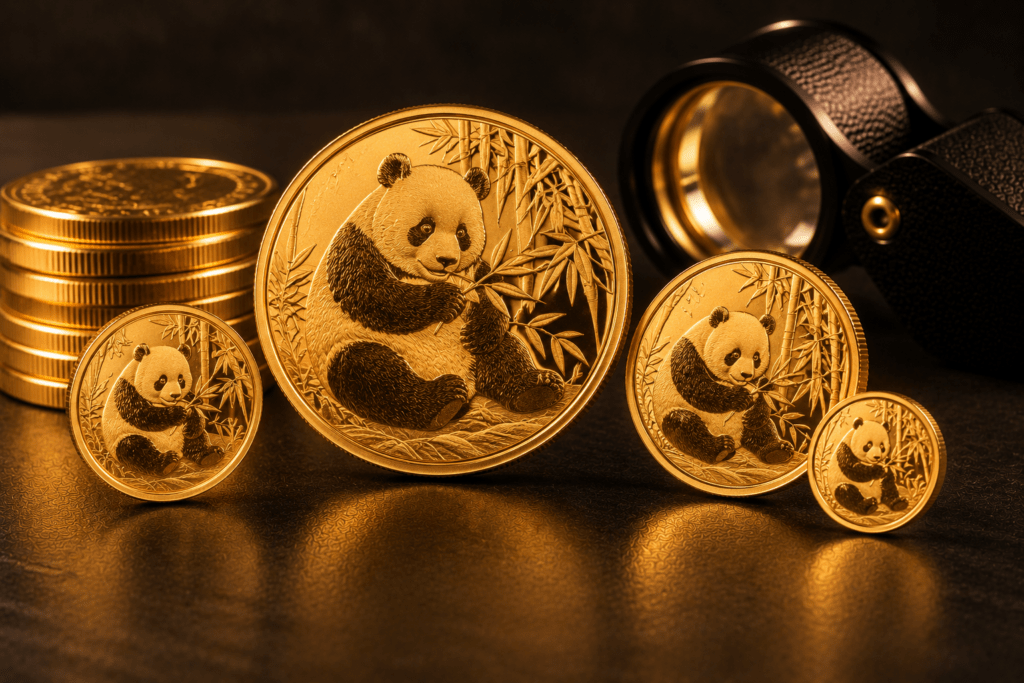
The Chinese Gold Panda is one of the world’s most recognizable gold bullion coins. It combines high-purity gold with something many bullion coins do not offer: a panda design that changes from year to year.
Most Gold Pandas are made from .999 fine gold, meaning they are 99.9% gold. The series began in 1982 and originally used traditional troy-ounce sizes. Beginning in 2016, China changed the standard Panda lineup to metric weights measured in grams.
That distinction is important if you own one.
A modern 30-gram Gold Panda is not quite the same amount of gold as a traditional one-troy-ounce bullion coin, and some older Gold Pandas may also carry collector value beyond their gold content.
At Gold Kings, we evaluate gold coins with both sides of the equation in mind: the precious-metal value of the gold and whether the particular coin may deserve additional consideration because of its date, condition, variety or collector demand.
Quick Answer: What Is a Chinese Gold Panda Coin?
A Chinese Gold Panda is a government-issued gold coin from the People’s Republic of China.
The first Gold Pandas were released in 1982 in 1-ounce, 1/2-ounce, 1/4-ounce and 1/10-ounce sizes. A 1/20-ounce version followed in 1983. The original coins were struck in .999 fine gold.
Modern Gold Pandas typically feature:
- .999 fine gold
- The Temple of Heaven on one side
- A panda design on the other
- A face value denominated in Chinese yuan
- Multiple available weights
- A panda design that generally changes each year
The changing artwork is one reason Gold Pandas appeal to both bullion investors and coin collectors.
How Pure Is a Chinese Gold Panda?
Standard Chinese Gold Panda coins are generally .999 fine gold, or approximately 99.9% pure gold.
That makes them essentially a 24-karat bullion product.
This differs from coins such as the American Gold Eagle, which is made from a 22K alloy but contains its stated amount of pure gold.
With a Gold Panda, the coin itself is nearly pure gold.
If you want to learn more about how different bullion coins compare, see Gold Kings’ Gold Coins & Bullion guide.
Chinese Gold Panda Sizes and Weights
One of the most important things to understand about Gold Pandas is the 2016 change from ounces to grams.
Before 2016, the common bullion sizes closely followed the traditional fractional-ounce system used by many international gold coins.
Beginning in 2016, China replaced those sizes with metric equivalents.
| Modern Gold Panda | Face Value | Rough Earlier Equivalent |
|---|---|---|
| 1 gram | 10 yuan | 1/20 oz |
| 3 grams | 50 yuan | 1/10 oz |
| 8 grams | 100 yuan | 1/4 oz |
| 15 grams | 200 yuan | 1/2 oz |
| 30 grams | 500 yuan | 1 oz |
China has also produced larger proof Gold Pandas, including 50-gram, 100-gram, 150-gram and 1-kilogram coins in various years.
Important: A 30-Gram Panda Is Not a Full Troy Ounce
One troy ounce equals approximately 31.1035 grams.
Therefore:
30 grams ≈ 0.9645 troy ounce
That means someone comparing a modern 30-gram Gold Panda with a one-ounce Gold Eagle, Gold Buffalo or older one-ounce Gold Panda should not assume they contain exactly the same amount of gold.
Why Did China Change Gold Pandas From Ounces to Grams?
China changed the Panda series to metric weights beginning with the 2016 issue.
Instead of:
- 1/20 ounce
- 1/10 ounce
- 1/4 ounce
- 1/2 ounce
- 1 ounce
the standard lineup became:
- 1 gram
- 3 grams
- 8 grams
- 15 grams
- 30 grams
The change aligned the series with the metric system used in China.
For collectors, this also created a clear dividing line between older ounce-based Pandas and modern gram-denominated Pandas.
Why Are Gold Panda Designs Different Every Year?
The changing panda design is one of the series’ signature features.
While many bullion coins use essentially the same artwork year after year, Gold Pandas usually depict pandas in a different scene each year.
Depending on the date, you may see:
- A single panda
- A mother and cub
- Pandas eating bamboo
- Pandas climbing
- Pandas resting or playing
There was a notable exception: the 2001 and 2002 coins shared the same panda design. Annual design changes resumed afterward.
The other side of the coin typically depicts the Hall of Prayer for Abundant Harvests at the Temple of Heaven in Beijing.
How Much Is a Chinese Gold Panda Coin Worth?
There is no single value for every Chinese Gold Panda.
Its value can come from two different sources:
1. Gold or Bullion Value
This is the value of the precious metal contained in the coin.
It depends primarily on:
Gold content × current gold price
Because the gold market changes throughout the day, the underlying bullion value of your Panda changes as well.
You can review Gold Kings’ current gold and silver price information when estimating the underlying metal value.
2. Collector or Numismatic Value
Some Gold Pandas trade for more than their gold content.
Factors can include:
- Year
- Mintage
- Condition
- Variety
- Original packaging
- Proof versus bullion issue
- Professional grading
- Collector demand
- Scarcity in a particular grade
This is why you should not automatically assume every Panda should be valued strictly as scrap gold.
Gold Kings explains this distinction in more detail in our guide to bullion value versus numismatic value.
Are Older Chinese Gold Pandas Worth More?
Sometimes.
But old does not automatically mean rare.
Some older Gold Panda dates have substantial collector demand. Others trade much closer to their underlying gold value.
For example, collectors may pay more for certain:
- Early dates
- Lower-mintage issues
- Scarce varieties
- Proof coins
- High-grade examples
- Coins still in desirable original packaging
Condition can also matter considerably.
A pristine Gold Panda and an identical coin that has been scratched, polished or damaged do not necessarily have the same collector value.
Should You Clean a Chinese Gold Panda?
No.
Do not polish or clean a Gold Panda before having it evaluated.
Avoid:
- Metal polish
- Jewelry cleaner
- Abrasive cloths
- Brushes
- Chemical dips
- Buffing wheels
Even fine scratches or altered surfaces can matter to collectors.
A coin does not become more valuable simply because it looks shinier.
If the coin is already inside a professionally graded PCGS or NGC holder, leave it in the holder.
If it remains in original mint packaging, do not automatically remove it simply to inspect the coin.
How Can You Tell Whether a Chinese Gold Panda Is Real?
Gold Pandas are valuable enough that authentication matters.
Do not rely on one simple home test.
A proper evaluation may consider several characteristics.
Weight
The measured weight should agree with the specifications for that particular Panda.
A modern 30-gram Panda, for example, should not weigh like a full one-ounce coin.
Dimensions
Diameter and thickness can help identify obvious discrepancies.
Design
The panda artwork should correspond with the correct year.
Lettering, relief, surface quality and Temple of Heaven design can also reveal inconsistencies.
Metal Composition
Professional precious-metals testing can help determine whether the coin’s metal composition is consistent with high-purity gold.
Gold Kings uses XRF testing where appropriate to analyze precious-metal composition without unnecessarily scratching or damaging an item.
However, XRF should not be treated as the only authentication method for a valuable coin.
Weight, dimensions, design characteristics, condition and known coin specifications can all matter.
Do Not Acid-Test or Scratch a Collectible Gold Panda
An acid test may be useful for certain types of scrap jewelry.
A potentially collectible bullion coin is different.
Scratching, filing or damaging the surface simply to test the metal can unnecessarily reduce collector appeal.
Professional evaluation should use non-destructive methods whenever practical.
That is particularly important with older, proof, graded or potentially scarce Pandas.
Gold Panda Face Value vs. Real Value
You may see values such as:
- 10 yuan
- 50 yuan
- 100 yuan
- 200 yuan
- 500 yuan
on modern Gold Pandas.
Those numbers are face values, not what the coin is actually worth in the precious-metals market.
For example, a 500-yuan 30-gram Gold Panda contains a substantial amount of physical gold.
Its gold value can therefore be many times greater than the denomination stamped on the coin.
Think of the face value as part of the coin’s legal denomination rather than a realistic estimate of its bullion market value.
Gold Panda vs. American Gold Eagle
Both are popular gold coins, but they are very different products.
| Feature | Chinese Gold Panda | American Gold Eagle |
| Purity | .999 gold | 91.67% gold alloy |
| Standard modern large size | 30 grams | 1 troy oz pure gold |
| Design | Panda changes most years | Traditional Eagle designs |
| Fractional sizes | Metric grams since 2016 | Fractional troy ounces |
| Collector interest | Strong for dates and designs | Strong bullion recognition plus some collector issues |
| Country | China | United States |
Neither structure is inherently better.
They simply use different standards.
Someone selling either type should know the exact coin, gold content and potential premium before accepting an offer.
What About a Gold Panda in a PCGS or NGC Holder?
A professionally certified Gold Panda deserves special attention.
Third-party certification can provide information about:
- Authenticity
- Grade
- Variety
- Year
- Coin type
Do not break a professionally graded coin out of its holder just to weigh or test it.
The certification itself can make the coin easier for collectors to identify and trade.
The grade may also affect its value.
Where Can I Sell a Chinese Gold Panda Coin Near Me?
If you are searching for a gold coin buyer near me, sell gold coins near me, or simply want to know what your Chinese Gold Panda is worth, the buyer should understand more than the weight of the gold.
Before selling, you should be able to understand:
- Which Gold Panda you own
- Its year
- Its weight
- Its expected gold purity
- The current value of its gold content
- Whether condition matters
- Whether it may have a collector premium
- How the offer was calculated
Gold Kings buys and evaluates gold coins and bullion along with gold jewelry, silver, watches and other qualifying precious-metal items.
You can also review what Gold Kings buys before bringing in your coins.
Have Your Chinese Gold Panda Evaluated at Gold Kings
If you own a Chinese Gold Panda and are unsure whether it should be valued primarily as bullion or as a collectible coin, bring it in for an evaluation before making assumptions.
Gold Kings can evaluate the coin’s precious-metal content, weight and identifying characteristics and explain the evaluation before you decide whether you want to sell.
Testing and weighing are handled transparently, and Gold Kings operates two Georgia locations.
Gold Kings of Snellville
3635 Stone Mountain Hwy
Snellville, GA 30039
770-771-4650
The Snellville location serves customers throughout Gwinnett County and surrounding communities and buys gold coins, bullion, gold jewelry, silver and other precious metals.
Learn more about Gold Kings of Snellville.
Gold Kings of Commerce
480 Banks Crossing Dr
Commerce, GA 30529
706-336-0043
The Commerce location serves Commerce, Banks Crossing and surrounding Northeast Georgia communities.
Learn more about Gold Kings of Commerce.
Frequently Asked Questions About Chinese Gold Pandas
Are Chinese Gold Panda coins real gold?
Yes. Standard Gold Panda bullion coins are generally struck in .999 fine gold, meaning approximately 99.9% gold.
Are Gold Pandas 24K?
They are generally considered 24K bullion because .999 fine gold is essentially pure gold.
How much gold is in a 30-gram Gold Panda?
A modern standard large Gold Panda contains 30 grams of .999 fine gold. Thirty grams equals approximately 0.9645 troy ounce.
Is a 30-gram Gold Panda the same as a one-ounce Gold Panda?
No.
A troy ounce is approximately 31.1035 grams. China changed from the traditional one-ounce Panda to the 30-gram Panda beginning in 2016.
Why did China stop making one-ounce Gold Pandas?
China transitioned its standard Panda bullion lineup to metric weights in 2016. The 30-gram coin replaced the traditional one-ounce size.
Do Chinese Gold Pandas change designs every year?
Generally, yes. The changing panda artwork is one of the series’ defining characteristics. The 2001 and 2002 coins are a notable exception because they used the same design.
Can a Chinese Gold Panda be worth more than its gold?
Yes.
Certain dates, varieties, proofs, high-grade coins and other desirable issues may have collector premiums above their underlying gold value.
Should I remove my Panda from its original packaging?
Usually not without a reason.
Original packaging may be desirable to some buyers and collectors, and handling exposes a nearly pure gold coin to fingerprints and surface damage.
Should I clean a dirty Gold Panda?
No.
Cleaning can alter the surfaces and potentially reduce collector appeal.
Can Gold Kings test a Chinese Gold Panda?
Gold Kings can evaluate gold coins and bullion and uses professional precious-metals testing, including XRF technology where appropriate. For coins, metal composition is only one part of the evaluation; weight, design, specifications, condition and possible collector value may also matter.
Before You Sell Your Gold Panda, Know What You Own
A Chinese Gold Panda is more than simply a piece of .999 gold.
Its value can involve:
gold content + current gold price + condition + date + collector demand
For a common modern issue, the precious-metal value may be the biggest factor.
For another Panda, the year, grade, variety or scarcity may justify additional value.
That is why the safest first step is identification before liquidation.
If you have one Gold Panda, a complete collection, inherited gold coins or other bullion you are considering selling, bring them to Gold Kings of Snellville or Gold Kings of Commerce.
We’ll help determine what you have, explain the gold content and evaluate the coin before you decide whether selling makes sense.
Know the coin. Know the gold. Know the value before you sell.