
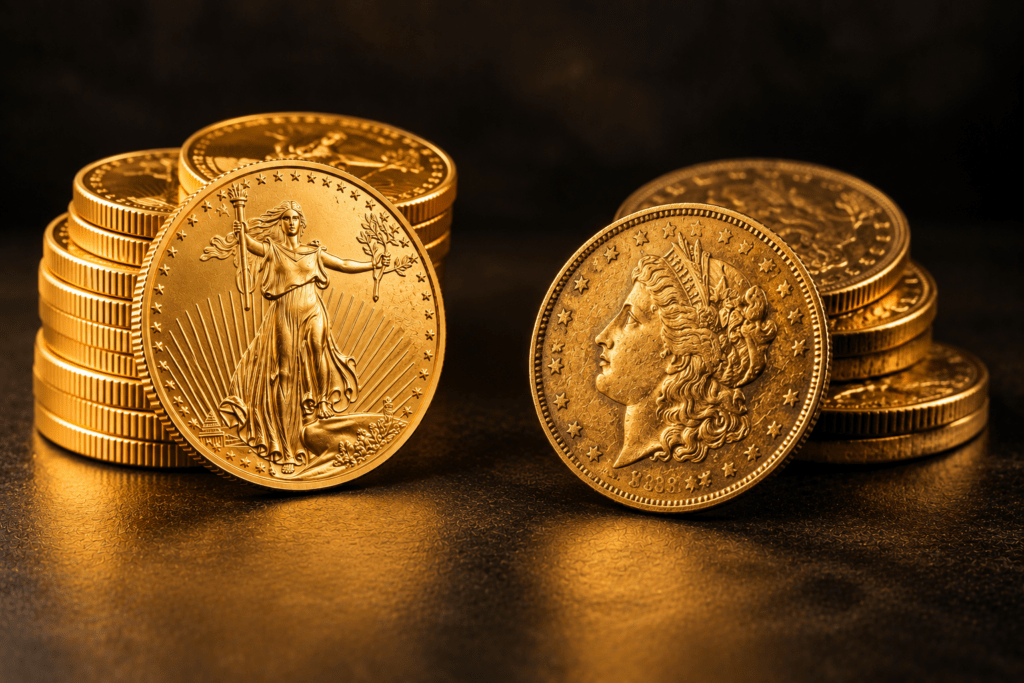
Two gold coins can contain nearly the same amount of gold and still be worth dramatically different amounts.
Why?
Because a gold coin can have two different types of value:
- Bullion value — what the precious metal inside the coin is worth.
- Numismatic value — additional value created by rarity, condition, date, mint mark, collector demand and other characteristics.
This distinction is extremely important before selling a gold coin.
A modern one-ounce bullion coin may trade primarily according to the current gold price. An older or scarce gold coin, however, could potentially be worth substantially more than its underlying gold content.
At Gold Kings, we evaluate gold coins and bullion with this distinction in mind. Before treating an older gold coin simply as precious metal, it makes sense to determine exactly what coin you have.
If you are comparing coins, bullion and bars, you can also read our guide to gold coins vs. gold bars.
Quick Answer: Bullion Value vs. Numismatic Value
Bullion value is primarily based on the amount of precious metal in a coin and the current market price of that metal.
Numismatic value is the collectible value of the coin.
A numismatic coin may be worth more than its bullion value because collectors are willing to pay a premium for factors such as:
- Rarity
- Low mintage
- Date
- Mint mark
- Condition or grade
- Historical significance
- Original surfaces
- Collector demand
- Certification
- Variety or error
The U.S. Mint makes essentially the same distinction. It describes bullion coins as investment-grade coins valued primarily by their precious-metal weight and fineness, while numismatic coins can derive additional value from limited mintage, rarity, condition and age. Learn about bullion coins from the U.S. Mint
That means you should not automatically sell every old gold coin based only on its gold weight.
What Is Bullion Value?
Bullion value starts with the intrinsic precious-metal content of the coin.
For a gold coin, the basic calculation is:
Pure gold weight × current gold price = approximate metal value
Suppose a coin contains exactly one troy ounce of pure gold.
If the gold spot price were hypothetically $X per ounce, the coin would contain approximately $X worth of gold before considering dealer premiums, market spreads or collectible value.
Bullion coins commonly trade somewhat above their raw metal value because there are costs and market premiums associated with minting, distributing and trading physical coins.
The U.S. Mint confirms that its bullion coin pricing is tied to prevailing precious-metal prices plus a premium.
You can check Gold Kings’ gold and silver price information to better understand how current precious-metal pricing affects an item’s underlying value.
Examples of Coins Primarily Bought for Bullion
Many modern investment coins are primarily valued according to their precious-metal content plus whatever market premium applies.
Common examples include:
- American Gold Eagles
- American Gold Buffalos
- Canadian Gold Maple Leafs
- South African Krugerrands
- Austrian Gold Philharmonics
- Modern gold bars and rounds
- Many modern sovereign-mint bullion products
These coins can still develop collector premiums in certain dates, finishes or varieties, but their primary purpose is generally precious-metal investment.
For example, the American Gold Eagle was introduced as an investment bullion coin. Although the coin itself is made from 22-karat gold alloy, it contains the full stated amount of pure gold.
That is why evaluating a bullion coin requires more than simply looking at the karat.
The actual fine gold content matters.
What Is Numismatic Value?
Numismatic value is what collectors may pay above the value of the metal itself.
This is where gold coin evaluation becomes much more interesting.
Imagine two older U.S. gold coins that contain approximately the same amount of gold.
One is a common date in worn condition.
The other is a scarce mint mark in exceptional condition.
Their gold content may be almost identical.
Their market values may not be.
The second coin could command a much larger premium because collectors are competing for the coin itself—not merely for the gold inside it.
Professional coin grading exists largely because condition can play such an important role in collectible value. PCGS notes that a coin’s grade, along with rarity, is a major factor in determining its value.
Bullion Value vs. Numismatic Value at a Glance
| Bullion Value | Numismatic Value | |
|---|---|---|
| Primary value comes from | Precious-metal content | Collector demand |
| Gold price matters? | Very strongly | Yes, but not exclusively |
| Rarity matters? | Usually little | Often significantly |
| Condition matters? | Usually less | Can be extremely important |
| Date and mint mark matter? | Usually less | Often very important |
| Certification matters? | Usually unnecessary | Can substantially affect marketability |
| Typical examples | Modern Gold Eagles, Buffalos, Maple Leafs | Scarce dates, key dates, rare pre-1933 gold |
| Evaluation focus | Weight, purity, authenticity | Identification, rarity, grade, originality and demand |
The important point is that the same evaluation method should not be used for every gold coin.
What Makes a Gold Coin Worth More Than Its Gold?
Several factors can create a numismatic premium.
1. Rarity
A coin that survives in very small numbers may attract significant collector demand.
Rarity is not simply about age.
A 150-year-old coin can sometimes be relatively common while a much newer coin may be difficult to find.
What matters is how many were produced, how many survived and how many collectors want them.
2. Mintage
Mintage refers to the number of coins originally produced.
Lower mintages can contribute to rarity, although low mintage alone does not guarantee a valuable coin.
Survival rate matters too.
3. Date
Some years are considerably harder to find than others.
With collectible gold coins, changing the date by a single year can sometimes change the market value substantially.
That is why an old gold coin should be identified before being valued solely as bullion.
4. Mint Mark
Where the coin was produced can matter just as much as the year.
Historical U.S. coins may carry mint marks identifying facilities such as:
- Philadelphia
- Denver
- San Francisco
- New Orleans
- Carson City
- Charlotte
- Dahlonega
Certain date-and-mint combinations are considerably scarcer than others.
5. Condition and Grade
Coin collectors pay close attention to condition.
A heavily circulated coin and an exceptionally preserved example of the same date can have very different values.
Grading typically considers characteristics such as:
- Wear
- Luster
- Surface preservation
- Strike
- Contact marks
- Eye appeal
A seemingly small difference in grade can sometimes create a large difference in value for a scarce coin.
6. Collector Demand
Rarity alone does not create value.
Someone must also want the coin.
Certain series have large communities of collectors, creating stronger demand for rare dates and high-grade examples.
Popular U.S. gold series can include:
- $1 Gold Pieces
- $2.50 Quarter Eagles
- $3 Gold Pieces
- $5 Half Eagles
- $10 Eagles
- $20 Double Eagles
Many pre-1933 U.S. gold coins deserve a closer look before being valued only for their gold content.
A Gold Coin Can Have Three Different Values
It is useful to think about a gold coin as potentially having three layers of value.
1. Face Value
This is the denomination stamped on the coin.
For example, an American Gold Eagle may say $50.
That does not mean the coin is worth only $50.
2. Precious-Metal Value
This is the value of the actual gold contained in the coin.
3. Collector Value
This is any additional amount collectors may pay for the coin because of its rarity, date, grade, mint mark or desirability.
For some coins, layer three is almost nonexistent.
For others, it can be the most important part of the coin’s value.
Not Every Old Gold Coin Is Rare
This is one of the biggest misconceptions about coin collecting.
Old does not automatically mean valuable.
Some old gold coins were produced in large numbers and remain readily available to collectors.
Likewise, a coin being made from gold does not automatically make it numismatically valuable.
Its value may still be primarily based on its precious-metal content.
The opposite mistake can be even more expensive: assuming an unfamiliar old coin is only worth its melt value when collectors may pay considerably more.
The safest approach is to identify the coin first.
Never Clean a Gold Coin Before Having It Evaluated
If you find an old gold coin in an estate, jewelry box or collection, resist the temptation to make it look better.
Do not automatically:
- Polish it
- Buff it
- Scrub it
- Use jewelry cleaner
- Use abrasives
- Try to remove toning or residue
Cleaning can permanently alter a coin’s original surfaces.
For a collectible coin, originality can matter considerably.
A shiny coin is not necessarily a more valuable coin.
In some cases, cleaning can reduce its numismatic appeal.
What If a Gold Coin Was Soldered Into Jewelry?
Gold coins were historically used in:
- Bracelets
- Necklaces
- Pendants
- Rings
- Bezels
- Money clips
Unfortunately, jewelry use can affect collector value.
A coin that has been:
- Soldered
- Holed
- Filed
- Bent
- Scratched
- Mounted
- Polished
may lose some or all of the numismatic premium it otherwise could have had.
However, that does not mean the coin is worthless.
The gold itself still has precious-metal value, and some damaged coins may retain collectible value depending on rarity.
This is another reason to evaluate the coin and its gold content separately.
How Gold Kings Evaluates Gold Coins
At Gold Kings, determining the value of a gold coin begins with figuring out what you actually own.
Depending on the coin, an evaluation may consider:
Identification
What country issued it?
What denomination is it?
What year was it produced?
Does it have a mint mark?
Precious-Metal Content
How much gold should the coin contain?
What is its weight?
What is its expected fineness?
Authenticity
Professional precious-metal testing can help evaluate the metal composition.
Gold Kings uses professional XRF technology where appropriate to analyze precious-metal composition, but XRF is only one part of evaluating a coin. Weight, dimensions, design characteristics and other physical details may also be important.
Condition
Is the coin circulated?
Has it been cleaned?
Is it damaged?
Has it been mounted or soldered?
Possible Collector Value
Does the date, mint mark, condition or type suggest that the coin deserves consideration beyond its underlying gold value?
Gold Kings purchases investment-grade bullion coins, circulated coins, collectible coins, U.S. and international coins, along with other precious metals. See the types of coins and bullion Gold Kings buys.
Why Testing Gold Coins Requires Care
Testing a broken gold chain is different from evaluating a potentially collectible coin.
With ordinary scrap jewelry, determining purity and weight is usually the central concern.
With a potentially valuable gold coin, preserving the coin’s surface matters.
An evaluation should therefore avoid unnecessary destructive testing.
Professional evaluation may combine:
- Known coin specifications
- Accurate weight
- Dimensions
- Visual examination
- Metal analysis
- Design comparison
- Date and mint-mark identification
- Condition assessment
For valuable numismatic coins, professional third-party grading may sometimes be appropriate before selling.
Where Can I Sell Gold Coins Near Me?
Your search should not simply be:
Who buys gold?
A better question is:
Will the buyer recognize when a coin might be worth more than its gold content?
That matters particularly when dealing with inherited collections, pre-1933 U.S. gold, unusual foreign coins, proof coins or unfamiliar pieces.
Gold Kings evaluates both gold bullion and gold coins, which allows the conversation to begin with what the item actually is rather than automatically treating every coin as scrap.
If you are unsure what you have, you can review what Gold Kings buys before visiting.
Have Your Gold Coins Evaluated at Gold Kings
If you inherited gold coins, found old coins in an estate or simply want to know whether your gold is bullion or potentially collectible, bring the coins in before making assumptions about their value.
Gold Kings can evaluate the precious-metal content, weight and characteristics of your coins and explain what you have before you decide whether to sell.
There is no reason to guess based only on a photograph or the coin’s face value.
Gold Kings of Snellville
3635 Stone Mountain Hwy
Snellville, GA 30039
770-771-4650
The Snellville location serves customers throughout Snellville, Loganville, Lawrenceville, Grayson, Lilburn, Stone Mountain and surrounding Gwinnett County communities.
Learn more about Gold Kings of Snellville. The location buys gold coins and bullion and performs testing and weighing in front of customers.
Gold Kings of Commerce
480 Banks Crossing Dr
Commerce, GA 30529
706-336-0043
The Commerce location is convenient for customers throughout Commerce, Banks Crossing, Jefferson and surrounding Northeast Georgia communities.
Learn more about Gold Kings of Commerce. Coins and bullion are among the items evaluated at the Commerce location.
Frequently Asked Questions About Bullion and Numismatic Value
What is the difference between bullion value and numismatic value?
Bullion value is primarily based on the precious-metal content of a coin.
Numismatic value includes additional collector value created by factors such as rarity, condition, date, mint mark and demand.
Can a gold coin be worth more than the gold inside it?
Yes.
A collectible gold coin may sell for more than its underlying gold value because collectors are paying for the coin’s rarity, condition or historical desirability in addition to the metal.
Are all old gold coins numismatic coins?
No.
Some older gold coins trade primarily according to their gold content.
Age by itself does not make a coin rare.
Are American Gold Eagles bullion or numismatic coins?
Standard American Gold Eagle bullion coins were created primarily as precious-metal investment products.
However, proof, uncirculated, scarce or special versions can have additional collector demand.
The U.S. Mint produces both bullion and collectible versions of American Eagle coins.
Does a graded coin automatically have numismatic value?
Not necessarily.
Certification helps establish authenticity and condition, but the coin still needs collector demand.
A common coin can be professionally graded without becoming rare.
Should I remove a gold coin from its holder?
Usually not.
If a coin is already professionally certified by a recognized grading service, leave it in the holder.
Removing it can eliminate the benefit of the existing certification and expose the coin to unnecessary damage.
Does cleaning a gold coin increase its value?
Usually not.
Collectors often prefer original surfaces. Improper cleaning can permanently alter the coin and reduce its collector appeal.
What happens if my gold coin has been soldered into jewelry?
Soldering or mounting can reduce numismatic value because the original coin has been altered.
However, the coin still contains gold, and rare coins may still deserve individual evaluation.
How do I know what my gold coin is worth today?
Start by identifying the exact coin.
Then consider:
- Gold content
- Current gold price
- Date
- Mint mark
- Condition
- Rarity
- Collector demand
- Any damage or alterations
For bullion coins, the current gold market is particularly important. You can review Gold Kings’ gold and silver price information before having the coin evaluated.
Before You Sell a Gold Coin, Find Out What You Have
A gold coin should never be valued by one number alone.
For some coins, the gold is almost the entire story.
For others, the date, mint mark, condition and rarity may be worth considerably more than the metal itself.
That is the difference between bullion value and numismatic value.
If you have gold coins you are thinking about selling, Gold Kings can help you determine what you actually own before you make a decision.
Bring your coins to Gold Kings of Snellville or Gold Kings of Commerce for an in-person evaluation.
Know the coin. Know the gold. Know the value before you sell.