
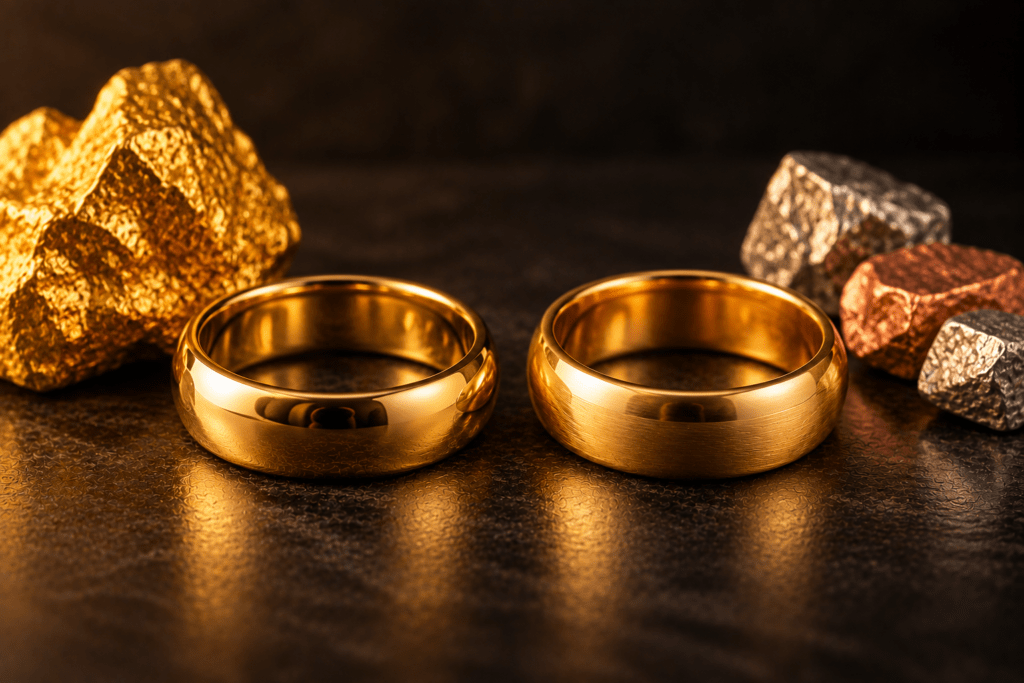
If you’re comparing 14K vs. 18K gold:
14K gold is about 58.3% pure gold, while 18K gold is 75% pure gold.
That makes 18K gold richer in pure gold and generally more valuable gram for gram. However, 14K gold is usually harder and better able to handle everyday wear.
Neither one is automatically “better.”
The right choice depends on whether you care most about gold content, durability, appearance, price, or resale value.
At Gold Kings, we regularly evaluate gold jewelry in different karats. One thing we see repeatedly is that the stamp is only the starting point. When the actual value matters, the item’s purity and weight matter more than what is stamped on the clasp or inside the ring.
14K vs. 18K Gold at a Glance
| Comparison | 14K Gold | 18K Gold |
|---|---|---|
| Pure gold content | About 58.3% | 75% |
| Common fineness mark | 585 or 583 | 750 |
| Other metal content | About 41.7% | 25% |
| Durability | Generally harder | Generally softer |
| Gold color | Usually less intense | Usually richer |
| Gold value per gram | Lower | Higher |
| Everyday wear | Excellent | Very good |
| Typical use | Rings, chains, bracelets, everyday jewelry | Fine jewelry, wedding jewelry, luxury pieces |
| Common stamps | 14K, 14KT, 585, 583 | 18K, 18KT, 750 |
The most important difference is the amount of actual gold in the jewelry.
What Is 14K Gold?
The “K” in 14K stands for karat, a system that measures gold purity out of 24 parts.
Pure gold is represented as 24K.
Therefore:
14 ÷ 24 = approximately 58.3% gold
The remainder is made from other metals used to create the alloy.
Depending on the jewelry, those metals can include copper, silver, zinc, nickel, palladium, or other metals.
You may also see 14K jewelry stamped 585. That fineness mark means the alloy is intended to contain approximately 585 parts gold per 1,000, or 58.5% gold.
The slight difference between the mathematical 58.3% karat calculation and a 585 fineness mark is normal. They are two closely related ways of expressing jewelry in the 14K purity range.
Common 14K Gold Markings
Look for stamps such as:
- 14K
- 14KT
- 14 Karat
- 585
- 583
A hallmark can be useful, but it should not be treated as absolute proof that the entire piece contains exactly that amount of gold.
What Is 18K Gold?
18K gold contains substantially more pure gold.
The calculation is:
18 ÷ 24 = 75% gold
That means an 18K item is three-quarters pure gold and approximately one-quarter other metals.
The most common European-style fineness stamp for 18K gold is 750, meaning 750 parts gold per 1,000.
Common 18K Gold Markings
You may see:
- 18K
- 18KT
- 18 Karat
- 750
Because 18K contains more gold than 14K, it normally has a richer gold appearance and a higher intrinsic precious-metal value.
Is 18K Gold Worth More Than 14K Gold?
Yes, assuming the pieces weigh the same and test at their expected purity.
Consider two pieces of jewelry that each weigh 10 grams.
10 Grams of 14K Gold
10 × 58.3% = approximately 5.83 grams of pure gold
10 Grams of 18K Gold
10 × 75% = 7.5 grams of pure gold
The 18K piece contains about 1.67 additional grams of pure gold even though both pieces weigh exactly 10 grams.
Another way to look at it:
18K gold contains approximately 28.6% more pure gold than 14K gold of the same weight.
That difference can become significant when you are dealing with heavy chains, bracelets, rings, or multiple pieces of jewelry.
How Is the Value of 14K and 18K Gold Calculated?
The basic precious-metal value of gold jewelry depends on three primary numbers:
Weight × actual gold purity × current gold price
Gold prices move throughout the trading day, so the dollar value of the exact same ring can change as the gold market moves.
For example, knowing that a bracelet weighs 25 grams is not enough.
You also need to know whether it is:
- 10K
- 14K
- 18K
- 22K
- Another purity
- Gold plated rather than solid gold
This is why professional testing matters when determining what gold is actually worth.
Jewelry Weight Is Not Always Pure Gold Weight
A piece can also contain components that should not be valued as gold, including:
- Diamonds
- Gemstones
- Springs
- Clasps
- Watch movements
- Steel components
- Non-gold decorative elements
A knowledgeable gold buyer should consider the actual precious-metal content rather than simply multiplying the total jewelry weight by the gold price.
Which Is More Durable: 14K or 18K Gold?
14K gold is generally more durable than 18K gold.
Pure gold is relatively soft. Adding other metals to gold can make the resulting alloy harder and more resistant to everyday wear.
Since 14K contains about 41.7% alloy metals compared with 25% in 18K, 14K jewelry is often better suited for pieces that receive frequent contact.
That can make 14K particularly attractive for:
- Wedding bands
- Engagement rings
- Bracelets
- Everyday chains
- Men’s rings
- Jewelry worn during physical activity
However, karat alone does not determine durability.
The exact alloy, thickness, design, construction, and type of jewelry also matter.
A heavy, well-made 18K band may withstand everyday wear better than a very thin 14K ring.
Does 18K Gold Scratch More Easily?
Generally, 18K gold can scratch or dent more easily than 14K gold because it contains more pure gold.
That does not mean 18K is too delicate to wear.
Millions of pieces of fine jewelry are made from 18K gold and worn regularly. It simply deserves a little more care, especially with rings and bracelets that frequently contact hard surfaces.
If maximum durability is your priority, 14K often has the advantage.
If higher gold content and a richer gold appearance matter more, 18K may be worth the tradeoff.
Does 18K Gold Look Different From 14K?
It can.
Yellow 18K gold often has a deeper, richer yellow color because it contains more pure gold.
14K yellow gold usually has a slightly lighter appearance because a larger portion of the alloy consists of other metals.
However, color also depends on the alloy formula.
Yellow Gold
More pure gold generally creates a richer yellow appearance.
White Gold
Both 14K and 18K white gold are mixed with white-colored metals. Many white-gold pieces are also rhodium plated, which can make the surface appearance of 14K and 18K white gold very similar.
Rose Gold
Rose gold typically gets its reddish or pink color from copper in the alloy. Because 14K contains a larger proportion of non-gold metals, its rose color can sometimes appear stronger than comparable 18K rose gold.
Color alone should never be used to determine karat.
Is 14K Gold Real Gold?
Absolutely.
14K gold is real solid gold jewelry when the alloy actually contains gold throughout the piece.
By the karat calculation, 14K is approximately 58.3% gold. Jewelry marked 585 represents approximately 58.5% fineness in the same general 14K purity range.
It should not be confused with:
- Gold-plated jewelry
- Gold-filled jewelry
- Gold vermeil
- Gold-tone costume jewelry
Those products may contain gold on the surface while having a different base metal underneath.
Solid 14K gold contains gold throughout the alloy.
Is 18K Gold Better Than 14K?
It depends on what you mean by better.
Choose 14K if you prioritize:
- Everyday durability
- Lower purchase price
- Resistance to dents and scratches
- Rings and bracelets worn frequently
- Real gold without paying for 75% purity
Choose 18K if you prioritize:
- Higher gold content
- Greater intrinsic gold value
- Richer yellow-gold color
- Fine or luxury jewelry
- A higher-purity gold alloy
For resale based primarily on precious-metal content, 18K has the advantage gram for gram.
For durability and everyday practicality, 14K often has the advantage.
585 vs. 750 Gold
Another way to compare 14K and 18K is by their fineness marks.
585 gold = 58.5% gold and generally corresponds to the 14K purity range.
750 gold = 75% gold = 18K gold.
These numbers represent how many parts out of 1,000 are intended to be pure gold.
- 585 = 58.5% gold
- 750 = 75% gold
If you find a piece marked 585 or 750 instead of 14K or 18K, that does not necessarily mean it is foreign, fake, or unusual. Fineness markings are common on jewelry made around the world.
Can a 14K or 18K Stamp Be Wrong?
Yes.
A stamp is useful evidence, but it does not replace testing.
There are several reasons the actual tested purity can differ from the stamp:
- Previous repairs
- Solder around joints
- Replacement clasps
- Mixed-karat components
- Plating
- Manufacturing variations
- Counterfeit hallmarks
- Different metals within the same item
Older jewelry may also have a worn or missing stamp while still containing real gold.
That is why you should not automatically throw away an unmarked piece or assume a stamped piece has a specific value without testing it. A gold hallmark can even be fake.
How Gold Kings Tests 14K and 18K Gold
If you are unsure whether your jewelry is 14K, 18K, or something else, Gold Kings can evaluate it.
Professional precious-metal testing, including XRF testing when appropriate, can help identify the metal composition of an item.
We can also weigh the jewelry and explain how purity and weight affect its gold value.
An XRF reading is especially useful because it provides information about the metals present in the area being tested. With jewelry that has multiple components, repairs, or solder, more than one area may need to be evaluated to understand the piece properly.
The goal is simple:
Find out what the item actually contains before deciding what it is worth.
Thinking About Selling 14K or 18K Gold?
If you have old, broken, or unwanted jewelry, its condition does not necessarily eliminate its gold value.
Gold Kings evaluates items such as:
- 14K and 18K rings
- Gold chains
- Bracelets
- Earrings
- Wedding bands
- Broken jewelry
- Single earrings
- Tangled chains
- Estate jewelry
- Inherited gold
- Dental gold
- Gold watches
- Gold coins and bullion
A broken 18K chain still contains gold. So does a damaged 14K ring. Learn more about selling broken gold jewelry.
When you’re deciding where to sell gold jewelry, understanding the item’s tested purity and weight gives you much better information than simply accepting an offer based on appearance.
Know What You Have Before You Sell It
If you’re searching for a gold buyer near you or wondering what your 14K or 18K gold is worth, start with the numbers.
Have the item tested.
Have it weighed.
Ask how the value was calculated.
At Gold Kings, customers can see their precious metals being evaluated and better understand what they own before deciding whether to sell.
Have Your Gold Tested at Gold Kings
Gold Kings has two Georgia locations where customers can bring gold jewelry and other precious metals for evaluation.
Gold Kings of Snellville
Gold Kings of Snellville
3635 Stone Mountain Hwy
Snellville, GA 30039
The Snellville location serves customers throughout Gwinnett County and surrounding communities looking to sell gold jewelry, coins, bullion, silver, and other precious metals.
Gold Kings of Commerce
Gold Kings of Commerce
480 Banks Crossing Dr
Commerce, GA 30529
The Commerce location is convenient for customers throughout Commerce and Northeast Georgia who want to have gold, silver, jewelry, coins, or bullion evaluated.
If you do not know whether your jewelry is 14K, 18K, or even real gold, you do not need to figure it out before visiting.
Bring it in and let us examine it.
We test it. We weigh it. We explain what you have. You decide whether to sell.
Frequently Asked Questions About 14K vs. 18K Gold
Which is better, 14K or 18K gold?
Neither is universally better. 14K is generally harder and more practical for everyday jewelry, while 18K contains more pure gold and is normally worth more per gram.
Is 18K gold more valuable than 14K?
Yes. An 18K item contains 75% pure gold compared with approximately 58.3% by the karat calculation for 14K. At the same weight, 18K contains about 28.6% more pure gold.
Is 14K real gold?
Yes. Solid 14K gold is real gold. By the karat calculation it contains approximately 58.3% pure gold, while a 585 fineness mark represents 58.5% gold.
What does 585 mean on gold?
A 585 stamp generally identifies an alloy containing approximately 58.5% pure gold. It corresponds to jewelry in the 14K purity range.
What does 750 mean on gold?
A 750 stamp means the metal is intended to contain 75% pure gold, which corresponds to 18K gold.
Is 14K more durable than 18K?
Usually. Because 14K contains a larger percentage of alloy metals, it is generally harder and more resistant to scratching and denting.
Can you wear 18K gold every day?
Yes. 18K is commonly used for everyday fine jewelry. However, it is softer than 14K and may require more care.
Is 14K or 18K better for a wedding ring?
Both can be excellent. Someone prioritizing durability may prefer 14K. Someone prioritizing higher gold content, richer color, and intrinsic gold value may prefer 18K.
How can I tell if my jewelry is 14K or 18K?
Start by looking for stamps such as 14K, 585, 18K, or 750. Because stamps are not absolute proof of purity, professional testing is the better option when authenticity or value matters.
Is an 18K ring always worth more than a 14K ring?
Not necessarily. Weight matters. A heavy 14K ring can contain more total pure gold than a very light 18K ring. Designer value, diamonds, and other factors can also affect what a finished piece is worth.
The Bottom Line: 14K vs. 18K Gold
The difference between 14K and 18K gold comes down primarily to purity.
14K gold: approximately 58.3% pure gold by the karat calculation.
585 fineness: 58.5% pure gold and commonly used for 14K-range jewelry.
18K gold: 75% pure gold.
750 fineness: 75% pure gold and equivalent to 18K.
14K is generally harder and more durable.
18K contains more gold, has a richer gold appearance, and is worth more gram for gram.
If you’re buying jewelry, choose the karat that best fits how you plan to wear it.
If you’re selling jewelry, don’t guess based only on the stamp.
Bring your 14K, 18K, or unmarked jewelry to Gold Kings in Snellville or Commerce. We can test it, weigh it, and help you understand what you actually have before you decide whether to sell.