
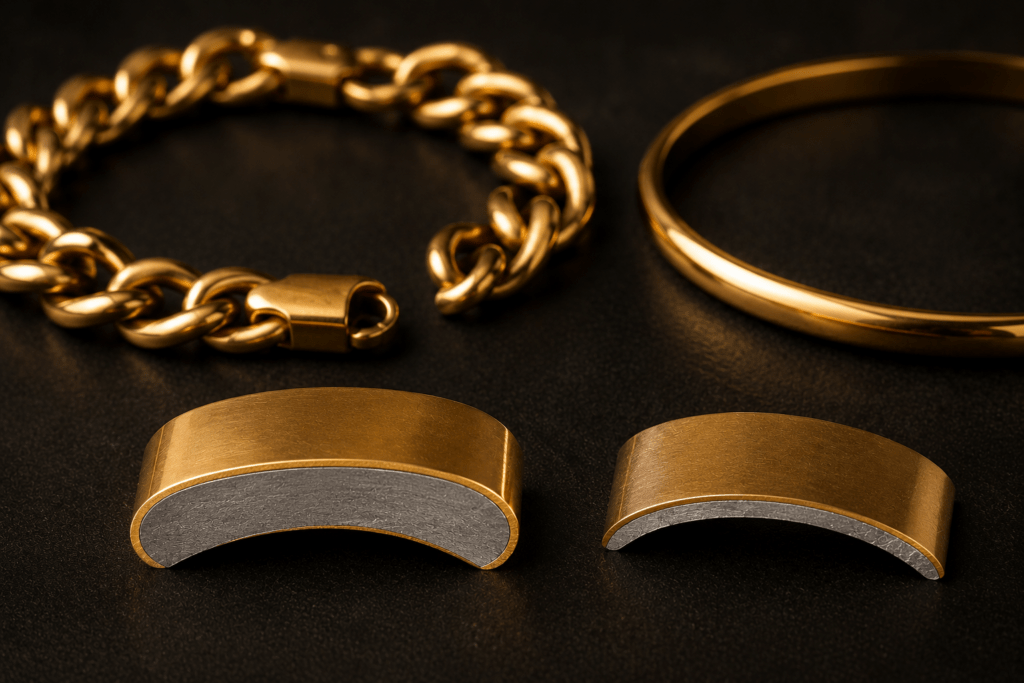
Gold filled and gold plated jewelry can look almost identical.
But when it comes to the amount of actual gold in the piece, there can be a huge difference.
Gold filled jewelry generally contains much more gold than gold plated jewelry.
However, neither type is the same as solid 10K, 14K, 18K, or 22K gold.
Here is how to tell the difference.
Gold Filled vs. Gold Plated at a Glance
| Type | What It Means | Amount of Gold | Typical Value |
|---|---|---|---|
| Solid Gold | Gold alloy throughout the piece | High | Highest |
| Gold Filled | Thick layer of karat gold bonded to base metal | Moderate | Can have gold value |
| Gold Plated | Thin coating of gold over another metal | Very low | Usually little gold value |
| Gold Vermeil | Gold plating over sterling silver | Low gold content + silver value | Depends on weight |
| Gold Tone | Gold-colored finish; may contain no gold | Possibly none | Usually minimal |
What Is Gold Filled Jewelry?
Gold filled jewelry is not solid gold, but it does contain a substantial layer of real karat gold mechanically bonded to another metal.
Under FTC guidance for gold jewelry, jewelry described as gold filled uses at least 10K gold, and the traditional gold-filled standard represents at least 1/20 of the item’s metal weight as the gold alloy layer.
As a result, gold-filled jewelry usually contains much more gold than ordinary gold-plated jewelry.
Common Gold Filled Markings
When reading jewelry hallmarks and markings, look for examples such as:
- 1/20 14K GF
- 1/20 12K GF
- 14K GF
- 12K GF
- G.F.
The letters GF usually mean Gold Filled.
What Does 1/20 14K GF Mean?
This marking confuses a lot of people.
If your jewelry says:
1/20 14K GF
it does not mean the entire piece is 14K gold.
It means that 1/20, or 5%, of the metal weight is 14K gold alloy.
Because 14K gold itself is about 58.3% pure gold, a 1/20 14K gold-filled piece theoretically contains about 2.9% pure gold by total metal weight.
Example
Imagine a gold-filled piece containing 20 grams of metal.
If it carries the mark 1/20 14K GF:
- 1/20 of 20 grams = 1 gram of 14K gold alloy
- 14K is approximately 58.3% pure gold
- 1 gram × 58.3% = about 0.583 gram of pure gold
That is still dramatically less gold than a solid 14K piece — but considerably more than most gold-plated jewelry.
Actual recoverable value can vary because of solder, clasps, stones, non-metal components, wear, and construction.
What Is Gold Plated Jewelry?
Gold plated jewelry usually consists of a base metal covered by a very thin layer of real gold.
The base underneath could be:
- Copper
- Brass
- Nickel
- Stainless steel
- Silver
- Another metal alloy
The FTC notes that plating eventually wears away. Its durability depends partly on the coating’s thickness and how you wear the jewelry.
Because the coating can be extremely thin, the total amount of gold in a plated piece is usually very small.
Is 14K Gold Plated Real Gold?
Yes — but only the plating is 14K gold.
For example:
14K GP
usually means that the outside coating consists of 14K gold alloy.
However, it does not mean the whole ring, chain, bracelet, or watch contains 14K gold throughout.
That distinction matters enormously when determining value.
A 30-gram solid 14K chain contains a large amount of gold.
By comparison, a 30-gram 14K gold-plated chain may contain only a tiny amount of gold on its surface.
Which Has More Gold: Gold Filled or Gold Plated?
Gold filled wins easily.
Gold-filled jewelry normally contains significantly more gold than ordinary gold-plated jewelry.
Think of it this way:
Solid gold: Gold alloy goes throughout the item.
Gold filled: Manufacturers bond a relatively substantial gold layer to another metal.
Gold plated: A thin gold coating covers another metal.
So when someone brings us an older piece of jewelry marked GF, we do not automatically treat it the same as ordinary costume jewelry.
The marking matters.
Does Gold Filled Jewelry Have Value?
It can.
Gold-filled jewelry may contain enough gold to have precious-metal recovery value, particularly when you have:
- Heavy chains
- Watch cases
- Bracelets
- Large lots of old jewelry
- Vintage eyeglass frames
- Older gold-filled items
- Several pieces you plan to sell together
However, one lightweight gold-filled item may contain only a small amount of recoverable gold.
In contrast, a large collection may contain enough gold to make recovery worthwhile.
Is Gold Plated Jewelry Worth Anything?
Sometimes — but not necessarily because of the gold.
Ordinary gold-plated jewelry generally contains so little gold that the gold coating alone may provide very little scrap value.
However, a piece could still have value because of:
- Sterling silver underneath
- Diamonds
- Gemstones
- Brand
- Age
- Collectibility
- Design
- Overall resale value
This is why you should identify the entire piece rather than assuming that everything marked “plated” is worthless.
What If It Says 925 and Looks Gold?
A piece marked 925 is usually sterling silver.
If it has a yellow-gold appearance, a thin gold coating may cover the sterling silver.
Jewelers commonly call this gold-over-silver jewelry.
That means the gold coating may be thin, but the sterling silver underneath still has precious-metal value.
How Can You Tell If Something Is Gold Plated?
Start with the markings.
Look carefully around:
- Clasps
- Inside rings
- Bracelet ends
- Necklace tags
- Watch cases
- Earring posts
Gold Plated Markings May Include
- GP
- GEP
- Gold Plate
- Gold Electroplate
- A karat number followed by a plating designation
For example:
14K GP
does not mean solid 14K gold.
Gold Filled Markings May Include
- GF
- 1/20 14K GF
- 1/20 12K GF
- Gold Filled
Finding the mark is only the first step.
Can You Tell With a Magnet?
A magnet can sometimes provide useful information, but it cannot prove that an item is real gold.
For example, some non-gold metals are not magnetic.
Some gold jewelry also contains components such as springs or clasps that can react differently from the rest of the item.
Our guide to using the magnet test on gold explains how this screening test can help and why it cannot confirm gold content.
How Do Professionals Test Gold Filled and Gold Plated Jewelry?
Professional gold testing may involve more than one method.
Depending on the item, testing can include:
- Examining stamps and markings
- Inspecting worn areas
- Testing multiple locations
- Electronic or XRF analysis
- Additional verification if the buyer suspects plating
This is especially important with coated jewelry.
XRF is extremely useful for precious-metal analysis, but it primarily analyzes the surface and near-surface material. Coatings can therefore influence a reading. Thermo Fisher specifically recommends secondary analysis when testing gold-filled jewelry or when thick plating may be present.
That is why a professional buyer should not determine an item’s value from one stamp or one test alone.
Gold Filled vs. Gold Plated: Which Is Better?
That depends on what you want.
For Jewelry You Plan to Wear
Gold filled typically:
- Contains more gold
- Lasts longer before the underlying metal becomes exposed
- Handles regular wear better
- Costs more than ordinary gold plate
Gold plated typically:
- Costs less
- Gives you the appearance of gold
- Contains much less gold
- May show wear sooner
For Gold Value
The order is generally:
Solid gold → Gold filled → Gold plated
The difference between each category can be substantial.
Frequently Asked Questions
Is gold filled real gold?
Yes. Gold-filled jewelry contains a layer of genuine karat gold bonded to another metal. However, the entire piece is not solid gold.
Is 14K gold plated real or fake?
The 14K gold coating can contain genuine 14K gold, but another metal forms most of the underlying item.
What does 14/20 mean on jewelry?
Read tiny stamps carefully because wear or small lettering can make them difficult to see. A common gold-filled marking is 1/20 14K GF, which identifies both the proportion and karat quality of the gold layer.
Does gold filled have more gold than gold plated?
Yes. Gold-filled jewelry generally contains far more gold than conventional gold-plated jewelry.
Can gold filled jewelry be sold for scrap?
Depending on its weight, marking, construction, and recoverable precious-metal content, gold-filled jewelry may have scrap value. If you are considering selling jewelry for its metal content, see our guide to selling scrap gold.
How do I know if my ring is gold plated?
Check inside the band for marks such as GP or other plating terminology. If you are unsure, have the ring professionally tested rather than relying only on its color.
Can a gold plated item test as gold?
Surface testing can detect the gold coating, which is one reason coated items require careful interpretation. Therefore, professionals may test multiple areas or use another method if they suspect plating.
Have Gold Jewelry You’re Not Sure About?
Old jewelry can be difficult to identify.
Some costume-style jewelry has a substantial bonded gold layer. In contrast, a piece that looks like solid 14K may have only a thin gold coating.
Don’t guess based on color alone.
At Gold Kings, we can examine your jewelry, check its markings, test the metal, and explain what you actually have.
Bring in:
- Broken jewelry
- Old chains
- Rings
- Bracelets
- Earrings
- Gold-filled jewelry
- Sterling silver
- Coins
- Unwanted precious metals
Knowing exactly what your jewelry contains is the first step toward knowing what it may be worth. You can also review the complete list of items Gold Kings buys.
Visit Gold Kings of Snellville or our Commerce location for professional precious-metal testing and evaluation.
We test it, we weigh it, and we pay you.