
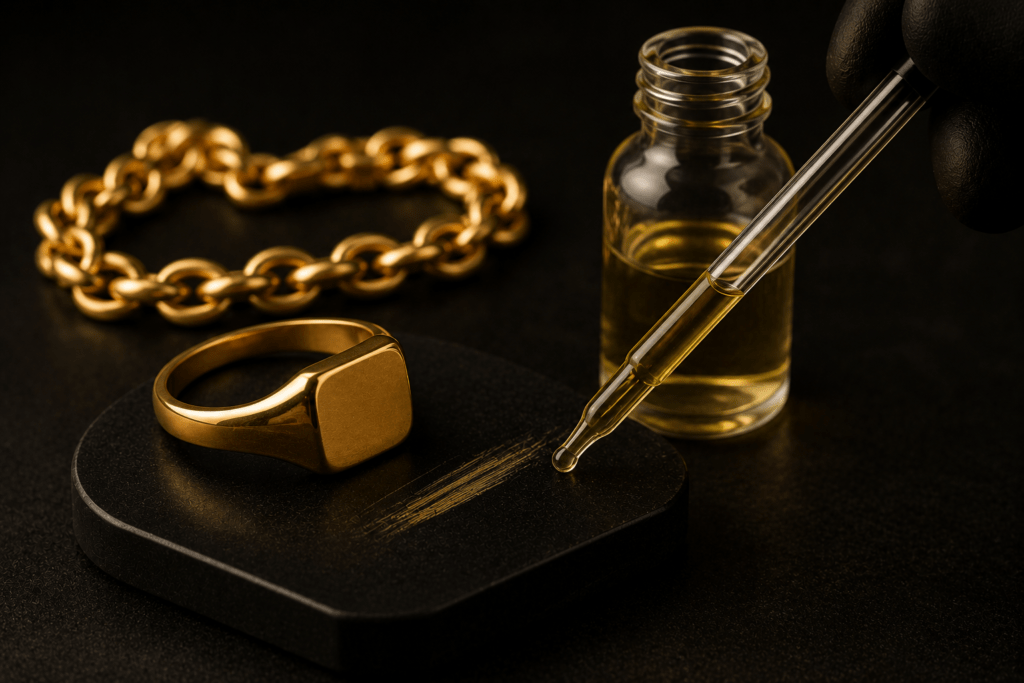
If you have ever taken gold jewelry to a jeweler, pawn shop, or gold buyer, you may have seen them rub the item across a black stone and apply a drop of liquid.
That is a
gold acid test
.
Gold acid testing is a traditional method used to determine whether an item contains real gold and to estimate its karat.
The basic idea is simple:
Gold resists acid better than most of the metals mixed with it.
The higher the gold content, the more resistant the sample is to a properly calibrated testing solution.
But there is more to the test than simply putting acid on a piece of jewelry.
What Is a Gold Acid Test?
A professional gold acid test usually uses a
touchstone
and special testing solutions made for different gold purities.
Common test levels include:
| Test | Approximate Gold Content |
|---|---|
10K / 417 |
41.7% gold |
14K / 585 |
58.5% gold |
18K / 750 |
75% gold |
22K / 916 |
91.7% gold |
24K / 999 |
Nearly pure gold |
Instead of placing acid directly on the visible surface of the jewelry, the tester normally rubs the item across a dark testing stone.
This leaves a small streak of metal behind.
The acid is then applied to the
metal streak
, allowing the tester to see how it reacts.
How the Gold Acid Test Works Step by Step
1. The Jewelry Is Inspected
Before testing, the item should be examined for markings.
Common gold markings include:
You may also see markings such as
GP, GEP, HGE or GF
, which can indicate gold plating or gold-filled jewelry.
However, a stamp alone does
not
prove that an item is genuine.
Fake jewelry can carry fake gold stamps.
That is why testing matters.
Learn more about how to read jewelry hallmarks
.
2. The Gold Is Rubbed on a Touchstone
The jewelry is gently rubbed across a special testing stone.
This creates a visible streak of metal.
Only a tiny amount of material is transferred, so a properly performed touchstone test is relatively nondestructive.
The tester can then work with the streak instead of putting acid directly on the jewelry.
3. The Correct Testing Acid Is Applied
The tester selects an acid solution calibrated for a particular karat.
Suppose an item is marked
14K
.
The tester may apply a 14K testing solution to the streak.
The reaction helps determine whether the metal contains enough gold to withstand that particular solution.
A simplified example:
If the streak remains strong after the appropriate test, the item may be at or above that purity.
If the streak quickly fades or disappears, the item’s gold content may be below that level.
Professional testing often involves comparing several reactions rather than relying on one drop of acid.
What Happens When Acid Touches Gold?
Pure gold is unusually resistant to chemical attack.
The other metals commonly mixed with gold—such as copper, silver, nickel and zinc—are more reactive.
That difference is what makes acid testing possible.
For example,
14K gold is only about 58.5% pure gold
. The remaining portion consists of other metals.
An acid solution can react with those other metals much more readily than it reacts with the gold.
The tester watches what happens to the streak and compares the reaction with known gold samples.
What Does a 14K Gold Acid Test Tell You?
This is one of the most common gold tests.
If jewelry is marked
14K
, the stamp is claiming that the item contains approximately:
58.5% pure gold
That is also why many 14K pieces are stamped
585
.
During testing, the metal’s reaction should be consistent with 14K gold.
If it fails the test, several explanations are possible:
- The jewelry is less than 14K.
- The item is gold plated.
- The stamp is incorrect.
- The jewelry contains different metals beneath the surface.
- The piece has been repaired or soldered.
- The test was performed on an unusual part of the jewelry.
This is why an experienced tester considers more than one piece of evidence.
Can Jewelry Say 14K and Still Be Fake?
Yes.
A 14K stamp is useful, but it is not proof.
Counterfeit jewelry can be stamped:
10K, 14K, 18K, 585, 750 or other legitimate-looking markings.
Gold-plated jewelry
can also look convincing, especially when the plating is thick.
Searches such as
“does all 14K gold have a stamp,” “fake 14K stamp,” “can fake gold be stamped 14K,”
and
“how to tell if 14K gold is real”
are common because stamps frequently confuse jewelry owners.
The better question is not simply:
“What does the stamp say?”
It is:
“What is the jewelry actually made of?”
That requires testing.
Can Gold-Plated Jewelry Pass an Acid Test?
This is where testing becomes more complicated.
If an item has a
thick layer of gold
over another metal, a surface test may initially test the gold layer instead of the metal underneath.
An experienced tester may need to expose a tiny area beneath the surface or use another testing method.
This is one reason a single test should not always be treated as the final answer.
Is Gold Acid Testing Accurate?
Gold acid testing can be very useful for estimating gold purity when performed correctly.
However, it is not perfect.
Results can be affected by:
- Gold plating
- Gold-filled construction
- Solder joints
- Jewelry repairs
- Contamination on the testing stone
- Worn or improperly stored testing solutions
- Testing only the surface
- An insufficient metal sample
- Human interpretation
Acid testing is best viewed as a
professional screening and karat-estimation method, rather than a laboratory assay giving an exact percentage to several decimal places.
Gold Acid Test vs. Magnet Test
A magnet can help eliminate some obviously fake jewelry, but it cannot prove that something is gold.
Real gold is not strongly magnetic.
The problem is that many non-gold metals are also nonmagnetic.
Therefore:
Not sticking to a magnet does not prove an item is gold.
The magnet test can be useful as a quick screening tool, but acid testing provides much more information.
For more home-testing methods, read our guide on
how to tell if gold is real
.
Gold Acid Testing vs. XRF Testing
Professional precious-metal testing can also involve
X-ray fluorescence
, commonly called
XRF testing
.
An XRF analyzer measures the elements present near the surface of an item without requiring the same type of metal streak used in a touchstone test.
Each method has advantages.
| Testing Method | What It Can Tell You | Main Limitation |
|---|---|---|
| Magnet | Basic screening | Cannot prove gold is genuine |
| Hallmark | Claimed purity | Stamps can be incorrect or fake |
| Acid/touchstone | Estimates karat purity | Requires skill and interpretation |
| XRF | Measures elemental composition near the surface | Surface coatings can affect results |
| Fire assay | Extremely precise gold content | Destructive and generally laboratory-based |
For valuable or questionable pieces, using more than one method can provide greater confidence.
Does Acid Testing Damage Gold Jewelry?
A traditional touchstone test transfers a very small amount of metal onto the testing stone.
When properly performed, the effect on the jewelry is usually minor and is typically taken from an inconspicuous area.
Applying strong testing acid directly to jewelry is different.
Acids can discolor or damage certain metals, finishes, gemstones and other materials.
Because gold testing solutions are corrosive chemicals,
acid testing is better left to people trained to handle them safely.
Should You Test Gold Yourself?
Home gold-testing kits are widely available, but that does not necessarily mean testing valuable jewelry yourself is a good idea.
The acids are corrosive, and interpreting the results takes experience.
There is also the risk of damaging a valuable piece or incorrectly deciding that genuine gold is fake.
If your goal is to determine what an item is worth before selling it, professional testing is usually the safer choice.
Why Accurate Gold Testing Matters When Selling Jewelry
A small difference in karat can make a substantial difference in value.
For example:
10K gold = 41.7% gold
14K gold = 58.5% gold
18K gold = 75% gold
22K gold = 91.7% gold
The buyer needs to know the actual gold content before determining the metal’s
melt value
.
That is why reputable gold buyers do more than look at the stamp.
The jewelry should be:
Tested. Weighed. Valued.
If you’re considering selling unwanted gold jewelry, coins or precious metals, visitGold Kings of Snellville,
Gold Kings of Commerce
, or
request a free quote
.
Frequently Asked Questions About Gold Acid Testing
How does acid testing tell if gold is real?
A small sample of metal is placed on a touchstone and exposed to a calibrated testing solution. The tester evaluates how strongly the sample reacts and compares the result with known gold purities.
Does real gold react to acid?
Gold is highly resistant to many acids. Lower-karat gold contains larger amounts of other metals, which react more readily. That difference helps testers estimate purity.
What does it mean if the gold streak disappears?
If a streak dissolves under a particular testing solution, the item may contain less gold than the level being tested.
Can fake gold be stamped 14K?
Yes. A stamp is not proof of purity. Counterfeit or plated jewelry can carry legitimate-looking 10K, 14K, 18K or numerical purity marks.
Is 14K gold real gold?
Yes. Genuine 14K gold is approximately
58.5% pure gold
mixed with other metals for strength, durability and color.
Can an acid test detect gold plating?
Sometimes, but plating can complicate the test. If only the surface is tested, a thick gold layer may hide the underlying metal. Additional testing may be necessary.
Is acid testing better than a magnet test?
Yes for determining gold purity. A magnet is primarily a screening tool. Many fake metals are also nonmagnetic, so passing a magnet test does not prove an item is gold.
What is the most accurate way to test gold?
The answer depends on the purpose of the test. Touchstone testing is fast and practical. XRF provides detailed elemental information without damaging the surface. Laboratory methods such as fire assay can provide extremely precise gold-content measurements but require removing and destroying a sample.
The Bottom Line
Gold acid testing works by taking advantage of gold’s resistance to chemical reaction.
A small sample is rubbed onto a touchstone and tested with solutions calibrated for different karat levels.
The reaction helps an experienced tester determine whether an item is real gold and estimate its purity.
But no stamp, magnet test or single surface test should automatically be treated as absolute proof.
When the value of the item matters, professional testing matters too.
We test it. We weigh it. We pay you.