
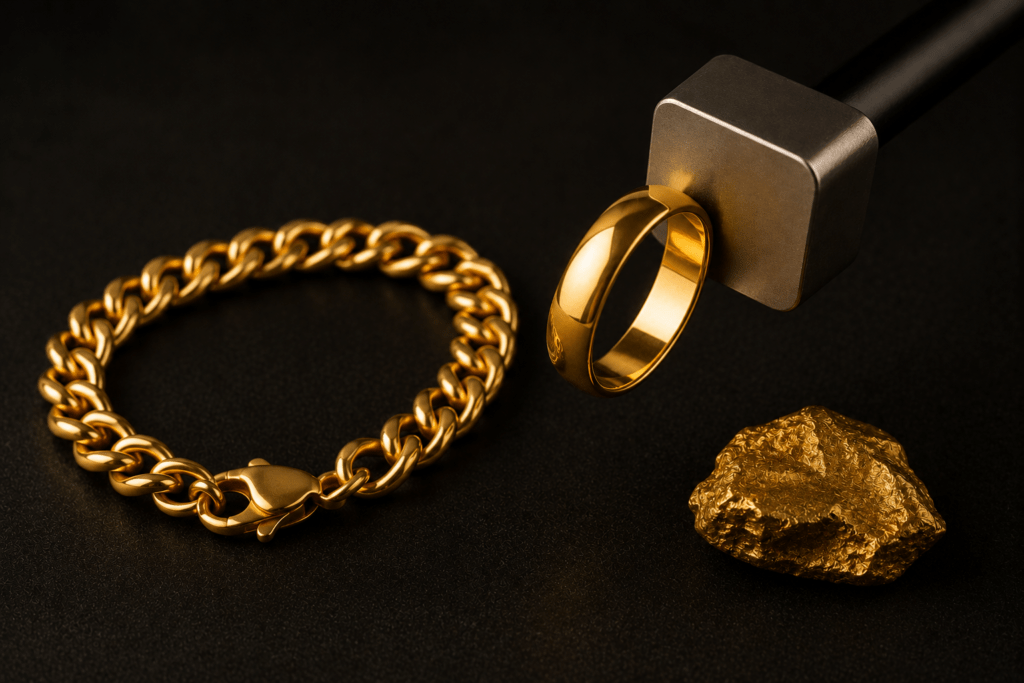
You may have heard this simple trick:
Put a magnet against your jewelry. If it sticks, the gold is fake.
There is some truth to that.
But the magnet test cannot prove that an item is real gold. It is only one of several ways to test whether gold is real.
Real bulk gold is diamagnetic rather than ferromagnetic, meaning it is not strongly attracted to an ordinary magnet.
So if a necklace, ring, bracelet, or coin strongly snaps toward a magnet, that is a warning sign.
But there is an important catch:
Many fake-gold metals are not magnetic either.
That means fake gold can sometimes pass the magnet test.
Quick Answer: Does the Magnet Test Work on Gold?
Yes—but only as a basic screening test.
Here’s the easiest way to understand it:
- Strong magnetic attraction: Red flag.
- No magnetic attraction: Could be real gold, but it is not proof.
- Magnet sticks only to the clasp: It may simply be a steel spring or other component.
- Very slight reaction: Inconclusive.
The magnet test is useful for eliminating some obvious fakes.
It should not be your only gold test. Use the magnet result together with other testing methods when authenticity or value matters.
Why Doesn’t Real Gold Stick to a Magnet?
Gold behaves differently from iron and steel.
Bulk gold is considered diamagnetic, which means it does not have the strong magnetic attraction people normally think of when they hear the word “magnetic.”
This is why a solid piece of high-purity gold should not suddenly jump toward a magnet.
But jewelry creates another complication.
Most Gold Jewelry Isn’t Pure Gold
A piece marked 10K, 14K, or 18K contains gold mixed with other metals. Understanding gold purity and how much your gold is worth can help you understand why different karats behave differently.
For example:
- 10K gold: about 41.7% gold
- 14K gold: about 58.5% gold
- 18K gold: about 75% gold
- 24K gold: nearly pure gold
Those additional metals affect the item’s color, hardness, durability, and sometimes how it reacts during testing.
The clasp, spring, pin, or another small component may also be made from a different metal than the main piece.
So don’t automatically assume a gold chain is fake because the clasp reacts to a magnet.
Test several parts of the jewelry.
How to Perform the Magnet Test on Gold
You can perform a basic magnet test at home in less than a minute.
1. Use a Strong Magnet
A weak refrigerator magnet may not tell you much.
A stronger magnet provides a more noticeable reaction.
2. Test the Main Body of the Jewelry
For a chain or bracelet, test several sections.
For a ring, move the magnet around the entire ring.
3. Test the Clasp Separately
Clasps can contain small steel springs.
A magnetic clasp does not automatically mean the entire chain is fake.
4. Watch for a Strong Pull
A piece that quickly snaps onto a magnet deserves additional testing.
A piece that does nothing may be real gold—but it may also be made from a nonmagnetic base metal.
Can Fake Gold Pass the Magnet Test?
Absolutely.
This is the biggest weakness of the magnet test.
Gold-plated, gold-filled, or gold-clad jewelry may have a base metal underneath the gold-colored surface that is not strongly magnetic.
That means you can hold a magnet against a fake piece and see absolutely no reaction.
You might think:
“It doesn’t stick, so it must be real.”
Not necessarily.
A magnet can help tell you what something isn’t.
It usually cannot tell you exactly what something is.
If you’ve encountered the term gold clad, read our guide explaining what gold clad really means and how it differs from solid gold.
Will 14K Gold Stick to a Magnet?
Normally, 14K gold jewelry should not have a strong magnetic attraction across the entire piece.
However, 14K jewelry is only about 58.5% gold.
The remaining portion consists of other metals.
Different manufacturers use different alloy mixtures, and jewelry can contain components such as clasps and springs that behave differently from the main piece.
So the better rule is:
A strong magnetic pull is suspicious. No magnetic pull does not prove the 14K mark is genuine.
What About a 14K Stamp?
A stamp helps, but a stamp isn’t proof either.
You may see gold jewelry hallmarks such as:
- 10K
- 417
- 14K
- 585
- 18K
- 750
These marks normally indicate the intended gold purity.
But stamps can be fake.
A counterfeit piece can say 14K just as easily as a genuine one.
That is why you should never base the value of expensive jewelry on the stamp alone.
For example, 585 normally indicates 58.5% gold, or approximately 14K gold. Learn more in our guide explaining what 585 means on gold jewelry.
The jewelry should still be tested if its actual gold content matters.
Magnet Test Results: What They Usually Mean
| Magnet Result | What It May Mean |
|---|---|
| Strong attraction over the entire piece | Likely contains a significant amount of magnetic metal |
| No attraction | Could be real gold or a nonmagnetic fake |
| Attraction only at the clasp | Could be caused by the clasp spring or another component |
| Slight or inconsistent reaction | More testing is needed |
| 14K stamp but strong magnetic pull | The stamp should not be trusted without additional testing |
The key word is may.
A magnet is a screening tool—not an assay.
What’s a Better Way to Test Gold?
Professional gold testing goes much further than simply checking whether something sticks to a magnet.
Common methods include:
Visual Inspection
The first step is checking markings, construction, wear areas, discoloration, and signs of plating.
Touchstone and Acid Testing
A small sample can be tested using acids designed to react differently depending on gold purity.
Electronic Gold Testing
Electronic testing equipment can provide additional information about metal composition.
X-Ray Fluorescence Testing
XRF technology can analyze metal composition without relying only on the jewelry’s stamp.
Research published by the Gemological Institute of America (GIA) has evaluated several methods used to determine gold content, including chemical touchstone testing, electronic testing, density testing, and X-ray fluorescence.
Each technique has strengths and limitations, which is one reason experienced gold buyers often use more than one clue when evaluating jewelry.
Don’t Damage Your Gold Trying to Test It
Some home gold tests found online can cause more problems than they solve.
Be cautious with methods involving:
- Lighters
- Bleach
- Strong chemicals
- Aggressive scratching
- Cutting jewelry open
You don’t need to damage a potentially valuable piece just to find out whether it contains gold.
If you are thinking about selling scrap gold, professional testing is the better option.
Think Your Jewelry Might Be Real Gold?
If you’ve found an old chain, bracelet, ring, broken piece of jewelry, or something marked 10K, 14K, 18K, 417, 585, or 750, don’t rely only on a magnet.
Have it professionally tested.
Gold Kings can evaluate your gold jewelry and explain what you’re dealing with before you decide whether you want to sell it.
We buy many types of precious metals, including gold jewelry, broken jewelry, coins, bullion, sterling silver, dental gold, and estate jewelry. See the complete list of what Gold Kings buys.
Selling Gold Near Snellville?
Visit Gold Kings of Snellville for professional gold testing and a free, no-obligation offer.
Selling Gold in Northeast Georgia?
Gold Kings also serves customers in Northeast Georgia from our Commerce location.
Not sure what your jewelry is worth? Get a free gold quote from Gold Kings.
We test it. We weigh it. We pay you.
Frequently Asked Questions
Is real gold magnetic?
Real bulk gold is not strongly attracted to a magnet. A strong magnetic pull is therefore a warning sign, but lack of attraction does not prove the item is gold.
Can fake gold pass a magnet test?
Yes. Many materials used in fake, plated, or clad jewelry are not strongly magnetic. A fake piece can therefore pass the magnet test.
Does 14K gold stick to a magnet?
A genuine 14K piece generally should not show strong magnetic attraction across the entire piece. However, clasps, springs, and other components may react differently.
If my chain doesn’t stick to a magnet, is it real?
Not necessarily. It simply passed one basic test. Further testing is needed to determine whether it is actually gold and what karat it is.
Can fake jewelry have a 14K stamp?
Yes. A 14K stamp by itself is not proof that jewelry contains 14K gold.
What is the best way to know if gold is real?
For valuable jewelry, professional testing is more reliable than any single home test. Testing may include inspection, touchstone testing, electronic testing, XRF analysis, or a combination of methods.