
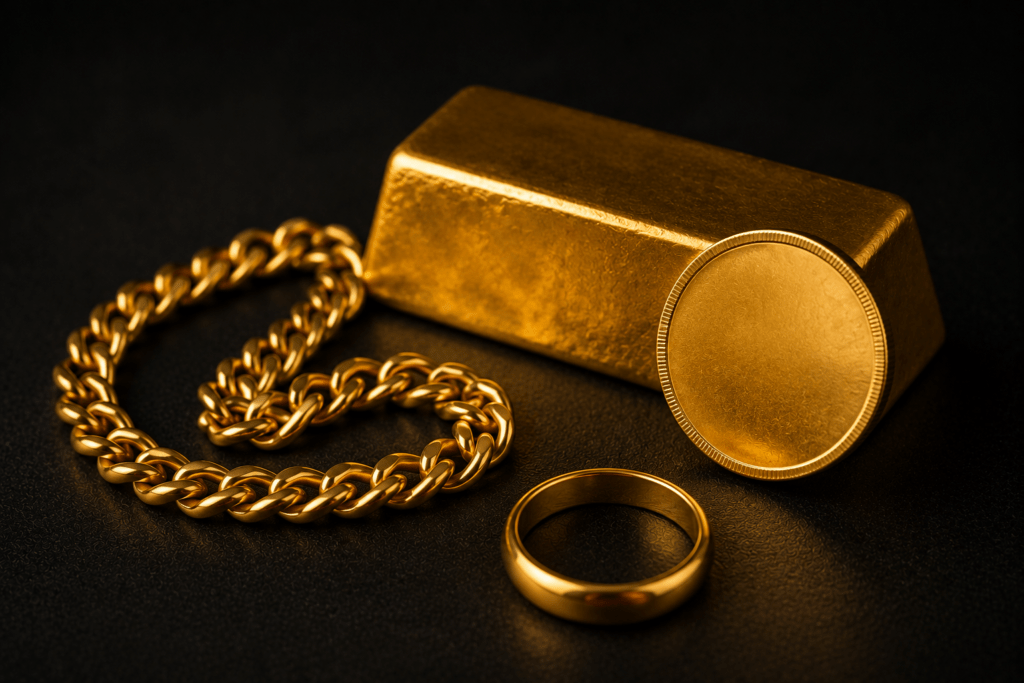
If you see 999 stamped on gold, it means the item is supposed to contain 999 parts pure gold out of 1,000.
In other words:
999 gold = 99.9% pure gold = approximately 24K gold
This is extremely high-purity gold and is commonly described as fine gold or pure gold. If you are comparing other jewelry stamps, see our guide to gold jewelry hallmarks.
For example, this mark appears on bars, bullion coins and some jewelry. You may also encounter markings such as 999.9, .999 or 9999.
They look similar, but there are a few differences worth understanding.
Quick Gold Purity Chart
| Gold Mark | Purity | Approximate Karat |
|---|---|---|
| 999.9 / 9999 | 99.99% | 24K |
| 999 | 99.9% | 24K |
| 995 | 99.5% | 24K |
| 916 / 917 | 91.6–91.7% | 22K |
| 750 | 75.0% | 18K |
| 585 | 58.5% | 14K |
| 417 | 41.7% | 10K |
| 375 | 37.5% | 9K |
The fineness system measures gold in parts per thousand, while the karat system measures it in parts out of 24. The London Bullion Market Association (LBMA) describes fineness as the number of parts of pure gold per thousand parts of metal.
What Does the 999 Stamp Mean on Gold?
This three-digit stamp is a fineness mark.
It indicates that the item should contain:
- 99.9% pure gold
- About 0.1% other material
- Virtually no alloy metals
As a result, dealers commonly describe this purity as fine gold.
The decimal point may also be written differently. For example:
999 = .999 = 99.9% gold
In other words, the key number is the proportion of actual gold in the metal.
Is 999 Gold Real Gold?
Yes. An authentic piece contains nearly pure gold.
In fact, it is among the purest forms of gold commonly bought and sold.
There is an important distinction:
However, a purity stamp alone does not prove what an item contains.
Stamps can be incorrect or counterfeit.
The same applies to jewelry marked 10K, 14K, 18K or 24K. A hallmark provides useful information, but a professional should still test the metal when authenticity or value matters. Learn more about how to tell if gold is real.
Is 999 Gold the Same as 24K Gold?
For practical purposes, the two descriptions refer to nearly pure gold.
The karat system divides gold into 24 parts. The Federal Trade Commission explains that 24K is pure gold and that lower-karat jewelry contains progressively more alloy metal.
Mathematically:
999 ÷ 1,000 = 99.9% gold
Commercial refining rarely produces literally 100.000% purity. Therefore, the 24 karat category commonly includes fineness levels such as 999 and 999.9.
So which description is better?
Both can be correct:
24K describes the gold using the karat system.
In contrast, 999 describes purity using the fineness system.
What Is the Difference Between 999 and 999.9?
This confuses a lot of people.
Three Nines: 99.9% Purity
99.9% pure gold
Four Nines: 99.99% Purity
99.99% pure gold
Dealers sometimes call this higher purity “four nines” because markings may read 9999 or .9999.
The Royal Mint notes that a fineness of 999.9 represents 99.99% purity.
The actual purity difference is tiny:
Three nines: 0.1% other material
Four nines: 0.01% other material
For most individual sellers, the weight of the item will make a much larger difference in its value than the difference between 999 and 999.9 purity.
What Does “Fine Gold” Mean?
Fine gold refers to the amount of actual pure gold contained in an item.
You may see terms such as:
- Fine gold
- Gold fineness
- .999 fine gold
- 999.9 fine gold
- Fine gold content
For example, a bar stamped:
1 OZ FINE GOLD 999.9
is telling you both its weight and its stated purity.
It contains one troy ounce of gold at a fineness of 999.9.
Does Fine Gold Always Mean 999?
Not necessarily.
This is one reason it is important to read the actual fineness number.
For example, the LBMA Good Delivery technical specifications permit gold bars with a minimum fineness of 995 parts per thousand, even though many modern investment bars are refined substantially higher.
So when buying or selling gold, look for the actual purity number, not simply the words “fine gold.”
Where Will You Find This Purity?
You are especially likely to encounter these high fineness levels in the following items:
Gold Bars
Refiners frequently use extremely high-purity gold for investment bars.
Common markings include:
- 999
- 999.9
- .9999
- 24K
- FINE GOLD
A legitimate bar may also have a refiner’s name or logo, weight, serial number and assay information.
Gold Coins
Many modern bullion coins contain very high-purity gold.
However, not every valuable bullion coin has this purity.
Some well-known gold coins use lower-purity alloys while still containing a specified amount of pure gold.
Never assume a gold coin should be valued only for its melt value. Certain coins can be worth more because of their rarity, condition, date or collector demand.
Gold Jewelry
Jewelry at this purity exists, but it is less durable than lower-karat pieces because very pure gold is soft.
As a result, jewelers often choose alloys such as:
- 22K
- 18K
- 14K
- 10K
In particular, adding other metals can make jewelry harder and more resistant to everyday wear.
Read more about why most gold jewelry is not made from pure 24K gold.
Why Is 999 Gold So Soft?
Pure gold is naturally soft and malleable.
That softness helps jewelers shape the metal, but it can be a disadvantage for everyday wear.
For example, a high-purity gold ring may scratch or bend more easily than a similar 14K or 18K ring.
However, that softness does not make the metal inferior.
Instead, it means purity and durability are two different things.
Can Fake Gold Be Stamped 999?
Yes.
A 999 marking alone does not guarantee an item is genuine.
Counterfeiters can stamp almost anything into metal.
A fake piece could potentially be marked:
- 999
- 24K
- 18K
- 14K
- 10K
That is why professional testing matters.
Warning Signs
Be cautious if:
- The color looks unusual
- The item is attracted strongly to a magnet
- Plating is wearing through
- The weight feels wrong for its size
- The hallmark appears poorly made
- The seller cannot explain where the item came from
But none of these tests alone proves whether an item is genuine.
How Can You Check Authenticity?
Buyers can use several methods to evaluate precious metals.
1. Check the Hallmarks
Look carefully for markings such as:
999, 999.9, 24K or FINE GOLD
Also look for a manufacturer’s mark, refinery logo or other identifying information.
2. Check the Weight
Gold is extremely dense.
Therefore, an item whose weight is inconsistent with its dimensions may deserve further investigation.
3. Magnet Test
Gold itself is not magnetic.
However, passing a magnet test does not prove something is gold because many other metals are also nonmagnetic.
4. Professional Gold Testing
When real money is involved, professional testing is much more reliable than trying to identify gold from its color or stamp alone.
Professional precious-metal buyers may use methods including electronic testing, acid testing, density measurements and X-ray fluorescence (XRF) analysis depending on the item. Gold Kings offers professional precious-metal testing at its Georgia locations; see how the selling and testing process works.
How Much Is 999 Gold Worth?
For a basic metal-value estimate, use this formula:
Weight × Gold Purity × Current Gold Price
At this fineness level, the purity factor becomes 0.999. Therefore, the calculation is:
Weight × 0.999 × current pure-gold value
For example, a 10-gram piece at this purity contains approximately:
10 × .999 = 9.99 grams of pure gold
The dollar value changes constantly because the gold spot price moves throughout the trading day.
This is why you should check the current gold price rather than relying on an old chart or article. You can also use our gold value guide to understand the basic calculation.
Is 999 Gold Worth More Than 14K or 18K Gold?
Per gram, yes.
This fineness level provides significantly more precious metal per gram.
For comparison:
999: 99.9% gold
18K / 750: 75% gold
14K / 585: 58.5% gold
10K / 417: 41.7% gold
If two items have the same metal weight, the purer piece contains substantially more actual gold.
However, jewelry can also have value from:
- Brand
- Design
- Gemstones
- Age
- Rarity
- Collectibility
So melt value is not always the entire story.
999 vs. 916 Gold
Another marking you may encounter is 916.
916 gold is approximately:
91.6% pure gold = 22K gold
By comparison:
999 = 99.9% = approximately 24K
Consequently, the higher fineness means more pure gold per gram.
999 vs. 750 Gold
750 gold is 75% pure gold, which corresponds to 18K.
Therefore:
999: 99.9% gold
750: 75% gold
Both contain real gold, but the higher fineness provides considerably more precious metal by weight.
999 vs. 585 Gold
A 585 stamp means 58.5% pure gold, which is the standard fineness associated with 14K gold.
Therefore:
999 = approximately 24K
585 = approximately 14K
If you’ve ever wondered why European jewelry sometimes says 585 instead of 14K, it is simply using the fineness system rather than the karat system.
Should You Sell High-Purity Items as Scrap?
Not automatically.
Before selling high-purity gold, determine what the item actually is.
A broken piece of high-purity jewelry might primarily be worth its gold content. If that is what you have, read our guide to selling scrap gold for the best price.
But a recognized bullion bar or collectible gold coin may have additional market value.
Before selling:
- Identify the item.
- Confirm its weight.
- Confirm its purity.
- Check the current gold price.
- Determine whether it has collectible or bullion value above melt.
- Compare the buyer’s offer with its actual gold value.
A knowledgeable buyer should explain how they calculated the offer. Before visiting, you can also review what Gold Kings buys.
Where Can I Sell 999 or 24K Gold in Georgia?
Before selling high-purity jewelry, bars or bullion, have a professional test the item.
Gold Kings buys gold based on its actual weight, purity and current market value. We test and weigh your items in front of you, explain what you have and make a no-pressure offer.
Gold Kings of Snellville
3635 Stone Mountain Hwy, Snellville, GA 30039
770-771-4650
This is the recommended Gold Kings location for customers in Snellville, Loganville, Lawrenceville, Grayson, Lilburn, Stone Mountain and surrounding Gwinnett County communities.
Gold Kings of Commerce
480 Banks Crossing Dr, Commerce, GA 30529
706-336-0043
This is the recommended Gold Kings location for customers in Commerce and surrounding Northeast Georgia communities.
Not sure what your gold is worth? Request a free Gold Kings quote before you visit, or read our customer reviews and testimonials.
We test it, we weigh it, and we pay you.
Frequently Asked Questions
Is 999 gold pure gold?
Yes. It contains 99.9% pure gold, so dealers commonly describe it as pure or fine gold.
Is 999 gold 24K?
Yes. It generally falls within the 24K category because it is nearly pure gold.
What does .999 mean on gold?
The decimal form indicates the same 99.9% purity. In other words, the dot does not change the meaning of the stamp.
What does 999.9 mean on gold?
This mark indicates 99.99% purity. Manufacturers may also write it as 9999 or .9999.
Is four-nines purity better than three nines?
Four nines indicates slightly greater purity, but both levels generally fall within the 24K category.
Is 999 gold more valuable than 18K gold?
Per gram, the purer metal normally has a higher melt value because it contains 99.9% gold, compared with 75% in 18K.
Can jewelry be made from 999 gold?
Yes. However, such pure metal can scratch and bend more easily than lower-karat alloys during everyday wear.
Does a 999 stamp prove gold is real?
No. A stamp is not proof by itself. Counterfeit items can carry fake purity markings, so ask a professional to test valuable pieces.
What is the difference between 999 and 916 gold?
999 is 99.9% pure and approximately 24K. 916 is about 91.6% pure and approximately 22K.
Where can I sell 999 gold?
Look for a precious-metals buyer who can verify the item’s purity and weight, explain the current gold value and show you how they calculated the offer. In Georgia, you can visit Gold Kings of Snellville or Gold Kings of Commerce for professional testing and a no-obligation offer.