
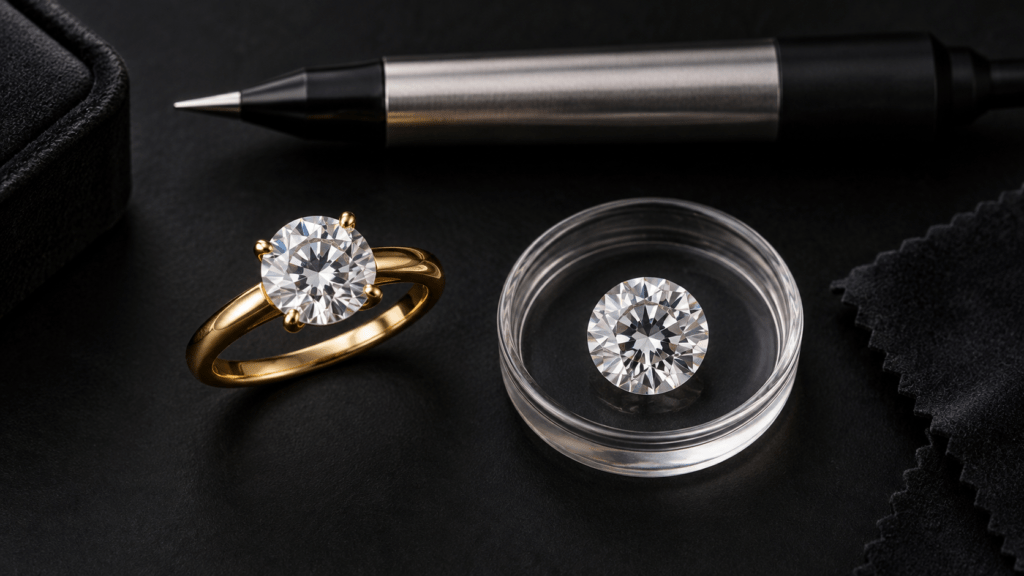
Mounted and loose gemstones require different handling arrangements. The important buying question is whether your tester can make its required contact on the actual stones you inspect—not simply whether the listing mentions both loose and mounted use.
Start with the mounting
A setting can restrict access to the stone and put metal very close to the probe. Before testing, inspect the piece under suitable magnification and choose a stable position.
Do not bend prongs, loosen a setting or press harder to make a probe reach a difficult stone. If access is inadequate, an inconclusive inspection is preferable to damage.
On a multi-stone ring, record which stone produced each observation. A result from the center stone does not identify every accent stone.
Follow the holder requirement for loose stones
A loose stone is easier to reposition, but that does not mean any support will work. The UltraTester 3+ manual specifies its conductive holder arrangement; consult the illustrated procedure before using it.
Tweezers are useful for moving a stone into position. They should not be assumed to replace the support required by the tester.
The EURO TOOL set linked below can be considered for handling tasks, but choose a suitable tip and practise over a contained, soft work area. Twelve tools in a set do not mean every one suits every stone.
Understand the sample-size claim
Presidium lists the Gem Tester II for stones down to 0.02 ct under its stated conditions. A weight threshold does not guarantee access to a usable surface in every setting.
Ask whether the visible facet and mounting allow correct contact. A tiny stone surrounded by prongs can be a more difficult sample than its carat weight suggests.
Keep preparation consistent
Follow the exact tester’s requirements for temperature, surface condition and repeated testing. Do not transfer a holder arrangement or contact routine from one instrument simply because another uses a similar probe.
If the result changes when you change the grip or support, resolve that setup issue before interpreting the stone.
Our recommendation
For frequent mounted-stone work, prioritize access, visibility and comfortable positioning when comparing testers. For loose stones, include the correct holder and handling tools in your budget.
Use the tester to gather a defined observation. When the mounting prevents a valid test or results remain uncertain, arrange appropriate professional identification.
Explore the relevant products
- GemOro UltraTester 3+ Diamond, Moissanite & White Sapphire Tester
- Presidium Gem Tester II PGT II Thermal Gemstone Tester
- EURO TOOL TWZ-700.12 Twelve-Piece Tweezers Set
Check the exact model, seller, package contents and current offer on the linked product page before ordering.
Sources and further reading
Explore more Gold Kings buying guides.
As an Amazon Associate I earn from qualifying purchases. The product pages linked in this article contain Amazon affiliate links. This guide is based on published specifications and practical buying considerations, not a controlled hands-on product test.