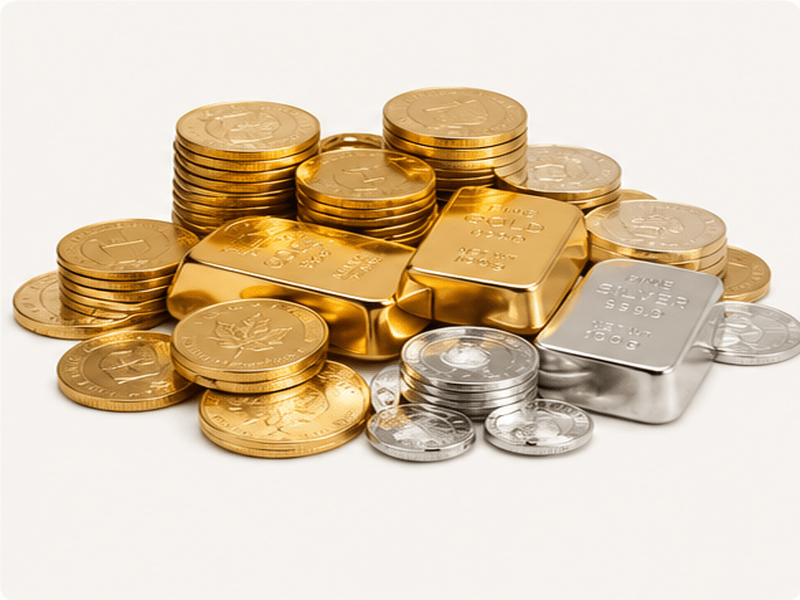
Old U.S. quarters can be worth much more than 25 cents.
Barber quarters, Standing Liberty quarters and Washington quarters dated 1964 or earlier were made with 90% silver. Some are primarily valuable for their silver content, while rare dates, mint marks and better-condition coins can have additional collector value.
At Gold Kings, we evaluate silver quarters for both their precious-metal content and potential collectible value.
If you have old quarters sitting in a jar, coin collection, inherited estate or safe-deposit box, bring them in and let us take a look.
Which Quarters Are Silver?
The three major U.S. silver quarter series covered on this page are:
| Quarter | Years | Silver Content |
|---|---|---|
| Barber Quarter | 1892–1916 | 90% silver |
| Standing Liberty Quarter | 1916–1930 | 90% silver |
| Washington Quarter | 1932–1964 | 90% silver |
For most people, the easiest rule to remember is:
A regular U.S. Washington quarter dated 1964 or earlier is 90% silver.
Quarters produced for regular circulation beginning in 1965 are generally copper-nickel clad rather than 90% silver.
There are some later special collector issues made with silver, so if you’re unsure what you have, let us examine it before spending it as ordinary change.
How Much Silver Is in a Silver Quarter?
A standard 90% silver U.S. quarter contains approximately:
5.625 grams of pure silver
or approximately:
0.1808 troy ounce of silver
That applies to regular:
- Barber quarters
- Standing Liberty quarters
- 1932–1964 Washington quarters
Because the silver spot price changes throughout the day, the melt value of a silver quarter changes with it.
Silver Quarter Melt Value Formula
A simple way to estimate the silver value is:
Current silver spot price × 0.1808 = approximate silver melt value
For example, rather than putting a fixed dollar value on this page that becomes outdated whenever silver moves, the value can be calculated using the current market price.
But melt value is only the starting point.
Some quarters are worth considerably more because of their date, mint mark, variety or condition.
Barber Quarters: 1892–1916
The Barber quarter was produced from 1892 through 1916.
These coins contain 90% silver.
The value of a Barber quarter depends on more than its silver content. Collectors also consider:
- Date
- Mint mark
- Condition
- Rarity
- Collector demand
Even heavily circulated Barber quarters have silver value, while scarcer issues and high-grade examples can be worth considerably more.
Barber Quarter Mint Marks
Barber quarters were produced at several U.S. Mint facilities.
Possible mint marks include:
- No mint mark: Philadelphia
- O: New Orleans
- S: San Francisco
- D: Denver
The mint mark is found on the reverse of the coin below the eagle’s tail feathers.
Some mintmarked Barber quarters can carry significant premiums.
The 1901-S Barber quarter, for example, is a particularly important issue and should be carefully evaluated rather than treated as ordinary silver.
Condition Matters With Barber Quarters
Two Barber quarters from the same year can have dramatically different values because of condition.
Collectors refer to a coin’s condition as its grade.
On circulated Barber quarters, the amount of remaining detail in Liberty’s headband, lettering, eagle and other design elements can help determine grade.
A heavily worn coin may primarily have silver and modest collector value.
A sharply detailed example may be worth substantially more.
If you think you have an unusually nice Barber quarter, don’t clean it.
Bring it in exactly as you found it.
Standing Liberty Quarters: 1916–1930
Standing Liberty quarters were produced from 1916 through 1930 and contain 90% silver.
The design features Liberty standing on the front of the coin with an eagle on the reverse.
Standing Liberty quarters can be challenging to evaluate because many circulated examples have significant wear, especially around the date.
Some dates and varieties are considerably scarcer than others.
Important Standing Liberty dates and varieties to watch for include:
- 1916
- 1918-S 18/17 variety
- 1919-D
- 1919-S
- 1921
- 1923-S
Coins like these should be evaluated individually before being sold simply for their silver content.
Standing Liberty Quarter Mint Marks
Standing Liberty quarters were produced at:
- Philadelphia: No mint mark
- Denver: D
- San Francisco: S
The mint mark appears on the front of the coin near the bottom, just above and to the left of the date.
When examining an old Standing Liberty quarter, check both the date and mint mark.
Standing Liberty Quarter Types
The Standing Liberty quarter design changed during its production.
Type 1
The original design was introduced in 1916 and continued into 1917.
Type 2
The design was modified during 1917.
Changes were made to both the front and reverse of the coin, including changes to Liberty’s clothing and the arrangement of the stars around the eagle.
Type 3
Beginning in 1925, the date was recessed to better protect it from wear.
This was important because dates on earlier Standing Liberty quarters frequently wore down during circulation.
These design differences can matter when identifying and evaluating a Standing Liberty quarter.
Washington Silver Quarters: 1932–1964
Washington quarters were introduced in 1932.
Regular Washington quarters produced through 1964 contain 90% silver and 10% copper.
Each originally contained approximately:
5.625 grams of pure silver
For many common circulated Washington quarters, silver content represents a major part of the coin’s value.
But not every Washington silver quarter should automatically be treated as ordinary silver.
Certain dates and varieties are collectible.
Valuable Washington Silver Quarters
Some Washington quarters deserve closer inspection before being included with common silver coins.
Important Washington quarter dates and varieties to watch for include:
- 1932-D
- 1932-S
- 1934 Doubled Die Obverse
- 1937 Doubled Die Obverse
- 1942-D Doubled Die Obverse
- 1943 Doubled Die Obverse
- 1943-S Doubled Die Obverse
- 1950-D D/S
- 1950-S S/D
If you find one of these coins, don’t assume its value is limited to the silver inside it.
Condition and authenticity can make a significant difference.
Washington Quarter Mint Marks
Silver Washington quarters were produced at:
- Philadelphia: No mint mark
- Denver: D
- San Francisco: S
On early Washington quarters, the mint mark can be found on the reverse of the coin beneath the wreath.
When evaluating older quarters, the mint mark can sometimes be just as important as the date.
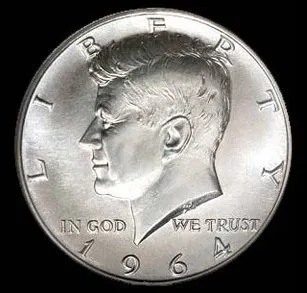
Is a 1964 Quarter Silver?
Yes.
Regular U.S. Washington quarters dated 1964 contain 90% silver.
This makes 1964 one of the easiest dates for people to recognize when sorting old change.
A 1964 quarter is worth more than its 25-cent face value based on its silver content alone whenever the silver inside it exceeds face value.
Certain examples may also have collector value.
Is a 1965 Quarter Silver?
Regular U.S. Washington quarters made for circulation beginning in 1965 are not 90% silver.
The U.S. Mint changed the composition of circulating quarters to copper-nickel clad.
That makes the cutoff easy to remember: 1964 = 90% silver for regular Washington quarters, while 1965 = copper-nickel clad for regular circulation issues.
If you have a large container of old quarters, checking the dates can be well worth the effort.
What Makes a Silver Quarter Valuable?
Several factors determine what an old quarter may be worth.
1. Silver Content
Barber, Standing Liberty and pre-1965 Washington quarters contain 90% silver.
The current silver market therefore establishes a basic precious-metal value.
2. Date
Some years were produced in much smaller quantities or are significantly harder to find today.
3. Mint Mark
Coins produced in Philadelphia, Denver, San Francisco or New Orleans can have different levels of rarity.
4. Condition
Coin collectors call condition grade.
Better-preserved coins generally command higher collector premiums.
5. Variety
Doubled dies, repunched mint marks and other recognized varieties may be collectible.
6. Collector Demand
Some coin series, dates and varieties are much more popular among collectors than others.
Silver Value vs. Collector Value
This is one of the most important things to understand before selling old coins.
A common circulated silver quarter may trade primarily based on its silver content.
A rare quarter can be completely different.
For example, a scarce date or variety could be worth much more to a coin collector than the silver contained inside it.
That is why you should avoid automatically placing every old quarter into a pile marked scrap silver.
Gold Kings can examine the coins first.
Don’t Clean Your Old Quarters
If you discover old silver quarters, do not clean them.
Do not:
- polish them
- scrub them
- use silver cleaner
- soak them in chemicals
- use an abrasive cloth
- try to make them shiny
Cleaning can alter the original surface of a coin and reduce its collectible value.
A dark or tarnished old quarter isn’t necessarily damaged.
Collectors may prefer the original surface.
Bring your coins in exactly as you found them.
Should I Have My Quarter Professionally Graded?
Most common circulated silver quarters do not need professional grading.
However, professional authentication and grading may make sense for particularly rare or high-quality coins.
Two of the best-known third-party grading services are:
PCGS — Professional Coin Grading Service
and
NGC — Numismatic Guaranty Company
If Gold Kings believes one of your coins deserves additional attention, we can discuss that with you during the evaluation.
Have a Jar of Old Quarters?
You don’t need to become a coin expert before bringing them to us.
Customers often bring us:
- jars of old coins
- inherited collections
- coin rolls
- estate collections
- loose silver quarters
- old coin albums
- boxes of mixed coins
- Barber quarters
- Standing Liberty quarters
- Washington quarters
We’ll look at what you have.
The important thing is making sure potentially collectible coins aren’t overlooked before the silver is valued.
Related Silver Coin Guides
Sell Your Silver Quarters to Gold Kings
If you have old silver quarters you want to sell, bring them to Gold Kings.
We can identify what you have, determine the silver content and look for coins that may deserve additional consideration because of their date, mint mark, condition or variety.
Whether you have one quarter or hundreds of coins, you’re welcome to bring them in.
We test it. We weigh it. We pay you.
Get a Free Quote on Your Silver Quarters
Have Barber quarters, Standing Liberty quarters or pre-1965 Washington quarters?
Request a free quote or visit our Snellville or Commerce location for a free evaluation.
Ready to Find Out What Your Quarters Are Worth?
Get a free Gold Kings quote, or visit our Snellville or Commerce location. No appointment is necessary.
Frequently Asked Questions About Silver Quarters
What years of quarters are silver?
Barber quarters from 1892–1916, Standing Liberty quarters from 1916–1930 and regular Washington quarters from 1932–1964 contain 90% silver.
Are all 1964 quarters silver?
Regular U.S. Washington quarters produced in 1964 contain 90% silver.
Is a 1965 quarter silver?
A regular 1965 Washington quarter produced for circulation is not 90% silver.
How much silver is in a 1964 quarter?
A regular 90% silver Washington quarter contains approximately 5.625 grams, or about 0.1808 troy ounce, of pure silver.
How do I calculate the melt value of a silver quarter?
Multiply the current silver price per troy ounce by approximately 0.1808.
Are Barber quarters silver?
Yes. Barber quarters produced from 1892 through 1916 contain 90% silver.
Are Standing Liberty quarters silver?
Yes. Standing Liberty quarters produced from 1916 through 1930 contain 90% silver.
Are Washington quarters silver?
Regular Washington quarters dated 1932 through 1964 contain 90% silver. Regular circulation quarters beginning in 1965 use a different composition.
Are old silver quarters worth more than melt value?
Some are. Scarce dates, mint marks, varieties and high-grade examples can have collector value above their silver content.
Should I clean silver quarters before selling them?
No. Cleaning can damage the original surface and reduce the collectible value of an old coin.
Where can I sell silver quarters in Georgia?
Gold Kings buys and evaluates silver coins in Georgia. Bring your quarters in for a free evaluation so we can identify the silver content and check for potentially collectible coins before making an offer.