
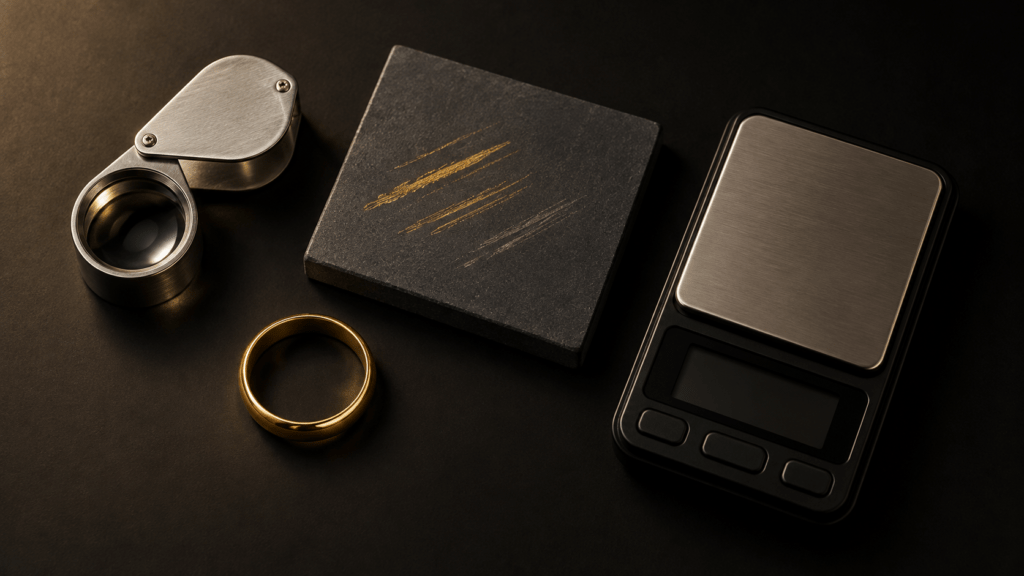
Build a starter kit around inspection, measurement and one testing method you can learn properly. Buying every available tool at once creates more equipment to interpret without necessarily producing a better answer.
Start with inspection
A useful loupe helps you examine markings, wear and construction before you test. Good lighting and a stable surface are part of that setup. Keep a notebook or digital record so an observed stamp is recorded as an observation, not immediately accepted as proof.
Magnification also helps you decide whether an item needs specialist attention. A collectible coin or finely finished antique may deserve a different approach from ordinary scrap jewelry.
Add a suitable scale
Choose capacity for the heaviest item and tray you expect to weigh. Check the required calibration weight and units. A scale measures total load; it does not separate gemstones, base-metal parts or coatings from gold.
For a beginner, a repeatable general-purpose jewelry scale is often more useful than a low-capacity model chosen only for additional decimal places. Keep weighing and purity assessment as separate steps.
Choose one testing route
An electronic tester needs the correct reference, compatible probe and a documented operating routine. An acid kit needs its own instructions, reference materials and appropriate chemical handling arrangements. Decide which method you can support before ordering.
If you are checking only one or two items, compare the complete kit cost with a professional assessment. Ownership is most useful when you have an ongoing reason to practice and maintain the equipment.
Buy the overlooked essentials
- A labeled place for reference samples.
- Trays that prevent customer items from mixing.
- Current instructions for the exact equipment.
- A plan for consumables and supplier support.
These are ordinary purchases, but they make the equipment easier to use responsibly. A reference mixed into scrap or a missing manual can stop the process more effectively than a lack of sophisticated features.
Gold Kings’ recommendation
Start with a loupe, appropriate scale and a clearly supported testing method. Practice on known items, record limitations and expand only when a specific unanswered question justifies another tool. For alloy-composition questions, learn what XRF adds before considering a major equipment purchase.
A starter kit should help you ask better questions about jewelry. It should not encourage a confident purchase merely because several inexpensive tests appear to agree.
Explore the relevant products
- KEE Gold Tester — Electronic Gold & Platinum Tester
- Bausch + Lomb Hastings Triplet 10x Jeweler’s Loupe
- Weigh Gram 200g × 0.01g Digital Pocket Scale with 100g Weight
Check the exact model, seller, package contents and current offer on the linked product page before ordering.
Sources and further reading
Explore more Gold Kings buying guides.
As an Amazon Associate I earn from qualifying purchases. The product pages linked in this article contain Amazon affiliate links. This guide is based on published specifications and practical buying considerations, not a controlled hands-on product test.