
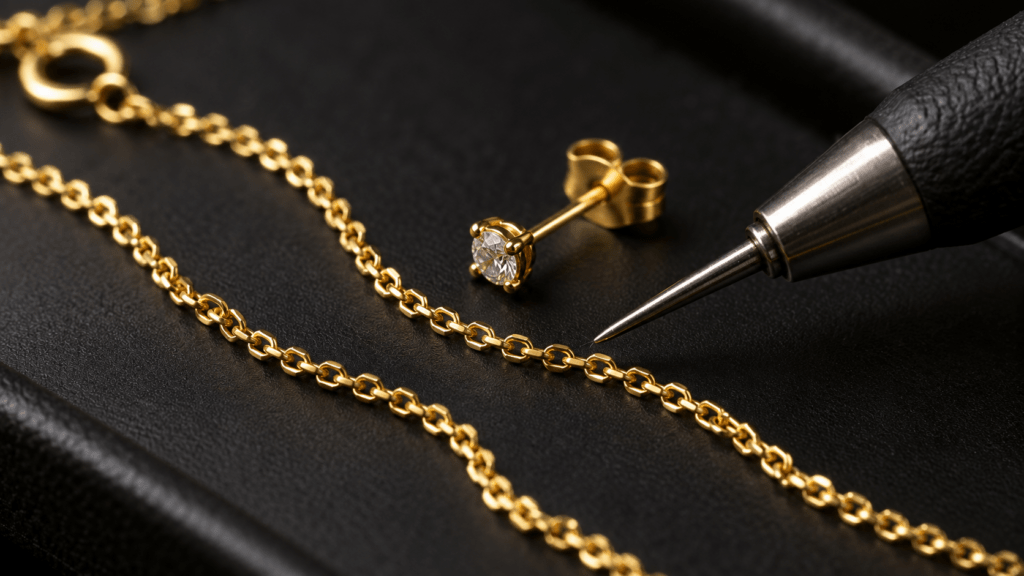
Small jewelry creates a contact problem as well as an identification problem. A thin link, curved post or tiny clasp may be difficult to position, even when the tester behaves correctly on a broad reference sample.
Inspect before touching the probe
Use magnification to locate a suitable surface and understand the construction. Identify which part belongs to the main body, which is a fitting and where soldered joints appear. The aim is to select a meaningful test location, not merely the easiest place to reach.
For a chain, one clasp reading should not become a conclusion about every link. For an earring, do not assume the post, backing and decorative section are identical. Record them separately when their construction warrants it.
Stabilize without damaging the item
Place the item as the instrument’s manual directs and arrange it so it does not slide during contact. Avoid pushing a probe through an opening or using extra force to stop a lightweight piece moving. If you cannot establish controlled contact, treat that as a limitation of the setup.
Keep loose components together in a labeled tray. A missing backing or mixed pair can cause a different problem from an incorrect reading, but it is just as avoidable.
Use a known sample to troubleshoot
If the tiny item gives an erratic indication, return to the known reference. A stable reference suggests you should investigate contact or sample suitability. An unstable reference suggests you should resolve the instrument setup first.
This comparison is useful because it changes one question at a time. Replacing a probe, adjusting calibration and changing the item position simultaneously makes it harder to understand what happened.
Know when another method is preferable
A tester purchase should match the items you actually handle. Ask for a demonstration on small pieces before buying, especially if earrings and delicate chains make up most of your work. Do not assume success on a heavy ring translates to every shape.
Gold Kings recommends stopping when positioning or surface preparation would damage a valuable piece. Seek a suitable professional assessment and preserve the observation that caused concern. A clearly recorded limitation is better than a forced reading that looks precise but does not represent the jewelry.
Explore the relevant products
- KEE Gold Tester — Electronic Gold & Platinum Tester
- GemOro AuRACLE PRO — Digital Gold & Platinum Tester
- Bausch + Lomb Hastings Triplet 10x Jeweler’s Loupe
Check the exact model, seller, package contents and current offer on the linked product page before ordering.
Sources and further reading
Explore more Gold Kings buying guides.
As an Amazon Associate I earn from qualifying purchases. The product pages linked in this article contain Amazon affiliate links. This guide is based on published specifications and practical buying considerations, not a controlled hands-on product test.