
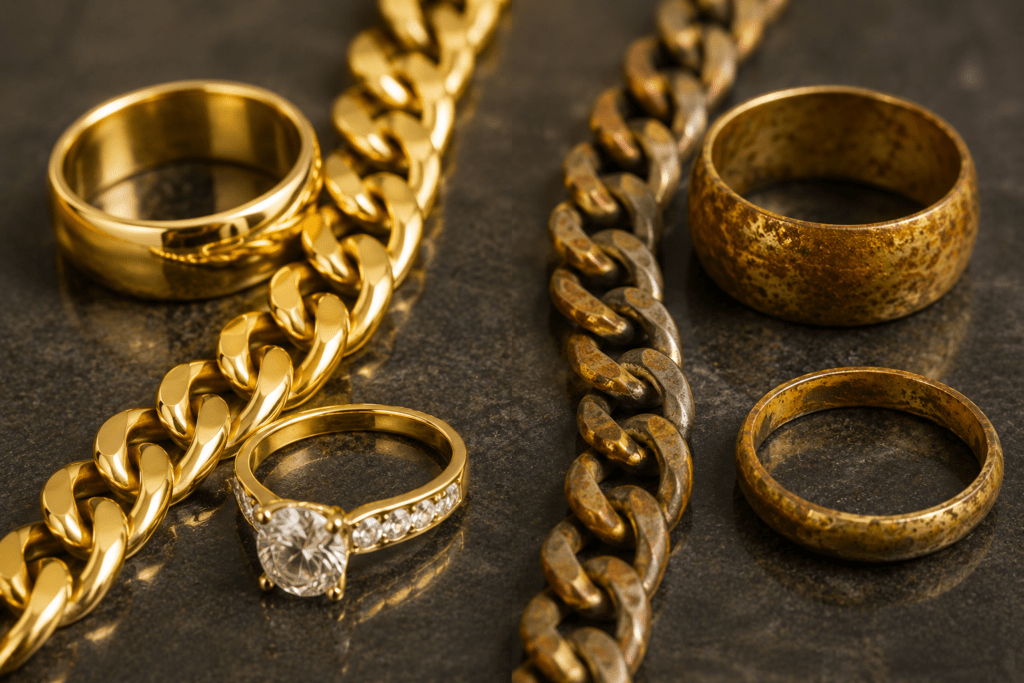
No. Pure gold does not rust.
Rust is a specific type of corrosion involving iron. Since gold contains no iron, pure gold cannot develop the reddish-brown iron oxide that we normally call rust.
Gold is also one of the least reactive metals. That is one reason ancient gold coins and jewelry can survive for hundreds or even thousands of years without the kind of corrosion seen on iron or steel.
But there is an important catch:
Most gold jewelry is not pure gold.
A 10K, 14K, 18K or 22K piece contains gold mixed with other metals. Those alloy metals can sometimes react with moisture, chemicals or substances in the environment and cause discoloration.
So if your gold ring, chain or bracelet appears to be turning brown, red, green or black, the gold itself probably isn’t rusting. Something else is happening.
At Gold Kings, unusual discoloration is one of the reasons we recommend testing jewelry rather than judging it by appearance alone. If you are unsure what you own, read our guide on how to tell if gold is real.
Why Doesn’t Pure Gold Rust?
Gold is classified as a noble metal, meaning it is unusually resistant to oxidation and corrosion under normal conditions.
Iron reacts readily with oxygen and moisture. That reaction eventually creates rust.
Gold behaves very differently.
Pure 24K gold can be exposed to normal air and moisture without developing ordinary rust. This chemical stability is one reason gold has historically been used for jewelry, coins, electronics and long-term stores of value.
Even so, gold is not chemically indestructible. Certain powerful chemical combinations and specialized laboratory conditions can attack or dissolve gold.
Your bathroom sink, swimming pool or humid Georgia summer, however, is not going to make pure gold develop iron rust.
Can 10K, 14K or 18K Gold Rust?
The answer becomes more interesting with gold jewelry because karat gold is an alloy.
Other metals are mixed with gold to change its hardness, color and durability.
| Gold purity | Approximate gold content | Can the gold itself rust? | Can the jewelry discolor? |
|---|---|---|---|
| 24K | 99.9%+ | No | Very resistant |
| 22K | 91.7% | No | Possible from alloy metals or contamination |
| 18K | 75% | No | Yes |
| 14K | 58.5% | No | Yes |
| 10K | 41.7% | No | More possible because more of the alloy is other metals |
For example, 14K gold is only about 58.5% pure gold. The remaining portion may contain metals such as copper, silver, zinc or other materials depending on the alloy.
Those other metals are much more reactive than gold.
That means lower-karat jewelry may show surface changes even though the gold content itself is not rusting.
Why Is My Gold Jewelry Turning Brown or Red?
Brown or reddish discoloration does not automatically mean your jewelry is fake.
Several things can cause it.
1. Metals in the Gold Alloy Are Reacting
Copper is commonly used in gold alloys.
When copper reacts with substances in the environment, it can cause reddish, brownish or darker areas to appear on jewelry.
The lower the gold purity, the larger the percentage of other metals in the alloy.
This is one reason 10K jewelry may react differently from 18K or 22K jewelry.
2. The Item May Be Gold Plated
Gold-plated jewelry is very different from solid karat gold.
A plated item contains a thin layer of gold over another metal.
As that layer wears away, the metal underneath may become exposed.
Depending on the base metal, you could see:
- Brown discoloration
- Green discoloration
- Dark spots
- Surface corrosion
- Actual rust if an iron-containing base metal is exposed
Seeing actual rust is therefore a strong clue that the area is not solid gold.
It doesn’t necessarily mean the entire object is worthless. It may simply mean you’re dealing with plated jewelry or an item made from several different materials.
Can Gold Tarnish?
Pure gold is extremely resistant to tarnish, but karat gold jewelry can discolor.
“Tarnish” and “rust” are often used as if they mean the same thing, but they are different.
Rust specifically involves iron.
Tarnish is a broader term describing surface discoloration that forms when a metal reacts with substances in its environment.
A gold alloy may contain metals that can tarnish even though the gold itself remains chemically stable.
Interestingly, researchers have even studied isolated red, brown and black spots on very high-purity gold. In some cases, the discoloration was associated with tiny amounts of silver contamination and sulfur compounds on the surface rather than corrosion of the gold itself.
So even a strange spot on apparently high-purity gold should not automatically be interpreted as “the gold is rusting.”
Why Is My Gold Turning Green?
Green discoloration commonly points toward copper.
Copper is used in many jewelry alloys and is also common in inexpensive base-metal jewelry.
When copper reacts with moisture, skin oils, cosmetics and other substances, green compounds can form.
You may notice:
- Green marks on the jewelry
- Green discoloration on your skin
- Darkened areas around clasps
- Color changes where plating has worn away
Again, this does not automatically tell you how much gold the piece contains.
Professional testing is much more useful than judging a piece based only on color.
Does Rust Mean Gold Is Fake?
If an area of jewelry is producing true iron rust, that specific material cannot be solid gold.
However, that does not necessarily mean there is no gold anywhere in the piece.
Jewelry can contain:
- Gold plating over another metal
- Gold-filled material
- Solid gold attached to non-gold components
- Steel springs inside clasps
- Replacement parts from earlier repairs
- Solder with a different metal composition
A chain might therefore contain genuine gold while a small component reacts differently.
This is why a magnet, hallmark or surface appearance should be treated as a clue—not definitive proof.
Can Real Gold Change Color?
Yes, depending on what you mean by “real gold.”
Pure 24K gold is exceptionally resistant to normal discoloration.
But real 10K, 14K and 18K gold jewelry contains substantial amounts of metals other than gold.
Those metals can react.
Skin chemistry, household chemicals and environmental exposure can also change how the surface looks.
Common causes include:
- Perfume
- Lotions
- Cosmetics
- Chlorine
- Cleaning chemicals
- Sweat
- Salt
- Sulfur compounds
- Moisture
- Residue from polishing
- Reactions involving alloy metals
That means color changes alone are not a reliable test for determining whether jewelry is genuine.
Does Gold Rust in Water?
Pure gold does not normally rust from exposure to water.
That includes ordinary freshwater exposure.
But jewelry presents additional issues.
Swimming pools contain chemicals such as chlorine, while saltwater contains salts that can affect some metals in jewelry alloys.
Repeated chemical exposure may also damage finishes or plating.
For valuable jewelry, avoiding unnecessary exposure to pools, cleaning chemicals and harsh compounds is generally a better practice even when the gold itself is highly corrosion resistant.
Does Gold Rust in Salt Water?
Pure gold remains highly resistant to ordinary saltwater exposure.
The other metals in gold jewelry, however, may be more vulnerable.
Clasps, solder joints, alloy metals and plated surfaces can behave differently than pure gold.
If an item changes color after repeated exposure to saltwater, do not assume the gold itself rusted.
The reaction may involve another metal in the piece.
What About White Gold?
White gold is real gold mixed with lighter-colored metals to create a white appearance.
Many white-gold pieces are also coated with rhodium to give them a bright white finish.
As that surface coating wears, the jewelry may begin looking:
- Slightly yellow
- Duller
- Uneven in color
That isn’t rust.
You may simply be seeing the natural color of the white-gold alloy underneath the rhodium finish.
What About Rose Gold?
Rose gold gets its pink or reddish color primarily from copper in the alloy.
Because copper is much more reactive than gold, rose-gold jewelry may develop surface changes over time.
Again, that does not mean the gold is rusting.
It means one or more alloy metals may be reacting.
How Can You Tell Whether Discolored Jewelry Is Really Gold?
Start by looking for a hallmark.
Common gold markings include:
- 10K or 417
- 14K or 585
- 18K or 750
- 22K or 916
- 24K or 999
A hallmark is useful, but it is not absolute proof.
Stamps can wear away. Jewelry can be repaired. Components can be replaced. Plated pieces can also carry confusing or misleading marks.
Gold Kings therefore does not rely on a stamp alone when an item needs to be evaluated.
Professional testing can provide much better information about what the metal actually contains.
You can learn more about how XRF gold testing works.
How Gold Kings Tests Gold
If you’re wondering whether unusual discoloration means your jewelry is fake, plated or simply a lower-karat alloy, you do not have to figure it out at home.
Gold Kings evaluates precious metals using professional testing methods, including XRF technology when appropriate.
XRF can help identify the elemental composition at the tested surface and provide information about metals such as:
- Gold
- Silver
- Copper
- Platinum
- Palladium
- Other metals present in the tested area
We also weigh precious-metal items so you can better understand what you own.
That is especially useful for jewelry that is:
- Unmarked
- Discolored
- Inherited
- Broken
- Old
- Worn
- Purchased secondhand
- Difficult to identify
You can also see the broader list of gold, silver, coins, bullion, jewelry and other items Gold Kings buys.
Can Tarnished or Discolored Gold Still Be Valuable?
Absolutely.
Appearance is not what primarily determines the precious-metal value of ordinary scrap gold.
Three of the biggest factors are:
1. Weight
More gold-bearing material generally means more potential precious-metal value.
2. Purity
An 18K item contains substantially more gold per gram than a 10K item.
3. Current gold price
The market price of gold changes throughout the day.
A scratched, tarnished, tangled or broken piece can therefore still contain valuable gold.
Do not throw jewelry away simply because it looks old or discolored.
Have it identified first.
Is It Worth Selling Old or Discolored Gold?
Sometimes.
If the piece is unwanted, broken or sitting unused, its gold content may still give it substantial value.
However, not every piece should automatically be treated as scrap.
Certain jewelry may have additional value because of:
- Designer branding
- Antique or vintage appeal
- Diamonds
- Gemstones
- Collectibility
- Craftsmanship
- Coin or bullion premiums
A proper evaluation should start with understanding exactly what the item is.
Have Your Gold Tested at Gold Kings
If your jewelry is turning brown, green, black or another unexpected color, don’t assume it is fake—and don’t assume it is genuine solely because it has a gold stamp.
Gold Kings can test and weigh your item so you can better understand what you have before deciding whether you want to sell it.
Gold Kings of Snellville
Customers in Gwinnett County and surrounding communities can visit Gold Kings of Snellville.
Gold Kings of Snellville
3635 Stone Mountain Hwy
Snellville, GA 30039
770-771-4650
The Snellville location evaluates gold jewelry, broken gold, coins, bullion, silver, watches and other qualifying precious-metal items.
Gold Kings of Commerce
Customers in Commerce, Banks Crossing and surrounding Northeast Georgia communities can visit Gold Kings of Commerce.
Gold Kings of Commerce
480 Banks Crossing Dr
Commerce, GA 30529
706-336-0043
The Commerce location evaluates gold jewelry, precious metals, coins, bullion, silver and other qualifying valuables.
If you’ve been searching for a gold buyer near you because you discovered old or discolored jewelry, the first step doesn’t have to be selling it.
The first step is finding out what you actually own.
Frequently Asked Questions About Gold Rust and Tarnish
Does 14K gold rust?
The gold in 14K jewelry does not rust. However, 14K gold is approximately 58.5% gold, with the remainder consisting of other metals. Those alloy metals can sometimes discolor or react with the environment.
Does 10K gold rust?
Gold itself does not rust. Because 10K gold contains only about 41.7% pure gold, it contains a larger percentage of other metals than 14K or 18K jewelry. Surface discoloration can therefore occur.
Does 18K gold rust?
No. The gold does not rust. An 18K alloy contains about 75% pure gold and is generally quite resistant to corrosion, although its other metals can still cause surface changes.
Does 24K gold rust?
No. Nearly pure 24K gold is extremely resistant to normal oxidation and corrosion.
Does real gold tarnish?
Pure gold is highly resistant to tarnish. Karat gold alloys can discolor because they contain other metals such as copper and silver.
Why is my gold turning black?
Black discoloration may result from reactions involving alloy metals, contamination, cosmetics, chemicals or surface deposits. It is not enough by itself to determine whether the item is real or fake.
Why is my gold turning green?
Copper or another base metal is often involved. The item could be a gold alloy, plated jewelry or another type of jewelry entirely. Testing can help determine what is actually present.
Can gold-plated jewelry rust?
The thin gold layer itself does not create iron rust. But if the plating wears away and exposes an iron-containing base metal, the underlying metal can rust.
If jewelry rusts, is it worthless?
No. An item may contain multiple materials, gold plating, genuine gold components or other valuable metals. Have it tested before deciding that it has no value.
What’s the best way to know if my gold is real?
Professional testing is more reliable than relying on color, stamps or a single at-home test. Start with our guide to testing whether gold is real or bring the item to Gold Kings for evaluation.
Your Gold Probably Isn’t Rusting—But Find Out What You Have
If a ring, chain, bracelet or other piece of jewelry has developed an unexpected color, don’t throw it away and don’t assume it is fake.
Pure gold doesn’t rust. But gold alloys, plating, contaminants and other metals in jewelry can create discoloration that looks like corrosion.
The important question isn’t simply whether the item looks rusty.
It’s what metals are actually in it.
Gold Kings can help you answer that question through professional precious-metal testing and transparent weighing.
Visit Gold Kings of Snellville if you’re in Gwinnett County or the surrounding area, or Gold Kings of Commerce if you’re in Commerce, Banks Crossing or Northeast Georgia.
Find out what you have first. Then you can make an informed decision about whether to keep it or sell it.