
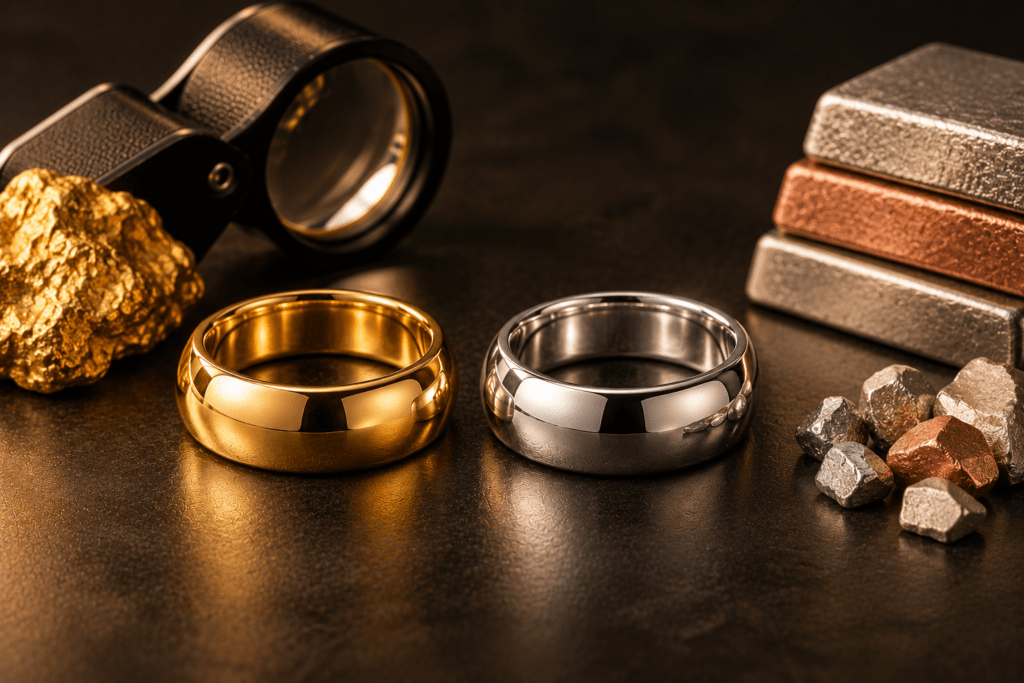
Yes. White gold is real gold.
This is a genuine gold alloy. Jewelers create its lighter color by mixing pure gold with other metals.
The amount of actual gold depends on the karat:
| White Gold Marking | Approximate Pure Gold Content |
|---|---|
| 10K / 417 | 41.7% |
| 14K / 585 | 58.3–58.5% |
| 18K / 750 | 75% |
| 24K | Nearly pure gold, but naturally yellow |
So an 18K white gold ring contains the same percentage of pure gold as an 18K yellow gold ring. The difference is mainly the metals mixed with the gold and the resulting color.
If you have white jewelry and aren’t sure whether it is gold, silver, platinum, or plated jewelry, Gold Kings can professionally test the metal before you make any decisions about selling it.
What Is White Gold Made Of?
Pure 24K gold is naturally yellow.
Refiners use different metal recipes to create a paler alloy. Depending on the formula, these may include nickel, palladium, silver, copper, or zinc.
As the World Gold Council explains, jewelers mix pure gold with white metals such as palladium or silver. In addition, rhodium plating often adds a harder surface and brighter shine.
In other words, the underlying metal remains a gold alloy.
Think of it this way:
14K yellow gold = gold + alloy metals
14K white gold = gold + different alloy metals
Both contain roughly the same percentage of pure gold.
The color is different. The gold content is not.
How the Alloy Gets Its Color
Pure gold has a strong yellow color.
Alloying metals change the appearance of the finished piece. Some reduce its yellow tone and create a lighter color.
However, the untreated alloy is not always the brilliant, icy-white color people associate with engagement rings.
It may have a slightly warm, grayish, or pale-yellow tone.
That is why many rings, necklaces, earrings, and bracelets receive a thin coating of rhodium.
Rhodium gives jewelry a bright, reflective finish. It also adds shine and surface protection.
Is White Gold Just Gold-Plated Jewelry?
No.
The confusion usually comes from the word “plated.”
A 14K ring may have a thin layer of rhodium on the outside, but underneath that coating is still a 14K gold alloy.
That is very different from ordinary gold-plated jewelry.
Gold Throughout the Alloy
The underlying jewelry itself contains gold throughout the metal.
Gold-plated jewelry
Only a thin outer layer contains gold. The material underneath may be brass, copper, stainless steel, or another base metal.
A Rhodium Surface Finish
The underlying jewelry is a gold alloy, while the rhodium is simply a surface finish.
Therefore, the word “plated” in a description of a rhodium finish does not mean the underlying metal is fake.
Does White Gold Turn Yellow?
Sometimes it can appear more yellow over time, but that does not necessarily mean anything is wrong with the jewelry.
The rhodium coating gradually wears through everyday use.
As this finish thins, the alloy’s natural color becomes more visible.
A jeweler can restore the bright finish by applying a fresh rhodium coating.
This is especially noticeable with rings because they constantly contact:
- Skin
- Countertops
- Clothing
- Soap
- Lotions
- Other jewelry
- Everyday surfaces
A change in color therefore does not automatically mean the ring is fake.
Understanding 14K and 585 Marks
At this karat level, the alloy contains approximately 58.3% pure gold.
The remaining approximately 41.7% consists of other metals used to alter characteristics such as color, hardness, and durability.
You may see markings including:
- 14K
- 14KT
- 583
- 585
The Federal Trade Commission explains karat markings and how they identify the amount of pure gold in an item. A 14K piece contains 14 parts gold out of 24 total parts.
If you want to understand a 585 marking specifically, see Gold Kings’ guide to what 585 means on gold.
Understanding 18K and 750 Marks
By comparison, an 18K alloy is 75% pure gold.
Only 25% of the alloy consists of other metals.
Common markings include:
- 18K
- 18KT
- 750
Because 18K contains more pure gold per gram than 14K, it generally has a higher precious-metal value at equal metal weights.
Gold Kings also has a detailed explanation of what 750 means on gold.
Is White Gold Worth as Much as Yellow Gold?
If the weight and karat are the same, the amount of pure gold is generally the same.
For example:
A 10-gram 14K yellow-gold ring and a 10-gram 14K white-gold ring both contain roughly the same amount of pure gold.
The color alone does not make one contain more gold.
However, the actual value of finished jewelry can involve much more than simply weighing the entire piece.
Factors may include:
- Actual gold purity
- Total precious-metal weight
- Current gold spot price
- Diamonds or gemstones
- Designer or brand value
- Condition
- Collectibility
- Non-gold components
That is why knowing the total weight of a ring does not automatically tell you exactly how much gold is inside it.
Thinking About Selling Your Jewelry?
If you have an old ring, broken chain, single earring, bracelet, necklace, or inherited jewelry, don’t assume its silver color means it has little value.
Gold Kings can test the metal, verify its purity, weigh the item, and explain what you have before you decide whether selling makes sense.
You can also see the types of gold, jewelry, coins, bullion and other valuables Gold Kings buys.
How Can You Tell If White Gold Is Real?
Color alone is not enough.
For example, a pale alloy can resemble:
- Sterling silver
- Platinum
- Palladium
- Stainless steel
- Rhodium-plated silver
- Costume jewelry
Several clues can help.
1. Look for a Hallmark
Check inside rings, near necklace clasps, on bracelet clasps, or on the backs of earrings.
For example, look for one of these marks:
10K or 417
14K, 583, or 585
18K or 750
A hallmark provides a useful clue, but it does not prove what the metal contains.
Jewelry can be repaired, altered, incorrectly marked, heavily worn, or plated.
And genuine gold jewelry does not necessarily have to carry a readable stamp.
Gold Kings explains this in more detail in Does Real Gold Have to Be Stamped?.
2. Don’t Depend on a Magnet Alone
Gold itself is not magnetic.
However, jewelry contains alloys, clasps, springs, solder, and other components that can complicate a simple magnet test.
A magnet can sometimes identify an obvious problem, but it cannot reliably tell you the exact purity of a piece.
3. Have the Metal Professionally Tested
If authenticity or value matters, professional testing is much more useful than guessing based on color.
Gold Kings uses professional testing methods, including XRF testing when appropriate, to evaluate precious-metal items. We then weigh each item and consider its precious-metal content. Customers can watch the testing and weighing process.
This can be particularly useful for jewelry that:
- Has no stamp
- Has a worn stamp
- Was inherited
- Has been repaired
- Looks like silver or platinum
- Came from another country
- Has an unfamiliar hallmark
- Was purchased secondhand
White Gold vs. Silver: What’s the Difference?
White gold and silver can look remarkably similar.
But chemically and financially they are very different metals.
| Feature | White Gold | Sterling Silver |
|---|---|---|
| Main precious metal | Gold | Silver |
| Common markings | 10K, 14K, 18K, 417, 585, 750 | 925, Sterling |
| Common surface | Often rhodium plated | May be polished or rhodium plated |
| Tarnishing | Generally less prone to silver-style tarnish | Common over time |
| Typical precious-metal value | Usually higher per gram | Usually considerably lower per gram |
Jewelers sometimes coat sterling silver with rhodium too, which makes visual identification even more difficult.
So if an old ring looks white and shiny, appearance alone cannot tell you what it is.
White Gold vs. Platinum
Platinum is another metal commonly confused with white gold.
But platinum is not gold.
White gold gets its precious-metal content from gold.
Platinum jewelry contains platinum.
The two also use completely different purity markings.
For example, a karat-gold ring might say:
- 14K
- 585
- 18K
- 750
A platinum ring may have markings referring to platinum instead.
Because both can have a similar appearance, professional testing can be helpful when markings are missing or difficult to read.
Does Broken Jewelry Still Have Value?
Yes.
A bent ring still contains its original gold.
Similarly, a broken necklace retains its precious-metal content even if the clasp is missing.
A single earring also retains value when its matching piece disappears.
For ordinary scrap jewelry, the precious-metal content can remain valuable even when the jewelry itself is no longer wearable.
Common items worth checking include:
- Broken rings
- Damaged chains
- Single earrings
- Old wedding bands
- Class rings
- Bent bracelets
- Tangled necklaces
- Outdated jewelry
- Inherited jewelry
- Jewelry with missing stones
Before throwing an unidentified piece into a costume-jewelry box—or worse, throwing it away—consider having it tested.
What Determines the Value of White Gold?
For many pieces, four factors matter most.
Gold Purity
18K contains more gold per gram than 14K.
14K contains more gold per gram than 10K.
Precious-Metal Weight
A heavier piece generally contains more gold at the same purity. However, the buyer must account for stones and other non-gold components.
Current Gold Price
Gold’s market price changes throughout the trading day.
As the underlying price of gold changes, so does the melt value of gold jewelry.
The Item Itself
However, a buyer should not automatically treat every piece as scrap.
Designer jewelry, diamonds, gemstones, watches, collectible pieces, and certain estate jewelry may deserve additional evaluation before being valued solely for metal content.
That is another reason Gold Kings focuses on identifying what you actually have before making an offer.
Visit Gold Kings for Testing
If you aren’t sure whether a white-colored ring, necklace, bracelet, watch, or pair of earrings is gold, you do not have to figure it out at home.
Gold Kings has two Georgia locations for precious-metal evaluations. At either location, you can walk in for professional testing and transparent weighing.
Gold Kings of Snellville
3635 Stone Mountain Hwy
Snellville, GA 30039
The Snellville location serves customers throughout Gwinnett County and surrounding communities, including Snellville, Loganville, Lawrenceville, Grayson, Lilburn, Stone Mountain, and nearby areas.
See information about selling gold at Gold Kings of Snellville.
Gold Kings of Commerce
480 Banks Crossing Dr
Commerce, GA 30529
The Commerce location is convenient for customers throughout Commerce, Banks Crossing, Jackson County, Banks County, and surrounding Northeast Georgia communities.
See Gold Kings location and contact information.
Instead of guessing from the color, have the metal tested.
Test it first. Know what you own. Then decide what you want to do with it.
Frequently Asked Questions
Is white gold actually real gold?
Yes. This alloy combines genuine gold with other metals. Its karat rating tells you the proportion of pure gold.
Does 14K mean 58.5% purity?
Approximately, yes. 14K represents about 58.3% pure gold, while jewelry marked 585 indicates approximately 58.5% gold.
Does 18K mean 75% purity?
Yes. An 18K or 750 mark indicates approximately 75% pure gold.
Why does white gold look silver?
Jewelers mix gold with metals that lighten its color. In addition, they coat many pieces with rhodium for a bright finish.
Does the color change over time?
The rhodium finish can gradually wear away, revealing the alloy’s slightly warmer color. However, that change does not mean the item is fake or has lost its gold content.
Is white gold more valuable than yellow gold?
Not simply because of its color. If two pieces have the same karat and contain the same amount of gold, their underlying gold content is similar. Finished-jewelry value can still differ because of brand, craftsmanship, diamonds, gemstones, or other factors.
How does it compare with sterling silver?
They are different precious metals rather than simply different grades of the same material. The gold alloy generally has a higher metal value per gram, while sterling silver is primarily silver.
Can this alloy carry a 585 mark?
Yes. A 585 hallmark generally corresponds to approximately 14K gold.
Does a 750 stamp indicate 18K?
Yes. A 750 hallmark indicates approximately 75% pure gold, which corresponds to 18K.
Can genuine jewelry have no stamp?
Yes. Genuine gold jewelry may have a worn, missing, removed, or difficult-to-find hallmark. Professional testing can help determine the metal when markings are inconclusive.
Will Gold Kings buy white gold?
Gold Kings evaluates qualifying jewelry along with other precious metals and valuables. The purity, weight, current market value, and characteristics of the individual item determine its evaluation.
White Gold Is Real Gold — Find Out What Yours Is Worth
The color can be misleading.
That silver-looking ring in an old jewelry box could be sterling silver, platinum, costume jewelry—or valuable 14K or 18K white gold.
You don’t need to guess.
If you have unwanted white-gold jewelry, Gold Kings can test it, weigh it, explain what you have, and provide an evaluation before you decide whether to sell.
Visit Gold Kings of Snellville or Gold Kings of Commerce, or use the Gold Kings quote page to start your evaluation.
We test it, we weigh it, and we pay you.