
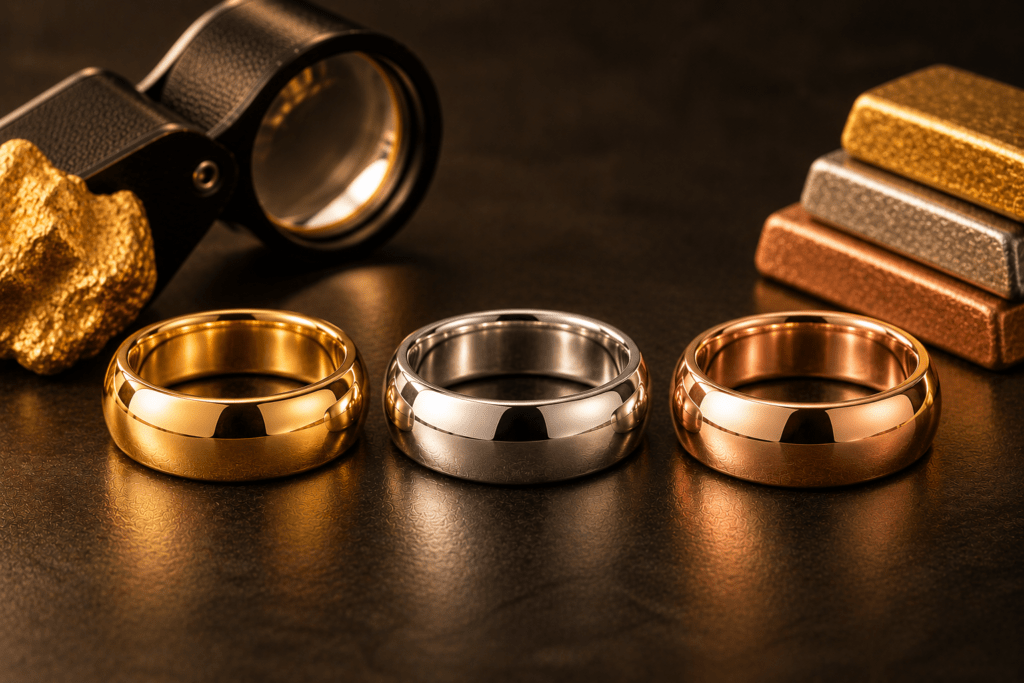
Yellow gold, white gold, and rose gold can look completely different, but they all start with the same precious metal: gold.
The difference is mainly the other metals mixed with the gold.
Pure 24K gold is naturally a rich yellow color. Because pure gold is relatively soft, jewelry makers commonly mix it with metals such as silver, copper, zinc, nickel, or palladium. These alloys can make jewelry stronger while also changing its color.
That means a 14K yellow gold ring, a 14K white gold ring, and a 14K rose gold ring can all contain essentially the same percentage of pure gold.
The color alone does not tell you which one is worth more.
At Gold Kings, we regularly evaluate gold jewelry in different colors, karats, styles, and ages. Professional testing is especially helpful because the color or stamp on a piece does not always tell the complete story.
Quick Answer: Yellow Gold vs. White Gold vs. Rose Gold
| Feature | Yellow Gold | White Gold | Rose Gold |
|---|---|---|---|
| Appearance | Traditional warm yellow | Bright white or silvery | Pink to reddish |
| Common alloy metals | Silver, copper, zinc | Nickel or palladium, often with zinc/copper | Copper and silver |
| Common karats | 10K, 14K, 18K, 22K | 10K, 14K, 18K | 10K, 14K, 18K |
| Rhodium plating | Usually no | Often yes | Usually no |
| Gold value | Based mainly on purity and weight | Based mainly on purity and weight | Based mainly on purity and weight |
| Best known for | Classic gold appearance | Modern white-metal look | Warm romantic color |
The Gemological Institute of America explains that yellow gold commonly contains metals such as copper, silver and zinc; white gold can contain nickel or palladium and is often rhodium plated; and rose gold gets its color primarily from copper.
What Is Yellow Gold?
Yellow gold is the color most people picture when they hear the word gold.
Pure gold is naturally yellow. However, most yellow gold jewelry is not pure 24K gold. It is an alloy containing gold plus other metals.
For example, a 14K yellow gold ring contains approximately 58.3% to 58.5% gold. The rest of the metal helps give the ring strength and affects its exact shade.
An 18K yellow gold ring contains 75% pure gold.
Because 18K contains more gold than 14K, it generally has a richer yellow color and contains more precious-metal value per gram, assuming the jewelry tests at the stated purity.
Yellow gold is commonly found in wedding bands, chains, bracelets, earrings, class rings, estate jewelry, watches, and older jewelry.
What Is White Gold?
White gold is real gold.
It is not platinum, silver, or simply yellow gold painted white.
White gold is created by mixing gold with lighter-colored metals such as nickel or palladium, along with other alloy metals. Many white gold pieces are then coated with a thin layer of rhodium to create the bright white appearance people associate with modern white gold jewelry.
That rhodium layer can gradually wear away.
When this happens, a white gold ring may begin showing a slightly warmer or yellowish color underneath. That does not automatically mean the jewelry is fake.
It may simply need to be replated.
Some white gold alloys contain nickel, which can also be important for people who are sensitive to nickel. Palladium-based white gold alloys are another option used in jewelry.
Can White Gold Test Differently Because of Rhodium?
Yes, and this is one reason experience matters when testing jewelry.
XRF analyzers primarily examine material at or near the surface. Because white gold is frequently rhodium plated, the surface coating can influence an initial reading.
At Gold Kings, XRF testing can help identify metals such as gold, silver, copper, nickel, zinc, palladium, and others. The test result should be considered along with the jewelry’s construction, markings, weight, appearance, and any surface treatments.
This is more reliable than assuming that a piece is 14K or 18K simply because of its color or stamp.
What Is Rose Gold?
Rose gold gets its pink or reddish appearance primarily from copper.
Gold itself remains the precious-metal component. Copper and other alloy metals change the color.
Generally, adding more copper creates a deeper reddish appearance, while different alloy recipes can produce softer pink or rose shades.
GIA describes rose gold as an alloy of gold with copper and silver, with manufacturers varying their formulations to create different colors.
Rose gold became especially popular in rings, watches, bracelets, necklaces, and engagement jewelry, but the concept is not new. Goldsmiths have been creating differently colored gold alloys for generations.
Most importantly:
Rose gold is not less “real” than yellow or white gold simply because it is pink.
A properly made 18K rose gold item contains the same 75% gold required of 18K yellow or white gold.
Does Gold Color Change the Karat?
No.
Color and karat are two different things.
Karat tells you how much gold is present.
Color tells you more about the metals alloyed with it.
| Karat | Approximate Pure Gold Content |
| 10K | 41.7% |
| 14K | About 58.3%–58.5% |
| 18K | 75% |
| 21K | 87.5% |
| 22K | About 91.7% |
| 24K | Approximately 99.9%+ |
The FTC advises consumers to look at the karat quality mark because the karat indicates how much pure gold the jewelry contains.
So if you have three rings that each weigh exactly 10 grams and all three are genuinely 18K:
10 grams of 18K yellow gold = 7.5 grams of pure gold
10 grams of 18K white gold = 7.5 grams of pure gold
10 grams of 18K rose gold = 7.5 grams of pure gold
The different colors do not change that basic gold content.
Is Yellow Gold, White Gold, or Rose Gold Worth More?
If the karat and weight are the same, the underlying gold value is generally similar because the pieces contain approximately the same amount of pure gold.
For example, an 18K rose gold ring is not automatically worth less than an 18K yellow gold ring simply because it contains copper.
Likewise, white gold is not automatically worth more because it looks similar to platinum.
When evaluating ordinary gold jewelry for its precious-metal value, the most important factors are:
Purity × weight × current gold price
However, jewelry can sometimes be worth more than its gold content.
A piece may also have value because of its brand, gemstones, diamonds, craftsmanship, age, condition, design, collectibility, or resale potential.
That is why it can be a mistake to look only at the color of the gold.
Does the Gold Stamp Matter?
Yes—but a stamp should be treated as useful information, not absolute proof.
Common markings include:
| Mark | Approximate Meaning |
| 417 or 10K | 41.7% gold |
| 585 or 14K | About 58.5% gold |
| 750 or 18K | 75% gold |
| 916 or 22K | About 91.6%–91.7% gold |
| 999 | Approximately 99.9% gold |
A white gold ring marked 750, for example, should be approximately 18K gold.
A rose gold bracelet marked 585 should be approximately 14K.
But jewelry can be repaired, resized, altered, plated, incorrectly marked, or made with components of different purity.
That is why professional testing becomes important when determining what an item actually contains.
How Gold Kings Tests Yellow, White, and Rose Gold
At Gold Kings, we do not determine gold purity based only on whether jewelry looks yellow, white, or pink.
Professional precious-metal testing can provide much more information about the composition of the jewelry.
An XRF gold analyzer uses X-ray fluorescence to identify elements in a metal sample without normally requiring the item to be cut or melted.
This can help identify gold along with metals commonly found in gold alloys, including silver, copper, nickel, zinc, palladium, and others.
That information matters because two pieces that look almost identical can contain very different amounts of gold.
A heavy gold-colored chain could be 10K, 14K, 18K, gold filled, plated, or something else entirely.
Testing answers a much more useful question:
What is actually in the jewelry?
Which Gold Color Is Best for Everyday Jewelry?
There is no single winner.
The better choice depends on the appearance you like, the karat, the specific alloy, and how the jewelry will be worn.
Yellow gold offers the traditional gold appearance and generally does not depend on rhodium plating to maintain its color.
White gold gives you a bright, modern white-metal appearance, but rhodium-plated pieces may eventually require replating.
Rose gold provides a distinctive warm pink or reddish color created largely by its copper content.
Karat also matters.
Higher-karat jewelry contains more gold and less alloy metal. Lower-karat jewelry contains more alloy metal, which can often make it more resistant to everyday wear, although durability ultimately depends on the particular alloy and construction of the piece.
Which Color Looks Best With Diamonds?
All three can work.
White gold creates a neutral white background that is popular with diamonds.
Yellow gold creates contrast between the warm metal and a white diamond.
Rose gold creates a softer, warmer contrast that can make the overall piece look distinctive.
From a precious-metal-value standpoint, however, the diamond setting being yellow, white, or rose does not by itself determine how much gold is present.
The karat does.
Can You Mix Yellow, White, and Rose Gold?
Absolutely.
Two-tone and three-tone jewelry intentionally combines different gold colors.
A bracelet might contain yellow and white gold. A ring might combine rose gold with white gold. Some pieces use all three.
When evaluating mixed-color jewelry, it may be necessary to examine different sections of the item because different components can contain different alloys or even different karats.
Clasps, solder joints, repaired areas, decorative sections, and replacement parts can also differ from the primary piece.
Which Gold Color Has the Best Resale Value?
There is no universal rule that yellow, white, or rose gold has the highest resale value.
For ordinary gold jewelry being evaluated primarily for its precious-metal content, purity and weight are usually much more important than color.
Consider two bracelets:
A lightweight 18K yellow gold bracelet might contain less total pure gold than a much heavier 14K white gold bracelet.
Even though 18K is the higher purity, the heavier 14K piece could contain more gold overall.
This is why jewelry should be weighed and tested before estimating its value.
If the piece contains diamonds, valuable gemstones, or has meaningful designer or collectible value, those factors should be considered separately rather than automatically treating the jewelry as scrap.
Thinking About Selling Yellow, White, or Rose Gold?
If you are comparing the three gold colors because you found old jewelry or are considering selling it, do not assume one color is more valuable than another.
First determine:
What karat is it? How much does it weigh? Does the tested purity match the stamp? Is there value beyond the metal?
Gold Kings can evaluate yellow gold, white gold, rose gold, broken jewelry, rings, chains, bracelets, earrings, estate jewelry, and other precious-metal items.
We test and weigh your jewelry so you can better understand what you own before deciding whether you want to sell.
Have Your Gold Tested at Gold Kings
If you have jewelry marked 10K, 14K, 18K, 417, 585, 750, 916—or jewelry with no readable stamp at all—Gold Kings can help determine what it contains.
Gold Kings of Snellville
3635 Stone Mountain Hwy
Snellville, GA 30039
770-771-4650
The Snellville location serves customers throughout Gwinnett County and surrounding communities and evaluates gold jewelry, coins, bullion, silver, watches, and other qualifying valuables.
Gold Kings of Commerce
480 Banks Crossing Dr
Commerce, GA 30529
706-336-0043
The Commerce location evaluates gold and other precious-metal items for customers in Commerce, Banks Crossing, Jackson County, Banks County, and surrounding Northeast Georgia communities.
There is no need to guess whether your jewelry is yellow gold, white gold, rose gold—or what karat it actually is.
Gold Kings can test it, weigh it, explain what you have, and give you a no-pressure evaluation.
Frequently Asked Questions
Is white gold real gold?
Yes. White gold is genuine gold alloyed with lighter-colored metals such as nickel or palladium. Many pieces are also rhodium plated to give them a brighter white appearance.
Is rose gold real gold?
Yes. Rose gold is real gold. Its pink or reddish appearance comes primarily from copper added to the alloy.
Is yellow gold more valuable than white gold?
Not simply because it is yellow. If two pieces have the same weight and tested gold purity, their underlying gold content should be similar.
Is rose gold cheaper than yellow gold?
Not necessarily. An 18K rose gold item contains the same percentage of gold as an 18K yellow gold item. Retail prices can vary because of brand, manufacturing, design, gemstones, and other factors.
Does white gold turn yellow?
White gold itself may have a slightly warm tone beneath its surface finish. Because many pieces are rhodium plated, wear to that plating can eventually allow the underlying warmer color to become more noticeable.
Is 14K white gold worth the same as 14K yellow gold?
If both pieces have the same weight and actually contain the same percentage of gold, their basic gold content is essentially the same. Other metals, gemstones, brand, design, and resale potential can affect the complete value.
Is 18K rose gold 75% pure gold?
Yes. Properly marked 18K rose gold is 75% gold, just like 18K yellow gold or 18K white gold.
Can XRF tell the difference between yellow, white, and rose gold?
XRF can identify many of the elements present in the alloy. Yellow, white, and rose gold typically contain different combinations or proportions of metals such as silver, copper, zinc, nickel, and palladium. Because surface treatments such as rhodium plating can affect an initial surface reading, proper interpretation is important.
Where can I sell yellow, white, or rose gold near me?
If you are in the Gwinnett County or Northeast Georgia area, Gold Kings has physical locations in Snellville and Commerce, Georgia.
Both locations evaluate gold jewelry and can help determine purity and weight before you decide whether to sell.
The Bottom Line
Yellow gold, white gold, and rose gold are not three different precious metals.
They are different gold alloys.
Yellow gold keeps the familiar warm appearance of gold. White gold uses lighter-colored alloy metals and is often rhodium plated. Rose gold gets its distinctive pink or reddish color largely from copper.
But when you want to know what a piece is actually worth, color is only the beginning.
Purity, weight, current gold prices, gemstones, brand, condition, and the type of jewelry can all matter.
If you have yellow, white, or rose gold jewelry sitting in a jewelry box and want to know what it actually contains, bring it to Gold Kings of Snellville or Gold Kings of Commerce.
We can professionally test it, weigh it, explain the results, and help you understand its value before you decide what to do next.
We test it. We weigh it. We pay you.