
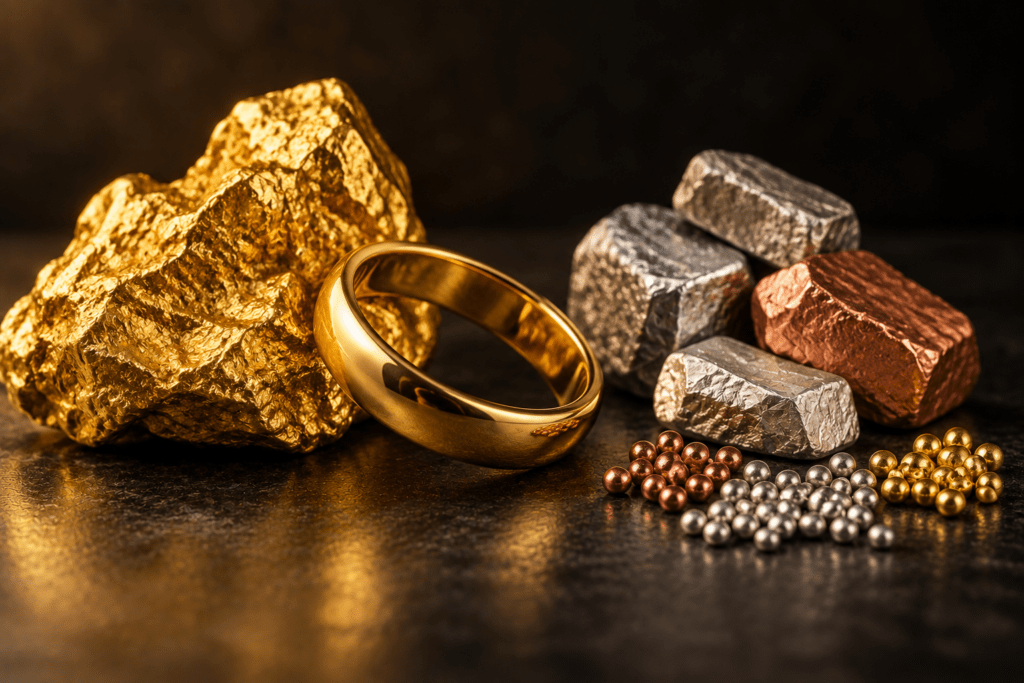
Pure gold is naturally yellow, valuable and extremely workable—but it is also relatively soft.
That is why jewelers usually avoid pure 24K gold for everyday jewelry.
Instead, jewelers mix gold with other metals such as copper, silver, zinc, nickel and palladium. Jewelers call these mixtures gold alloys.
The added metals also affect strength, color and how easily jewelers can shape and polish each piece.
The exact mixture also helps explain why two pieces marked with the same karat can look noticeably different.
Quick Answer: What Metals Are Mixed With Gold?
The most common metals mixed with gold jewelry are:
- Copper
- Silver
- Zinc
- Nickel
- Palladium
Less common or specialized gold alloys can contain other metals as well.
According to the Gemological Institute of America, jewelers commonly mix gold with copper, silver and zinc to improve durability. In addition, they use metals such as nickel and palladium to produce white gold.
At Gold Kings, the alloy matters because the color of a piece does not tell us exactly how much gold it contains.
A yellow ring, white-gold chain and rose-gold bracelet could all be 14K gold even though their alloy mixtures and appearances are very different.
When purity or value matters, professional testing provides a much better answer than color alone.
Why Is Gold Mixed With Other Metals?
Pure gold is approximately 24 karat.
It is highly malleable, meaning jewelers can bend, stretch and shape it relatively easily. Those characteristics help jewelers work with gold, but pure gold can be too soft for many everyday pieces.
Mixing gold with other metals can make the finished jewelry:
- Harder
- More resistant to scratching and bending
- Easier to use for rings, clasps and stone settings
- Different colors
- More practical for everyday wear
- Less expensive than an equivalent piece made from nearly pure gold
Karat tells you the percentage of actual gold.
Meanwhile, alloy metals make up the remaining portion.
For example:
| Gold Mark | Approximate Gold Content | Other Metals |
|---|---|---|
| 24K / 999 | 99.9% | About 0.1% |
| 22K / 916 | 91.6% | About 8.4% |
| 18K / 750 | 75.0% | 25.0% |
| 14K / 585 | 58.5% | 41.5% |
| 10K / 417 | 41.7% | 58.3% |
This is why the word karat is so important when determining what gold jewelry may be worth.
An 18K ring contains considerably more gold by weight than an otherwise identical 10K ring.
For more detail, see Gold Kings’ guides to 585 or 14K gold and 750 or 18K gold.
The Most Common Metals Mixed With Gold
1. Copper
Copper plays an important role in gold jewelry.
Adding copper can:
- Increase hardness
- Increase durability
- Add reddish or pink tones
- Help create rose gold
The more copper used in certain gold alloys, the warmer and redder the finished jewelry can appear.
This is why rose gold gets much of its color from copper.
Rose gold is still real gold. Its pink appearance does not mean it contains less gold than yellow gold of the same karat.
For example:
14K yellow gold and 14K rose gold are both approximately 58.5% gold.
The difference is primarily in the metals making up the remaining portion.
2. Silver
Silver is another traditional gold-alloy metal.
For example, jewelers add silver to gold to:
- Lighten the yellow color
- Modify hardness and workability
- Balance the reddish effect of copper
- Help create certain yellow, greenish or rose-colored alloys
Yellow-gold jewelry commonly contains varying amounts of both silver and copper.
However, there is no single universal recipe.
As a result, two manufacturers could use different recipes for 14K yellow gold while keeping approximately the same gold percentage.
3. Zinc
Manufacturers commonly add smaller amounts of zinc to gold alloys.
It can help:
- Lighten the color of an alloy
- Improve certain manufacturing characteristics
- Modify hardness
- Contribute to white- and yellow-gold formulas
For example, a jewelry maker may combine zinc with copper, silver, nickel or other metals, depending on the recipe.
4. Nickel
Jewelers have long used nickel to create white gold.
Because natural gold is yellow, jewelers mix it with whiter metals to create the lighter appearance of white gold.
Nickel can:
- Make gold appear whiter
- Increase hardness
- Create a strong jewelry alloy
However, nickel can cause skin reactions in people who are sensitive to it. GIA identifies nickel as a common allergen found in some white-gold alloys.
Not all white gold contains nickel.
5. Palladium
Jewelers also mix palladium with gold to make white gold.
It is part of the platinum-group family of metals and can create a white-gold alloy without relying as heavily on nickel.
Palladium-containing gold alloys may be more expensive to manufacture because palladium itself is a precious metal.
White gold can therefore vary considerably in composition even when two pieces carry exactly the same karat stamp.
What Is Yellow Gold Mixed With?
Yellow gold usually contains a mixture of:
- Gold
- Silver
- Copper
- Sometimes zinc
The goal is generally to strengthen the gold while preserving much of its traditional yellow appearance.
However, the precise formula can vary by manufacturer.
Example
An 18K yellow-gold ring contains approximately:
75% gold + 25% other metals
Those other metals might include different proportions of silver, copper and zinc.
That does not mean every 18K yellow-gold item has exactly the same alloy recipe.
The important number for value is how much actual gold the item contains.
What Is White Gold Mixed With?
White gold may contain metals such as:
- Nickel
- Palladium
- Silver
- Copper
- Zinc
GIA explains that jewelers make white gold by mixing gold with white metals such as nickel or palladium. They then coat many pieces with rhodium for an even brighter white appearance.
Is Rhodium Mixed Into White Gold?
Not necessarily.
This is an important distinction.
For example, jewelers apply a thin rhodium plating to the outside of many white-gold rings.
However, rhodium plating forms a surface finish rather than the main gold alloy.
As the plating wears, some white-gold jewelry may begin to show a slightly warmer or yellowish underlying color.
However, that color change does not mean the jewelry is fake.
What Is Rose Gold Mixed With?
Rose gold gets its distinctive pink or reddish appearance primarily from copper.
Typical rose-gold alloys contain:
- Gold
- Copper
- Silver
- Sometimes small amounts of zinc
More copper generally produces a stronger reddish tone.
In contrast, less copper and more silver can result in a softer pink appearance.
GIA notes that jewelers generally produce rose gold by mixing gold with copper and silver.
Again, the color does not determine the karat.
An 18K rose-gold piece still contains approximately 75% gold.
Is 14K Gold Mostly Gold?
Yes, although just over half of the metal is pure gold.
14K gold is approximately:
58.5% gold
and
41.5% alloy metals
Those alloy metals commonly include combinations of copper, silver, zinc, nickel or palladium depending on the desired color.
For example, a piece may carry one of these stamps:
- 14K
- 14KT
- 583
- 585
You can read more in our guide to what 585 means on gold.
What About 18K Gold?
18K gold contains substantially more pure gold:
75% gold
and
25% other metals
For example, look for one of these stamps:
- 18K
- 18KT
- 750
Because it contains a higher percentage of gold, 18K jewelry will generally have a higher precious-metal value than equal-weight 14K jewelry, assuming the purity is genuine.
Does More Alloy Mean the Gold Is Fake?
No.
An alloy does not make gold fake.
Almost all commonly worn gold jewelry is an alloy.
In fact, a genuine 14K ring contains metals other than gold by design.
The important distinction is between:
solid karat gold
and materials such as:
- Gold plated
- Gold filled
- Gold vermeil
- Gold clad
- Costume jewelry
Solid 14K jewelry contains gold throughout the alloy.
In contrast, gold-plated jewelry generally has only a thin layer of gold over another base metal.
Those are very different products.
Can You Tell What Metals Are in Gold From the Stamp?
Usually not.
A stamp such as 14K, 585, 18K or 750 tells you the expected amount of gold.
It normally does not tell you the complete alloy recipe.
A 585 stamp indicates approximately 58.5% gold, but the other 41.5% could contain different combinations of copper, silver, zinc, nickel or other metals.
That is one reason two 14K rings can:
- Look slightly different in color
- Have different hardness
- React differently during jewelry repair
- Show different metal combinations during testing
However, a hallmark alone does not prove that an item is genuine.
Gold Kings explains this further in our guide on how to tell if gold is real.
How Gold Kings Tests Gold Alloys
If you are trying to determine what a piece of jewelry actually contains, appearance and stamps only tell part of the story.
Gold Kings uses professional testing methods, including XRF technology, to help analyze the elemental composition of precious-metal items.
XRF testing can identify elements contained in a piece and help determine whether the tested metal is consistent with the expected gold purity.
That is useful when evaluating:
- Unmarked jewelry
- Older jewelry
- Foreign gold
- White gold
- Rose gold
- Jewelry with questionable hallmarks
- Pieces stamped at one purity that need verification
- Scrap or broken gold
Gold Kings also weighs precious-metal items in front of the customer and explains the evaluation process.
Don’t Guess From the Color
A white metal could be white gold, silver, platinum or another material.
A yellow item could be solid gold, gold filled, plated or something else entirely.
And a rose-colored piece could contain genuine karat gold or merely have a rose-colored finish.
Therefore, professional testing offers a better way to determine what you actually own.
Does the Alloy Affect What Gold Jewelry Is Worth?
Yes—but the amount of pure gold is usually the most important precious-metal factor.
When evaluating gold jewelry for its metal value, several things can matter:
- Weight
- Actual gold purity
- Current gold price
- Whether the entire item is precious metal
- Stones or non-gold components
- Whether the jewelry has additional collectible, designer or resale value
Consider two rings weighing 10 grams.
If one is 10K and the other is 18K, they do not contain the same amount of gold.
The 18K piece contains approximately 7.5 grams of gold before considering any stones or non-gold components.
By comparison, the 10K piece contains approximately 4.17 grams of gold.
As a result, that difference can significantly affect value.
Thinking About Selling Gold Jewelry?
If you searched this topic because you found an old ring, chain, bracelet or inherited jewelry and want to know what it contains, you do not need to identify every alloy metal yourself.
Gold Kings can professionally test the jewelry, verify its purity, weigh it and explain what you have before you decide whether you want to sell.
We purchase many types of gold jewelry, including broken, tangled, damaged and outdated pieces.
Have Your Gold Tested at Gold Kings
Gold Kings has two Georgia locations for customers who want to know what their gold jewelry actually contains or what it may be worth.
Gold Kings of Snellville
3635 Stone Mountain Hwy
Snellville, GA 30039
770-771-4650
The Snellville location serves customers throughout Snellville, Loganville, Lawrenceville, Grayson, Lilburn, Stone Mountain and surrounding Gwinnett County communities.
Learn more about Gold Kings of Snellville.
Gold Kings of Commerce
480 Banks Crossing Dr
Commerce, GA 30529
706-336-0043
The Commerce location serves Commerce and surrounding Northeast Georgia communities, including customers throughout the Banks Crossing area and nearby cities.
Learn more about Gold Kings of Commerce.
At either location, you can bring gold jewelry in for professional testing and evaluation.
We test it, weigh it and explain what you have. Then you decide.
Frequently Asked Questions
What is usually mixed with gold to make jewelry?
Copper, silver and zinc are among the most common metals. White-gold alloys may also contain nickel or palladium.
Why isn’t jewelry made from pure gold?
Pure gold is relatively soft. Alloying it with other metals makes jewelry more durable and can also change its color.
What is mixed with 14K gold?
14K gold is approximately 58.5% gold and 41.5% other metals. The remaining metals can include copper, silver, zinc, nickel or palladium depending on the alloy.
What is mixed with 18K gold?
18K gold contains 75% gold and 25% alloy metals. The specific metals vary according to whether the jewelry is yellow, white or rose gold.
What metal makes rose gold pink?
Copper is primarily responsible for the pink or reddish color of rose gold.
What metals make white gold white?
Jewelers commonly use nickel and palladium to whiten gold. Other metals such as zinc, silver and copper may also be present.
Is white gold real gold?
Yes. White gold contains genuine gold mixed with other metals. Its purity can be 10K, 14K, 18K or another recognized karat.
Is rose gold worth less than yellow gold?
Not simply because of its color. If two pieces have the same verified karat and the same gold weight, they contain approximately the same amount of pure gold regardless of whether they are yellow, white or rose.
Can a gold stamp be wrong?
Yes. A stamp provides useful information, but it cannot confirm authenticity or value on its own. Professional testing can verify the actual metal.
Can Gold Kings tell me what my jewelry contains?
Gold Kings uses professional precious-metal testing methods, including XRF technology, to help analyze gold jewelry and determine its composition and purity.
Know What Your Gold Is Made Of Before You Sell It
The metals mixed with gold are not just filler.
They determine much of the jewelry’s strength, color and physical characteristics.
Copper helps create rose gold. Nickel or palladium can help create white gold. Silver and zinc appear in many common jewelry alloys.
But when you are trying to determine value, the most important question is usually:
How much actual gold does the jewelry contain?
If you have old, broken, inherited or unwanted gold jewelry, Gold Kings can help you find out.
Visit Gold Kings in Snellville or Commerce, Georgia for professional testing, transparent weighing and an explanation of what your jewelry contains before you make a decision about selling.
Gold Kings — We test it, we weigh it, and we pay you.