
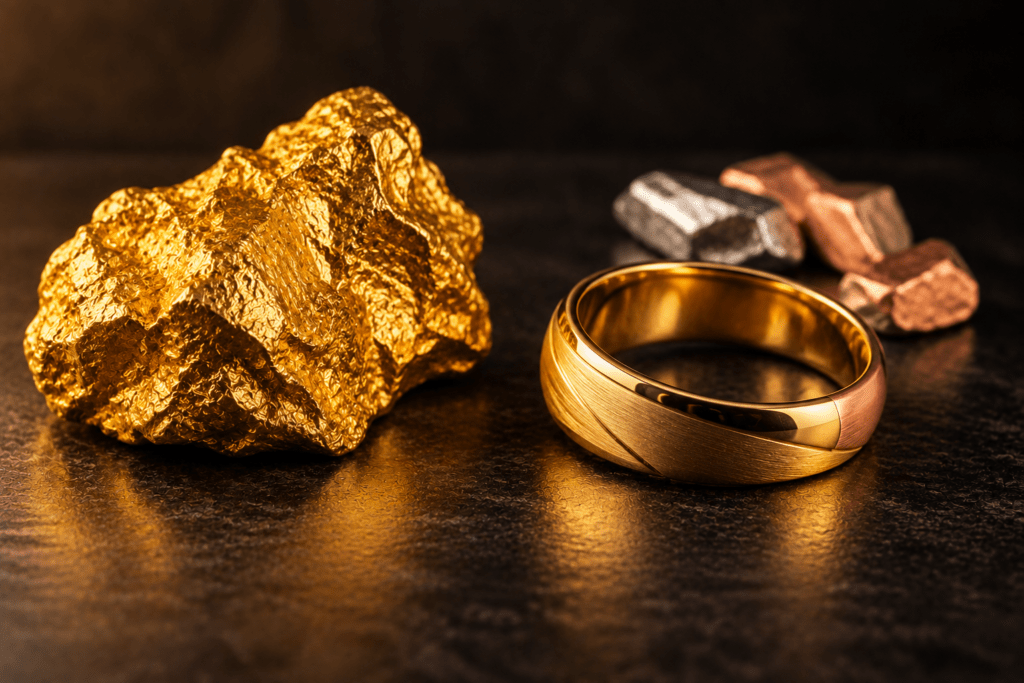
Pure 24K gold is beautiful, valuable, and extremely resistant to corrosion—but it is also very soft compared with the gold alloys commonly used for everyday jewelry.
A ring, chain, bracelet, or pair of earrings has to survive bumps, scratches, bending, pulling, and years of normal wear.
That’s why jewelers usually mix gold with metals such as silver, copper, palladium, or zinc.
Jewelers call these mixtures gold alloys.
Alloying gold can:
- Make jewelry stronger
- Reduce scratching and denting
- Help rings and settings hold their shape
- Make gemstone settings more secure
- Create yellow, white, and rose gold colors
- Make jewelry more practical for everyday wear
The World Gold Council explains that alloying pure 24K gold with other metals gives naturally malleable gold greater durability. GIA likewise notes that 24K is the purest and softest form of gold and is more prone to scratches and dents than 14K or 18K jewelry.
At Gold Kings, we regularly evaluate jewelry made from different gold purities. Whether an item is marked 10K, 14K, 18K, 22K, 24K, 417, 585, 750, 916, or 999, the gold content can have a major effect on its precious-metal value.
What Is 24K Gold?
The karat system divides gold purity into 24 parts.
In this system, pure gold accounts for 24 out of 24 parts.
24K = approximately 100% gold
In practice, makers commonly mark investment-grade and fine gold 999 or 999.9, meaning 99.9% or 99.99% gold.
You can read more about what 999 means on gold.
In contrast, other common gold purities contain progressively more alloying metal.
| Gold Type | Approximate Gold Content | Common Purity Mark |
|---|---|---|
| 24K | 99.9%+ | 999 / 999.9 |
| 22K | 91.6–91.7% | 916 |
| 18K | 75% | 750 |
| 14K | 58.3–58.5% | 585 |
| 10K | 41.7% | 417 |
Therefore, an 18K ring is not “fake gold.”
It is approximately 75% pure gold and 25% other metals.
Likewise, 14K jewelry is approximately 58.5% gold, while 10K is approximately 41.7% gold.
The Main Reason: Pure Gold Is Soft
Gold has several unusual physical properties.
Gold is extremely malleable, so craftspeople can hammer or shape it without breaking it. In addition, its high ductility allows them to draw it into very thin wire.
As a result, craftspeople have valued these properties for thousands of years.
But they create a problem for jewelry intended for daily wear.
A 24K Ring Can Dent and Scratch More Easily
For example, imagine wearing a pure gold wedding band every day.
It may encounter:
- Door handles
- Countertops
- Tools
- Keys
- Shopping carts
- Exercise equipment
- Other rings
- Hard surfaces
Because pure gold is relatively soft, it can accumulate scratches, dents, and deformation more readily than lower-karat gold alloys.
Therefore, adding other metals can improve the finished jewelry’s durability.
That is a major reason jewelers commonly choose 14K and 18K gold for rings and other everyday pieces. GIA specifically identifies 14K and 18K as more suitable for everyday wear because alloying increases strength.
Gemstone Settings Need Strength
Softness becomes even more important when a piece contains diamonds or other gemstones.
For example, consider an engagement ring.
Small metal prongs may hold a valuable diamond in place.
Those prongs need to resist:
- Bending
- Spreading
- Wearing down
- Catching on clothing
- Repeated impacts
However, extremely soft metal can make that job more difficult.
As a result, a stronger gold alloy can give designers a better balance between gold content, beauty, workability, and durability.
However, that does not mean 24K jewelry cannot exist.
It absolutely does.
Instead, pure gold is not always the most practical material for every type of jewelry.
Why Mix Other Metals With Gold?
Durability is the biggest reason, but it isn’t the only one.
1. Gold Alloys Can Be Stronger
Copper, silver, palladium, zinc, and other metals can alter the physical characteristics of gold.
The exact mixture depends on the jewelry a maker wants to produce.
For example, a piece for frequent wear may benefit from a different alloy than one for occasional use.
2. Alloys Create Different Gold Colors
Pure gold naturally has a rich yellow color.
In addition, mixing gold with other metals makes new colors possible.
Yellow Gold
Yellow gold retains the familiar warm gold appearance while using other metals to improve durability.
Rose Gold
Copper gives rose gold its pink or reddish tone.
White Gold
Manufacturers create white gold by combining gold with lighter-colored metals. They also apply rhodium plating to many pieces for a bright white finish.
So when you see yellow, rose, and white gold jewelry, the difference is not simply cosmetic plating. The composition of the underlying gold alloy may also be different.
Is 24K Gold Jewelry Actually Made?
Yes.
Some people mistakenly believe jewelers cannot make jewelry from pure gold.
That isn’t true.
Jewelers produce 24K and very high-karat jewelry, and people wear it throughout the world.
In particular, buyers in some cultures and markets place a high value on the jewelry’s actual gold content.
There are also modern manufacturing techniques designed to produce harder forms of high-purity gold jewelry. The World Gold Council has documented the development of specialized “24K hard gold” products as manufacturers work to combine high purity with more complex jewelry designs.
So the better question isn’t:
“Can jewelers make jewelry from 24K gold?”
It can.
The better question is:
“Is 24K the best choice for this particular piece of jewelry?”
Often, it isn’t.
Is 22K Gold a Compromise?
For some jewelry, yes.
22K gold contains approximately 91.6% gold, leaving a relatively small percentage for other metals.
That means it retains much of the rich color and high gold content associated with pure gold while gaining some additional strength from the alloy.
You may see 22K jewelry stamped:
- 22K
- 22KT
- 916
- 917
High-karat jewelry can still be softer than 14K or 18K jewelry, but many people prefer it because of its high precious-metal content and distinctive color.
Why Is 18K Gold Popular?
By comparison, 18K gold offers another balance.
It contains:
75% pure gold
with approximately 25% consisting of other metals.
That is why makers commonly stamp genuine 18K jewelry 750.
Compared with 24K, 18K can offer substantially greater practicality while still containing a high percentage of gold.
If you find jewelry marked 750, see our explanation of what 750 means on gold.
Why Is 14K Gold So Common?
14K gold contains approximately 58.5% gold.
The remaining portion consists of alloying metals.
That lower gold percentage allows manufacturers to create jewelry that is generally more resistant to everyday wear than higher-karat gold.
Consequently, 14K can be especially practical for:
- Wedding bands
- Engagement rings
- Chains
- Bracelets
- Earrings
- Pendants
- Everyday jewelry
A common fineness mark for 14K jewelry is 585.
Learn more about what 585 means on gold.
Does Lower-Karat Gold Mean Lower-Quality Jewelry?
Not necessarily.
Gold purity and jewelry quality are related, but they are not the same thing.
For example, a beautifully made 14K ring can suit everyday wear better than a poorly constructed higher-karat ring.
Quality can depend on:
- Craftsmanship
- Design
- Condition
- Gold purity
- Alloy composition
- Stone quality
- Brand
- Construction
- Age
- Rarity
Karat tells you primarily about the percentage of gold in the metal.
However, it does not tell you everything about the finished piece.
Is 24K Gold Worth More Than 14K or 18K Gold?
When comparing the same weight of gold alloy, higher-karat gold contains more actual gold.
For example, ignoring stones and other non-gold components:
10 grams of 24K gold contains close to 10 grams of gold.
By comparison, 10 grams of 18K gold contains approximately 7.5 grams of gold.
10 grams of 14K gold contains approximately 5.85 grams of gold.
Consequently, that difference matters when determining the precious-metal value of jewelry.
But total jewelry value can involve more than melt value.
In addition, these features may affect a piece’s resale value:
- Diamonds
- Gemstones
- Designer or brand
- Collectibility
- Condition
- Antique value
- Resale demand
- Construction
This is why simply weighing a ring and checking its stamp does not always tell the entire story.
Thinking About Selling Gold Jewelry?
If you’re trying to determine how much your jewelry may be worth, start with three basic questions:
What does it weigh?
How pure is the gold?
What is the current gold price?
Gold Kings can professionally test and weigh gold jewelry and explain what the markings and tested purity mean.
We purchase many of the items listed on our What We Buy page, including gold jewelry, broken jewelry, coins, bullion, silver, watches, and estate jewelry.
There is no reason to guess whether an old chain, ring, bracelet, or mismatched earring contains valuable gold.
A Gold Stamp Is Helpful—But It Isn’t the Final Test
A hallmark such as 585, 750, 916, or 999 gives a clue about the gold content a maker claims.
However, you should not treat a stamp alone as absolute proof.
An item may have:
- Repairs
- Replacement parts
- Solder joints
- Signs of wear
- Incorrect markings
- Surface plating
- Other alterations
Therefore, look beyond the hallmark when you’re trying to determine what an item is worth.
At Gold Kings, professional precious-metal testing, including XRF testing when appropriate, can help determine the metal composition of an item.
We can also weigh the jewelry in front of you and explain how purity and weight affect its potential precious-metal value.
As a result, you get more useful information than a stamp alone can provide.
Have Your Gold Tested at Gold Kings
If you’ve discovered old jewelry and aren’t sure whether it is 10K, 14K, 18K, 22K, or 24K, you can bring it to either Gold Kings location for evaluation.
Gold Kings of Snellville
3635 Stone Mountain Hwy
Snellville, GA 30039
770-771-4650
Gold Kings of Snellville serves customers throughout Snellville, Loganville, Lawrenceville, Grayson, Lilburn, Stone Mountain, and surrounding Gwinnett County communities.
Learn more about Gold Kings of Snellville.
Gold Kings of Commerce
480 Banks Crossing Dr
Commerce, GA 30529
706-336-0043
The Commerce location is convenient for customers throughout Commerce, Jackson County, Banks County, and surrounding Northeast Georgia communities.
Both Gold Kings locations evaluate precious metals and provide customers with an opportunity to understand what they own before deciding whether to sell. Current Gold Kings location information confirms walk-in service at both Snellville and Commerce.
Frequently Asked Questions
Is 24K gold too soft for jewelry?
Not necessarily too soft to make jewelry, but it is softer and more prone to scratching and denting than commonly used 14K and 18K alloys. That makes it less practical for certain types of everyday jewelry.
Is 24K gold real gold?
Yes. 24K is the highest standard karat designation and generally describes gold with a purity of approximately 99.9% or better.
Is 14K gold fake because it isn’t pure?
No.
14K gold is real gold. It contains approximately 58.3% to 58.5% gold combined with other metals.
Is 18K gold real gold?
Yes.
18K gold contains 75% pure gold. Jewelry marked 750 usually indicates 18K gold.
What does 999 mean on jewelry?
A 999 mark indicates approximately 99.9% pure gold, which jewelers typically describe as 24K or fine gold.
Why do jewelers add copper to gold?
Copper can increase durability and influence color. Higher levels of copper are also responsible for the pink or reddish appearance associated with rose gold.
Does 24K gold scratch easily?
Compared with lower-karat jewelry alloys, yes. Pure gold is relatively soft, which makes it more susceptible to scratches, dents, and deformation.
Is higher-karat gold always worth more?
Higher-karat gold contains more gold per unit of weight, so its precious-metal value per gram is generally higher when comparing equivalent weights.
However, the total value of a finished jewelry item may also depend on gemstones, craftsmanship, brand, collectibility, condition, and resale demand.
How can I tell exactly what karat my jewelry is?
Start by looking for a hallmark such as 417, 585, 750, 916, or 999.
For greater certainty, ask a professional to test the item. Gold Kings offers precious-metal evaluation at both its Snellville and Commerce locations.
The Bottom Line
Jewelers often choose alloys over pure 24K gold because the purest gold isn’t always the most practical gold for jewelry.
Pure gold provides maximum gold content, but mixing it with other metals can give jewelry the strength, durability, color, and structural stability needed for everyday use.
That is why you see so much:
10K — 41.7% gold
14K — approximately 58.5% gold
18K — 75% gold
22K — approximately 91.6% gold
24K — approximately 99.9%+ gold
However, none of those numbers alone tells you whether a piece is “good” jewelry.
Instead, they tell you how much gold the alloy contains.
And if you’re trying to determine what an old ring, chain, bracelet, earrings, or other jewelry actually contains—and what that gold may be worth—you don’t have to rely on guesswork.
Visit Gold Kings of Snellville or Gold Kings of Commerce for professional testing, accurate weighing, and an explanation of what you have.
We test it, we weigh it, and we pay you.