
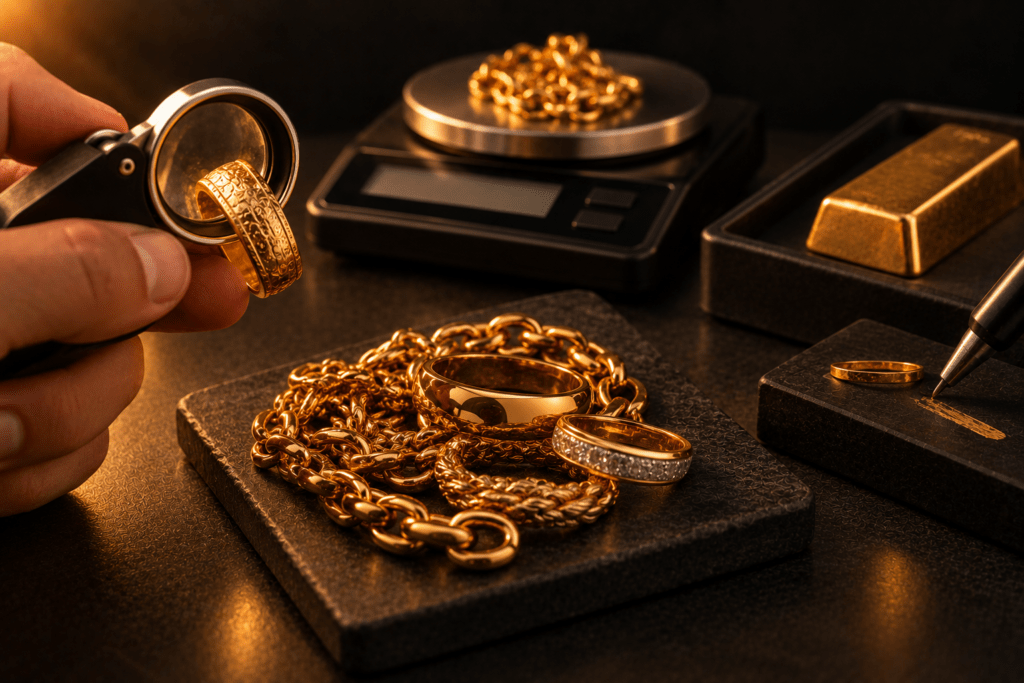
If you have an old gold chain, ring, bracelet, class ring, broken necklace, or inherited jewelry, one of the first questions you may ask is:
How much is my jewelry actually worth?
A professional gold buyer generally starts with four major factors: purity, precious-metal weight, the current gold price, and the type of item being evaluated.
For ordinary scrap gold jewelry, the basic calculation looks something like this:
Gold weight × gold purity × current gold market price = approximate precious-metal value
But there is more to a professional evaluation than putting a piece of jewelry on a scale.
At Gold Kings, we evaluate gold jewelry by identifying what the item is made of, testing its actual precious-metal content, weighing it accurately, and comparing that information with current gold prices.
Understanding that process can help you make a much more informed decision before selling your jewelry.
The Quick Answer: What Determines the Value of Gold Jewelry?
For most gold jewelry being purchased for its precious-metal content, the biggest factors are:
How much real gold is in the item and what that gold is worth today.
A heavy 18K bracelet usually contains considerably more gold than a lightweight 10K ring. Likewise, two pieces that look almost identical can have very different values if one is 10K and the other is 18K.
Condition may matter far less than many people expect.
A broken chain can still contain the same amount of gold as it did before it broke. A scratched ring can still contain valuable gold. Even a single earring may have value if it is made from real gold.
If you are thinking about selling unwanted jewelry, you can see the types of gold jewelry and precious metals Gold Kings buys.
1. The Buyer Looks for Gold Hallmarks
The first clue is usually the jewelry’s hallmark or purity stamp.
You may see markings such as:
| Marking | Approximate Gold Content |
|---|---|
| 10K or 417 | 41.7% gold |
| 14K or 585 | 58.5% gold |
| 18K or 750 | 75% gold |
| 22K or 916 | 91.6% gold |
| 24K or 999 | Nearly pure gold |
These markings are useful, but an experienced gold buyer should not automatically assume that every stamp is accurate.
Jewelry can be incorrectly marked. Older pieces can contain unusual alloys. Repairs and solder can have a different purity from the rest of the piece. Some gold-plated jewelry may even contain stamps or markings that confuse an inexperienced seller.
That is why the stamp should usually be treated as the starting point, not the final answer.
2. The Jewelry Is Tested for Actual Gold Purity
Purity can have a major effect on value.
Consider two chains that each weigh 20 grams.
A 10K chain contains approximately 41.7% gold, while an 18K chain contains 75% gold. Even though they weigh exactly the same amount, the 18K chain contains substantially more pure gold.
Professional testing helps determine what the jewelry actually contains.
At Gold Kings, professional precious-metal testing equipment, including XRF analysis when appropriate, can help identify the metallic composition of an item.
XRF is particularly useful because it can analyze metal without the destructive filing or cutting associated with some testing methods. However, professional evaluation involves more than simply reading one machine result. The item’s construction, markings, different components and possible plating also need to be considered.
This matters because what an item tests as can sometimes differ from what is stamped on it.
A Stamp Doesn’t Determine Your Payment — The Actual Gold Does
Finding “14K” stamped inside your ring does not automatically establish its final value.
The buyer still needs to determine how much the piece weighs, whether the entire item is gold, whether stones or non-gold components are present, and whether testing supports the marked purity.
If you’re unsure whether a piece is 10K, 14K, 18K or even real gold, Gold Kings can evaluate the item before you decide whether you want to sell it.
3. The Buyer Weighs the Jewelry
Once purity has been established, weight becomes extremely important.
Gold may be measured in grams, pennyweights or troy ounces.
One troy ounce contains approximately 31.1035 grams, while one pennyweight equals approximately 1.555 grams.
The important thing isn’t which measurement system the buyer uses. The important thing is knowing what weight is actually being used to calculate your offer.
A transparent gold buyer should be willing to show you the weight and explain the measurement.
At Gold Kings, customers can see their precious metals being weighed and have the evaluation explained before deciding whether to sell.
4. Stones and Non-Gold Parts May Need to Be Deducted
The number on the scale is not always the amount of gold you actually have.
Imagine a ring weighs 15 grams but contains a large stone. The entire 15 grams cannot automatically be treated as gold because part of that weight belongs to the stone.
The same issue can occur with watches, class rings, jewelry containing multiple gemstones, steel springs inside clasps, filled pieces, non-gold findings or other components.
A buyer therefore needs to determine the approximate precious-metal weight, rather than simply using the gross weight of everything sitting on the scale.
Small stones often add little or no value when jewelry is being purchased primarily for scrap metal. Larger diamonds or valuable gemstones can be different and may deserve a separate evaluation.
5. The Buyer Calculates How Much Pure Gold Is Present
Once the weight and purity are known, the buyer can estimate the amount of pure gold contained in the jewelry.
Suppose a piece contains 20 grams of 14K gold.
Fourteen-karat gold is approximately 58.5% pure gold.
The calculation would be:
20 grams × 0.585 = 11.7 grams of pure gold
That means a 20-gram 14K piece contains approximately 11.7 grams of actual gold, assuming the full 20 grams represents gold alloy and there are no stones or other components that need to be deducted.
This is one reason simply asking, “What do you pay per gram?” can be misleading.
The buyer needs to know what karat those grams are.
Twenty grams of 10K and 20 grams of 18K are not remotely the same amount of gold.
6. Today’s Gold Spot Price Is Applied
Gold trades on international markets, and its price changes throughout the day.
The commonly quoted market price is known as the spot price of gold.
Spot price generally refers to the value of one troy ounce of pure gold. Because jewelry is usually an alloy rather than pure gold, its theoretical metal value must be adjusted for purity.
For example, after determining that a piece contains the equivalent of 11.7 grams of pure gold, that amount can be converted into a fraction of a troy ounce and compared with the current spot price.
This gives the approximate melt value of the gold.
It does not necessarily mean that a gold buyer will pay 100% of that amount.
Melt Value and a Gold Buyer’s Offer Are Not the Same Thing
This is one of the most important concepts to understand when selling gold.
Melt value is the theoretical value of the precious metal contained in an item.
A buyer’s offer is the amount the business is willing to pay you for that item.
Gold buyers have operating expenses and may also face refining costs, assay differences, price fluctuations, processing expenses, regulatory requirements and the risk associated with holding precious metals while market prices change.
For that reason, buyers generally purchase scrap jewelry at some percentage of its calculated precious-metal value.
The percentage can vary depending on the buyer, quantity, purity, item type and current market conditions.
This is also why comparing buyers can matter.
A difference of only a few percentage points becomes increasingly important as the value of the jewelry increases.
Before You Sell, Understand the Numbers
You should be able to understand three things before accepting an offer: the tested purity, the weight being paid for, and the gold price being used.
Gold Kings focuses on making those parts of the transaction understandable so you can evaluate the offer rather than simply being handed a number.
7. Retail Price Usually Does Not Determine Scrap Gold Value
One of the biggest surprises for jewelry sellers is the difference between retail jewelry price and precious-metal value.
A necklace may originally have cost $3,000 at a jewelry store. That doesn’t mean there is $3,000 worth of gold in it.
Retail jewelry prices can include manufacturing, design, branding, store overhead, marketing, labor, gemstones and retail markup.
When ordinary jewelry is sold to a precious-metals buyer for scrap, many of those costs disappear.
The buyer is primarily interested in the value of the recoverable gold.
That does not necessarily mean the original purchase was a bad deal. It simply means retail value and scrap value are two different measurements.
8. Some Jewelry Is Worth More Than Its Gold Content
Not every piece should automatically be treated as scrap.
Certain jewelry may have additional value because of its maker, age, design, diamonds, gemstones, rarity or resale demand.
Luxury jewelry from desirable manufacturers may have a resale market that exceeds its melt value.
The same principle can apply to certain watches, estate jewelry and collectible pieces.
A knowledgeable buyer should recognize when an item deserves a closer look instead of automatically dropping it into the scrap category.
At Gold Kings, we evaluate more than just ordinary scrap gold. Depending on the item, we can also evaluate jewelry, diamonds, coins, bullion, watches and other precious-metal items.
What About Broken Gold Jewelry?
Broken does not automatically mean worthless.
If a 14K chain breaks in half, the gold itself hasn’t disappeared.
Its value as wearable jewelry may have changed, but its precious-metal content remains.
That means broken chains, damaged bracelets, bent rings, single earrings, old class rings and mismatched jewelry may still have meaningful value.
For scrap jewelry, purity and precious-metal weight usually matter far more than cosmetic condition.
Should You Remove the Stones Before Selling Gold?
Usually, don’t start pulling stones out yourself.
Removing stones can damage a piece, and it may be unnecessary.
Instead, ask how the buyer handles jewelry containing stones.
For small or low-value stones, the buyer may simply estimate or deduct their weight. If the jewelry contains a significant diamond or potentially valuable gemstone, it may make sense to evaluate that separately.
The important thing is that you understand whether you are being paid for the stone, the gold, or both.
Questions to Ask Before Selling Your Jewelry
A reputable buyer should be comfortable answering basic questions about the evaluation.
- What purity did my jewelry test?
- Can I see the weight?
- Are you deducting anything for stones or non-gold parts?
- What gold price are you using?
- What is the approximate melt value?
- How did you calculate my offer?
- Does this piece have value beyond its gold content?
You don’t need to become a precious-metals expert.
You simply need enough information to understand the transaction.
How Gold Kings Determines What Your Jewelry Is Worth
At Gold Kings, the goal is to make the process understandable.
We examine the item, determine its precious-metal content, test the purity when needed, weigh the item and use current market pricing to evaluate its gold value.
If stones, non-gold components or other factors affect the calculation, those factors can be considered as part of the evaluation.
And if an item may have value beyond ordinary scrap gold, that deserves consideration as well.
You can learn more about the process in our Gold Kings gold and silver FAQs.
Have Your Jewelry Tested at Gold Kings
If you have jewelry sitting in a drawer and aren’t sure whether it’s real gold, what karat it is or what it may be worth, you don’t have to guess.
Gold Kings has locations in Snellville and Commerce, Georgia, where customers can bring in gold jewelry and other precious-metal items for evaluation.
Gold Kings of Snellville
3635 Stone Mountain Hwy
Snellville, GA 30039
770-771-4650
Learn more about selling gold in Snellville.
Gold Kings of Commerce
480 Banks Crossing Dr
Commerce, GA 30529
706-336-0043
You can also review what Gold Kings buys before visiting.
There is no reason to sell something you don’t understand. Have it tested, see what it weighs, understand the purity and find out how the offer was calculated before making your decision.
Frequently Asked Questions About Gold Jewelry Value
How do gold buyers calculate the value of jewelry?
For most scrap gold jewelry, buyers determine the item’s precious-metal weight, test or verify its purity, calculate how much pure gold it contains and compare that amount with the current gold spot price. The buyer then determines an offer based on the recoverable value of the gold and other relevant costs or market factors.
Is 14K gold worth more than 10K gold?
Gram for gram, yes. Fourteen-karat gold contains approximately 58.5% gold, while 10K contains approximately 41.7%. If two pieces have the same precious-metal weight, the 14K piece contains more pure gold.
Does broken gold have less value?
When jewelry is being purchased for scrap, breakage usually has little effect on its precious-metal value. Purity and weight are generally more important than whether the jewelry can still be worn.
Do gold buyers pay for diamonds and gemstones?
It depends on the stones. Small stones may have little secondary-market value and may simply have their weight deducted from the jewelry. Larger diamonds or valuable gemstones may deserve a separate evaluation.
Does the stamp inside my jewelry determine its value?
No. A hallmark such as 10K, 14K, 18K, 417, 585 or 750 provides useful information, but the item’s actual metal content should still be verified when appropriate.
Why is a gold buyer’s offer lower than melt value?
Melt value represents the theoretical value of the precious metal itself. A buyer’s offer also accounts for the costs and risks involved in purchasing, processing, holding and potentially refining the item.
Where can I sell gold jewelry near me?
If you’re in the Snellville, Gwinnett County, Commerce or Northeast Georgia area, Gold Kings provides in-person gold jewelry evaluations at its Snellville and Commerce locations. You can have your items tested and weighed, understand what you own, and then decide whether selling makes sense.
Know What You Have Before You Sell It
The most important number isn’t the original retail price printed on an old receipt.
It’s the amount of actual precious metal contained in your jewelry and what that metal is worth today.
Purity, weight, current gold prices, stones, non-gold components and possible resale value can all affect the final number.
If you’re considering selling a chain, ring, bracelet, inherited jewelry, broken gold or an entire jewelry box, bring it to Gold Kings.
We’ll help determine what you have, explain how it is valued and give you the information you need to make your own decision.
We test it. We weigh it. We explain the value. You decide.