
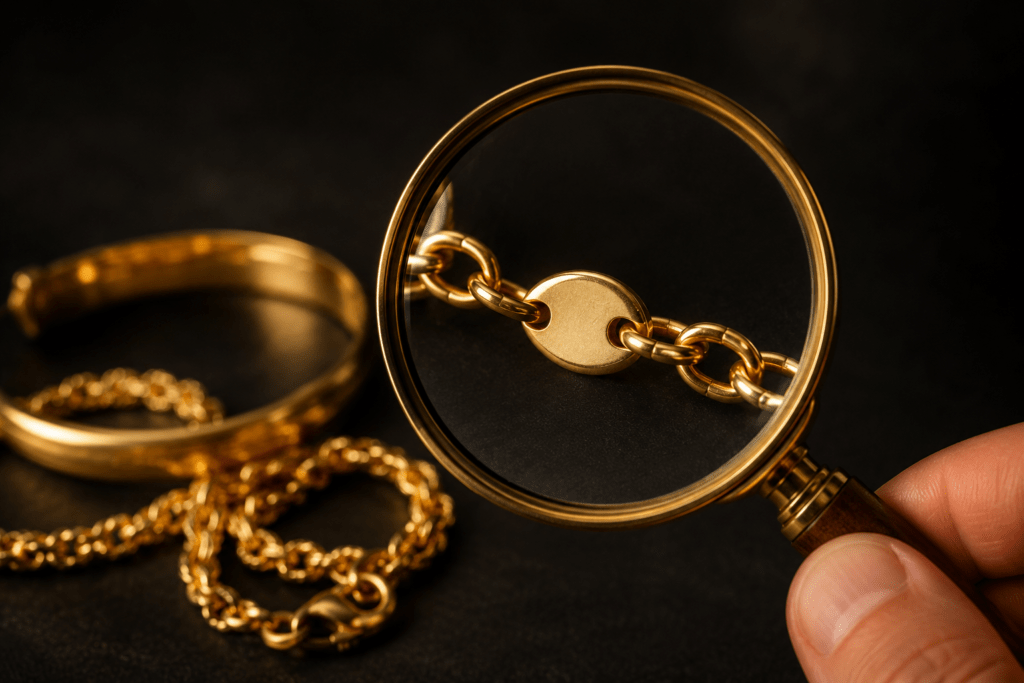
If your ring, necklace, bracelet, or earrings look gold but are stamped 925, the jewelry is usually sterling silver underneath—not solid gold.
The gold color normally comes from a layer of gold or gold-colored plating applied over the silver.
That does not make the jewelry fake. Sterling silver is itself a precious metal. But a 925 stamp means something very different from gold markings such as 417, 585, 750, or 916.
Have jewelry you can’t identify? Gold Kings can test precious-metal jewelry and explain what you have.
Quick Answer: What Does 925 Mean on Gold Jewelry?
925 means the underlying metal is sterling silver containing 92.5% pure silver.
If an item stamped 925 appears yellow or rose gold, it is generally gold-plated sterling silver. Depending on the purity and thickness of the gold coating, some pieces may qualify as gold vermeil.
The important distinction is:
925 does not mean 92.5% gold.
The Federal Trade Commission explains that jewelry marked 925 contains 925 parts pure silver out of 1,000.
What Does the 925 Stamp Actually Mean?
Precious-metal markings often describe the purity of the metal.
A 925 stamp means:
- 92.5% silver
- 7.5% other metals
- Commonly called sterling silver
The additional metals help make silver more durable for jewelry.
That is why you will commonly see 925, STERLING, or STER on silver rings, chains, bracelets, earrings and other jewelry.
If you want to understand other markings, see Gold Kings’ guide to how to read jewelry hallmarks.
Why Does My 925 Jewelry Look Like Gold?
This is where the confusion usually begins.
A piece can have a sterling silver interior and a gold-colored exterior.
Think of it as two layers:
Outside: Gold or gold-colored coating
Inside: 925 sterling silver
The 925 stamp identifies the sterling-silver base.
It does not indicate that the entire item is solid gold.
For example, a yellow-gold-looking necklace stamped 925 may be a sterling silver necklace that has been plated with gold.
Does 925 Mean Gold Vermeil?
Sometimes—but not automatically.
This is an important distinction.
People often use the terms gold plated and gold vermeil interchangeably, but they are not necessarily the same thing.
For jewelry to be described as vermeil under FTC guidance, it must have:
- A sterling silver base
- Gold or gold alloy of at least 10K
- Gold applied to the significant surfaces
- A qualifying coating thickness of at least 2.5 microns
So:
925 + gold color does not automatically prove that a piece is vermeil.
The 925 mark tells you about the silver underneath. It does not tell you how thick the gold layer is.
A thinner coating over sterling silver may simply be described as gold-plated sterling silver.
925 vs. Solid Gold: What’s the Difference?
| Marking | Usually Means | Precious Metal Content |
|---|---|---|
| 925 | Sterling silver | 92.5% silver |
| 417 / 10K | Solid 10K gold alloy | About 41.7% gold |
| 585 / 14K | Solid 14K gold alloy | About 58.5% gold |
| 750 / 18K | Solid 18K gold alloy | 75% gold |
| 916 / 22K | Solid 22K gold alloy | About 91.6% gold |
| 999 | Fine gold | About 99.9% gold |
Notice something important:
925 fits into the silver purity system—not the gold-purity sequence.
For comparison, Gold Kings’ guides explain that 585 means 14K gold and 750 means 18K gold.
Is 925 Gold Real Gold?
925 is not a solid-gold purity.
The item may contain a real gold coating, but the 925 stamp refers to the sterling silver underneath.
That means there is an important difference between:
Solid gold: Gold alloy extends throughout the jewelry.
Gold-plated 925 silver: Sterling silver forms the body of the jewelry and gold is applied to its surface.
Both may look very similar when they are new.
Their precious-metal values can be very different.
What Does 18K 925 Mean?
You may occasionally see markings such as:
18K 925
or
925 18K
This generally suggests that the piece has a 925 sterling silver base combined with an 18K-gold surface treatment or component, rather than meaning the entire piece is solid 18K gold.
However, markings can vary among manufacturers.
A stamp alone should never be treated as absolute proof of composition.
If significant money is involved, have the item tested.
Is 925 Gold-Colored Jewelry Worth Anything?
Yes.
Even though it usually isn’t solid gold, a genuine 925 piece contains sterling silver, which has precious-metal value.
Its value can depend on several things:
Sterling Silver Weight
The more sterling silver the piece contains, the greater its potential precious-metal value.
Current Silver Price
Silver prices change throughout the day, so the metal value of sterling jewelry also changes.
Gold Coating
The gold coating usually represents only a small portion of the item’s total weight.
For ordinary plated jewelry, the gold layer generally contributes much less melt value than solid-gold jewelry would.
Brand or Designer
Some jewelry may be worth more as a finished piece than simply for its silver content.
Stones
Diamonds, gemstones or other valuable components may affect the overall value independently of the metal.
Condition and Collectibility
Vintage, designer and collectible pieces can sometimes be worth more than their scrap-metal value.
So don’t assume a 925 piece is worthless just because it isn’t solid gold.
Can a 925 Stamp Be Fake?
Yes.
A hallmark is an important clue, but a stamp is not a laboratory test.
Someone can stamp 925 onto metal that is not actually sterling silver.
Likewise, genuine older jewelry may have a stamp that has become:
- Worn
- Difficult to read
- Partially polished away
- Damaged during a repair
- Hidden near a clasp or hinge
That is why Gold Kings recommends looking at the hallmark as one piece of evidence, rather than relying on it alone.
You can also read our guide on .
How Can You Tell What 925 Gold-Colored Jewelry Really Is?
1. Examine the Stamp
Look inside ring bands, near necklace clasps, around bracelet closures, on earring posts and on the back of pendants.
A phone camera or magnifying glass can help.
2. Look for Other Markings
You might see additional letters, numbers, country marks or manufacturer marks.
These can provide clues about how the piece was made.
3. Look for Wear
Areas with frequent contact may reveal a different-colored metal underneath the gold surface.
That can indicate plating.
4. Have the Metal Professionally Tested
Professional testing can help determine what metals are actually present.
Gold Kings uses professional precious-metal testing methods, including XRF analysis, when evaluating jewelry.
Testing matters because what the metal actually contains is more important than what someone stamped onto it.
Can XRF Testing Identify Gold-Plated 925 Jewelry?
XRF testing can provide useful information about the elements present in jewelry, but plated pieces require experience to interpret correctly.
Because XRF analyzes material at or near the surface, a gold coating can affect the initial reading.
An experienced precious-metals buyer therefore considers more than one clue, including:
- Hallmarks
- Surface composition
- Jewelry construction
- Weight
- Wear
- Other appropriate testing methods
That is particularly important with plated, filled or layered jewelry.
Should I Sell Jewelry Stamped 925?
That depends on what you have.
If testing confirms that the piece is sterling silver, it may have precious-metal value even though it is not solid gold.
Before selling, determine:
- Whether the 925 stamp is genuine
- How much the item weighs
- Whether the item contains stones or valuable components
- Whether it has collectible or designer value
- What the current silver price is
Gold Kings buys qualifying sterling silver and other precious-metal items. Our Snellville location specifically lists sterling silver marked 925 among the items we purchase.
Have a Gold-Colored Piece Stamped 925?
Don’t guess based on the color.
Gold-colored jewelry marked 925 is usually sterling silver underneath, and it may still have value.
Bring your jewelry to Gold Kings and we’ll help determine what it actually contains.
We test it. We weigh it. We explain it. You decide.
Gold Kings of Snellville
3635 Stone Mountain Hwy
Snellville, GA 30039
770-771-4650
Gold Kings of Commerce
480 Banks Crossing Dr
Commerce, GA 30529
706-336-0043
No appointment is necessary for normal precious-metal evaluations.
Frequently Asked Questions About 925 Gold-Colored Jewelry
Does 925 mean 22K gold?
No. A 925 stamp normally refers to sterling silver containing 92.5% silver. 22K gold is approximately 91.6% gold and is commonly marked 22K, 916 or a similar gold fineness mark. The similar percentages sometimes cause confusion, but 925 is not another way of saying 22K.
Is 925 real gold?
No. 925 is a sterling-silver mark, not a solid-gold purity mark. A gold-colored 925 item may have real gold on its surface, but the underlying jewelry is generally sterling silver.
Is gold-colored 925 jewelry always vermeil?
No. Genuine vermeil uses sterling silver underneath, but it must also meet requirements for the gold’s purity and coating thickness. A 925 stamp alone does not tell you whether the coating is thick enough to qualify as vermeil.
What does 925 mean on a gold ring?
A gold-colored ring stamped 925 normally has a sterling silver base with a gold-colored surface coating. The 925 mark describes the silver underneath, not the gold color you see on the outside.
What does 18K 925 mean on jewelry?
It commonly indicates a 925 sterling-silver base associated with an 18K-gold coating or component. It should not automatically be interpreted as a solid 18K piece. Because manufacturing marks vary, valuable pieces should be professionally tested.
Is 925 jewelry valuable?
It can be. Genuine 925 sterling silver has precious-metal value. Brand, weight, design, stones, age and collectability can also affect what a piece is worth. A gold coating generally does not give the piece the same melt value as solid-gold jewelry.
Can a fake piece of jewelry say 925?
Yes. A stamp can be incorrect or fraudulent. Professional testing is the best way to confirm whether an item really contains sterling silver.
Where can I have 925 jewelry tested?
Gold Kings evaluates gold and silver jewelry at its Snellville and Commerce, Georgia locations. If you are unsure whether something is sterling silver, gold plated or solid gold, you can bring it in for testing and a no-obligation evaluation.
Find Out What Your Jewelry Really Is
A tiny stamp can tell you a lot—but it doesn’t always tell the entire story.
If your jewelry is gold colored and marked 925, start with the most likely explanation:
925 = sterling silver underneath, not solid gold.
Then have the piece properly tested before deciding what it is worth or whether you want to sell it.
Get a free Gold Kings evaluation and know what you have before you make a decision.