
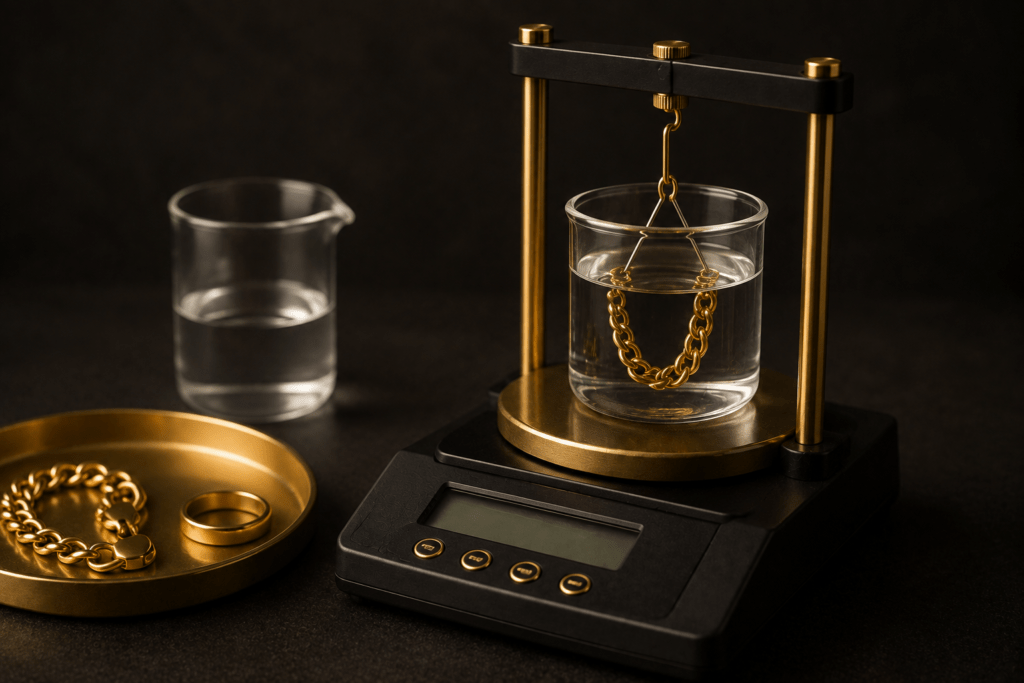
If you want to know whether a piece of jewelry may be real gold, a gold density test is one of the better tests you can perform at home.
Gold is unusually dense. Pure 24K gold has a density of about 19.32 grams per cubic centimeter (g/cm³).
That means a small piece of real gold can feel surprisingly heavy for its size.
By weighing your gold and measuring how much water it displaces, you can estimate its density and compare the result with what you would expect from gold.
Quick Answer
To test gold with a density test:
- Weigh the gold in grams.
- Place a cup of water on your scale.
- Zero or tare the scale.
- Suspend the gold completely underwater without touching the cup.
- Record the new weight shown on the scale.
- Divide the dry weight of the gold by the underwater reading.
The result is the approximate density of your gold in g/cm³.
The closer the result is to the expected density for the item’s karat, the more likely the item contains the amount of gold you expect.
However, a density test alone cannot prove that an item is genuine gold.
Why Does a Density Test Work on Gold?
Density measures how much mass is packed into a certain amount of space.
Gold is one of the densest metals commonly used in jewelry.
Pure gold has a density of approximately:
19.32 g/cm³
For comparison:
| Material | Approximate Density |
|---|---|
| Pure gold | 19.32 g/cm³ |
| Silver | 10.49 g/cm³ |
| Copper | 8.96 g/cm³ |
| Brass | About 8.4–8.7 g/cm³ |
| Stainless steel | About 7.7–8.0 g/cm³ |
This large difference is why density can help identify many pieces of fake or gold-plated jewelry.
What You Need for a Gold Density Test
You don’t need expensive equipment.
You will need:
- A digital scale that measures grams
- A cup or container of water
- Thin thread or fishing line
- Your gold item
- A calculator
For small jewelry, a scale accurate to 0.01 gram will usually produce much better results than a normal kitchen scale.
Step 1: Weigh the Gold
Place the item directly on your scale.
Write down its weight in grams.
For example:
Gold weight = 38.64 grams
Make sure the item is dry before weighing it.
Step 2: Put Water on the Scale
Fill a cup with enough water to completely submerge the item.
Place the cup on your digital scale.
Press the tare or zero button.
Your scale should now display:
0.00 grams
Do not remove the cup from the scale.
Step 3: Suspend the Gold in the Water
Tie a thin piece of thread or fishing line around the gold.
Slowly lower the item completely underwater.
Important:
The gold should:
- Be completely submerged
- Not touch the bottom
- Not touch the sides
- Have no air bubbles attached to it
Hold it steady.
Your scale will display a new number.
For example:
2.00 grams
This represents approximately how much water the object displaced.
Step 4: Calculate the Density
Divide the item’s dry weight by the weight shown while it is suspended in water.
Using our example:
38.64 ÷ 2.00 = 19.32
The estimated density is:
19.32 g/cm³
That result is almost exactly the density of pure 24K gold.
What Density Should Gold Be?
This is where density testing becomes more complicated.
24K gold is approximately 19.32 g/cm³, but lower-karat gold is mixed with other metals.
For example, 14K gold contains approximately 58.5% pure gold, while the remainder may contain copper, silver, nickel, zinc, or other metals.
Because different manufacturers use different alloy mixtures, two genuine pieces of 14K gold can have different densities.
Typical results may fall roughly in these areas:
| Gold Purity | Approximate Density |
| 24K gold | About 19.3 g/cm³ |
| 22K gold | About 17.5–18.1 g/cm³ |
| 18K gold | About 15–16 g/cm³ |
| 14K gold | About 12.4–14 g/cm³ |
| 10K gold | About 10.8–12.5 g/cm³ |
These numbers are only general guides.
The exact density depends on the metals used to make the alloy.
You should not conclude that a piece is fake simply because its density is slightly outside one of these ranges.
Can You Use Density to Test 14K Gold?
Yes, but density testing cannot tell you with certainty that an item is 14K gold.
Suppose a ring weighs:
20 grams
During the water test, your scale reads:
1.50 grams
Calculate:
20 ÷ 1.50 = 13.33 g/cm³
A density of 13.33 g/cm³ would be reasonable for many 14K gold alloys.
But it still doesn’t prove the ring is 14K.
The density result should be considered another piece of evidence along with the hallmark and other gold tests.
Can Fake Gold Pass a Density Test?
Yes.
This is one of the biggest limitations of testing gold by density.
Most inexpensive metals are much less dense than gold, so the test can quickly reveal many fake pieces.
But some metals have densities surprisingly close to gold.
Tungsten, for example, has a density close to that of pure gold.
A sophisticated counterfeit gold bar containing tungsten could therefore produce a density result similar to real gold.
That’s why density testing should never be the only test used when evaluating valuable bullion.
When a Density Test Will Not Work Well
A density test works best on a solid piece of metal.
Results can become inaccurate when testing:
Hollow Gold Jewelry
Hollow chains, bracelets, earrings, and pendants may trap air inside.
That can make the item appear less dense than it really is.
Jewelry With Stones
Diamonds, gemstones, and other materials have different densities than gold.
Testing the entire piece measures the combined density of everything in it.
Jewelry With Non-Gold Parts
Clasps, springs, steel components, solder, and other materials can change the result.
Gold-Plated Jewelry
The test may indicate that the item is not solid gold, but density alone cannot determine exactly how much gold plating is present.
Items That Trap Air
Small openings, hollow sections, and complicated designs can trap bubbles and distort the measurement.
Is the Density Test Better Than the Magnet Test?
Generally, yes.
A magnet test is useful as a quick screening test because gold itself is not strongly magnetic.
But passing a magnet test does not mean something is gold.
Copper, silver, brass, and many other non-gold metals are also not strongly attracted to magnets.
A density test provides considerably more information because it measures a physical property of the entire item.
The best approach is to use several tests together.
What If My Gold Has a 10K, 14K, 18K or 585 Stamp?
A stamp is another clue—but it isn’t proof.
Common markings include:
- 10K or 417 — approximately 41.7% gold
- 14K or 585 — approximately 58.5% gold
- 18K or 750 — 75% gold
- 22K or 916 — approximately 91.6% gold
- 24K or 999 — approximately 99.9% gold
You can learn more in our guide to reading jewelry hallmarks.
Unfortunately, fake jewelry can also be stamped 10K, 14K or 18K.
That is another reason a hallmark should never be the only thing you rely on.
What About Gold-Plated and Gold-Clad Jewelry?
A thin layer of gold does not make an item solid gold.
Terms such as:
- Gold plated
- Gold filled
- Gold clad
- HGE
- RGP
- GP
may indicate that only the outside of the item contains gold.
Because most of the item’s weight comes from the base metal underneath, a density test may help reveal the difference.
If you’re unsure about these markings, read our guide explaining what gold clad means.
How Accurate Is a Home Gold Density Test?
A carefully performed density test can be a useful screening tool, but it is not an assay.
Small measurement errors can create surprisingly large changes in the final number.
Common problems include:
- An inaccurate scale
- Air bubbles
- The jewelry touching the container
- Water trapped inside hollow jewelry
- Gemstones
- Solder
- Mixed metals
- Measuring extremely small items
The smaller the item, the more a small error can affect the result.
Density Test vs. Professional Gold Testing
Home tests are useful when you’re curious about a piece of jewelry.
But if you’re trying to determine the actual value of an item, professional testing is much more useful.
Professional gold buyers can evaluate several things together, including:
- Weight
- Hallmarks
- Construction
- Gold purity
- Plating
- Alloy composition
- Current gold value
A density test may tell you that something could be gold.
Professional testing helps determine what you actually have.
Want to Know If Your Gold Is Real?
If you’re considering selling old jewelry, broken chains, rings, bracelets, coins, or other gold, you don’t have to rely on a home experiment.
Gold Kings can professionally evaluate your items and explain what you have before you decide whether to sell.
Visit Gold Kings of Snellville or learn about our Gold Kings of Commerce location.
You can also start with our complete guide:
How to Tell If Gold Is Real With Five Simple Gold Tests
Frequently Asked Questions
What is the density of real gold?
Pure 24K gold has a density of approximately 19.32 g/cm³. Lower-karat gold has a lower density because it contains other metals.
Can I test gold with water?
Yes. By weighing an item and measuring the amount of water it displaces, you can estimate its density.
Does 14K gold have a density of 14?
No. The number 14K refers to gold purity, not density. Fourteen-karat gold is approximately 58.5% pure gold.
Can fake gold have a 14K stamp?
Yes. A stamp can be added to fake or plated jewelry. A hallmark should be treated as a clue rather than proof.
Can gold-plated jewelry pass a density test?
Usually its overall density will be closer to the base metal than solid gold, but density testing is not reliable enough to identify every plated or counterfeit item.
Can real gold fail a home density test?
Yes. Hollow jewelry, gemstones, trapped air, solder, mixed metals, and inaccurate measurements can all cause a genuine gold item to produce an unexpected result.
Is a density test enough to prove gold is real?
No. Density testing is best used as a screening method. Valuable jewelry and bullion should be evaluated using additional professional testing methods.
Bottom Line
A gold density test is one of the most useful non-destructive gold tests you can perform at home.
If your result is reasonably close to the expected density for the item’s stated purity, that’s a positive sign.
But remember:
Density can tell you whether an item behaves like gold. It cannot prove by itself that the item is gold.
For valuable jewelry or bullion, use the density test as one clue—and have the item professionally tested before buying, selling, or making a decision based on its value.