
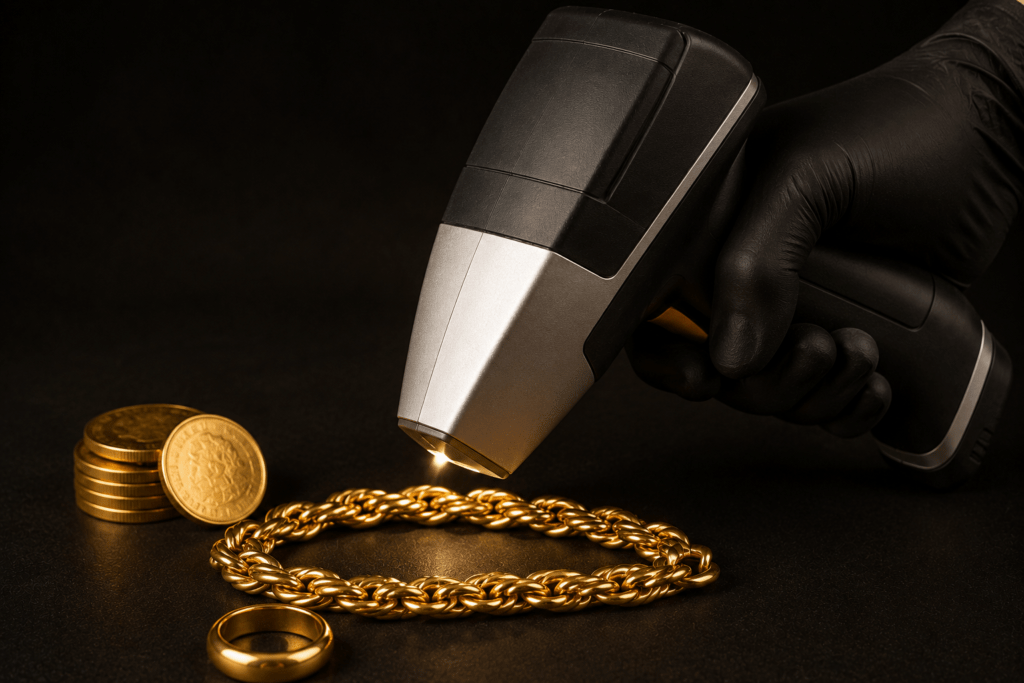
If you have ever wondered whether a gold ring, chain, bracelet, coin, or other piece of jewelry is really gold, there are several ways to test whether gold is real.
One of the most advanced methods is an XRF gold tester.
XRF stands for X-ray fluorescence. An XRF analyzer can identify the metals in an object and estimate their percentages without cutting, melting, or damaging the jewelry.
That means we can learn much more than simply whether something is “real gold.”
We can see how much gold is present and what other metals are mixed with it.
What Is an XRF Gold Tester?
An XRF gold tester is a specialized machine used to analyze the elemental composition of metal.
Instead of scratching the jewelry and applying acid, the tester uses a controlled beam of X-rays.
When those X-rays interact with the atoms in the jewelry, the atoms release secondary X-rays. Different elements produce different energy signatures.
Think of those signals like fingerprints for metals.
Gold produces one fingerprint. Silver produces another. Copper, zinc, nickel, platinum, palladium, and other metals produce their own signals.
The XRF detector reads those signals and calculates approximately how much of each element is present.
How Does an XRF Gold Tester Work?
The entire process can take only seconds.
1. The Jewelry Goes Into the Tester
The gold item is positioned inside or against the XRF testing area.
With a benchtop precious-metal analyzer, the jewelry is normally placed inside an enclosed testing chamber.
2. The Machine Sends X-Rays at the Metal
The analyzer directs a controlled X-ray beam toward the surface of the jewelry.
The X-rays excite atoms in the metal.
3. The Metal Responds
When the atoms are excited, they release their own fluorescent X-rays.
Each element releases X-rays with a characteristic energy.
That is how the machine can distinguish gold from silver, copper, nickel, zinc, platinum, palladium, and other metals.
4. The Detector Reads the Results
A detector inside the XRF machine measures the energy and intensity of the X-rays coming back from the jewelry.
The software then analyzes the information.
5. The Metal Composition Appears on the Screen
Within seconds, the tester can display a breakdown similar to this:
| Metal | Example Result |
|---|---|
| Gold | 58.4% |
| Silver | 12.7% |
| Copper | 23.8% |
| Zinc | 5.1% |
A reading around 58.5% gold is approximately 14-karat gold.
The machine is not simply looking for a stamp that says “14K.” It is actually analyzing the metal. If you are trying to understand markings such as 10K, 14K, 417, 585, 750, or 916, see our guide to jewelry hallmarks and gold stamps.
What Do Gold Karat Numbers Mean?
Karat tells you approximately how much pure gold is contained in an alloy.
| Gold Karat | Approximate Pure Gold |
|---|---|
| 10K | 41.7% |
| 14K | 58.5% |
| 18K | 75.0% |
| 21K | 87.5% |
| 22K | 91.7% |
| 24K | Approximately 99.9% |
This is important because a stamp does not determine what your jewelry is worth. The actual gold content does. Purity is only one part of the calculation; weight and the current gold price also affect value.
A piece stamped 14K may test slightly above or below 58.5%.
Older jewelry, repairs, solder, plating, and manufacturing differences can all affect a reading.
Why Is XRF Better Than Simply Reading the Gold Stamp?
A gold stamp is useful, but it isn’t proof.
Someone can stamp almost anything with:
10K, 14K, 18K, 22K, 585, 750, or 916.
Counterfeit jewelry can even carry convincing-looking hallmarks. That is why a gold hallmark should be treated as a clue, not absolute proof.
That is why professional testing is important when significant money is involved.
An XRF gold tester analyzes the metal itself instead of trusting the stamp.
Does XRF Testing Damage Gold Jewelry?
Normally, no.
One of the biggest advantages of XRF gold testing is that it is non-destructive.
There is generally no need to:
- Scratch the jewelry
- Apply testing acid
- Cut the item
- Melt it
- Remove part of the jewelry
This makes XRF especially useful for jewelry that the owner does not want damaged. XRF is widely used specifically because it can determine elemental composition without destroying the sample.
Is an XRF Gold Tester Accurate?
A properly operated professional XRF analyzer can provide extremely useful information about precious-metal composition.
But there is something important to understand:
XRF primarily analyzes the surface and near-surface material.
That means plating and surface treatments can sometimes affect the result.
For example, white gold jewelry is sometimes rhodium plated. Because XRF is surface-sensitive, that rhodium layer can influence what the analyzer initially detects.
This is why experience still matters.
A professional gold buyer should consider the XRF result along with the item’s construction, weight, markings, appearance, and other appropriate testing methods.
Can Gold-Plated Jewelry Fool an XRF Tester?
This is one of the most important questions about XRF testing.
Because XRF analyzes the surface, thick plating or layered metals require additional attention.
Modern precious-metal analyzers may include software designed to help identify suspicious plating. However, no single gold-testing method should automatically be treated as perfect for every item.
For suspicious pieces, heavily plated jewelry, gold-filled items, or certain bullion products, additional testing may be appropriate. If you are unsure about the difference between solid gold and plated material, read our guide to gold-clad and plated items. Precious-metal testing guidance also recommends combining methods when there is a possibility of thick plating or adulteration.
XRF Testing vs. Acid Testing
Traditional acid testing has been used by jewelers and gold buyers for generations.
The jewelry is normally rubbed against a testing stone, and different strengths of acid are applied to the streak.
It works, but XRF provides considerably more information.
Acid testing might tell you: “This appears to be around 14K.”
XRF testing can tell you: “This sample contains approximately 58.5% gold, 23% copper, 12% silver, and 6.5% other metals.”
That detailed composition can be extremely useful when evaluating jewelry.
Can XRF Tell If a 14K Gold Stamp Is Real?
It can help verify whether the metal composition matches the stamp.
For example, suppose a bracelet is stamped:
14K
A typical 14K alloy should contain approximately 58.5% pure gold.
If the XRF analyzer reports something close to that level, the reading supports the 14K marking.
But imagine the machine reports:
Gold: 3%
That would be a major warning sign that the item is plated, counterfeit, or otherwise not solid 14K gold.
This is one reason professional testing is much more reliable than simply looking for a stamp.
Can XRF Test Gold Without a Stamp?
Yes.
In fact, this is one of the most useful applications of XRF testing.
Older jewelry may have worn or missing hallmarks. Other pieces may have been handmade or manufactured in countries that use different marking systems.
An XRF test does not need a stamp to identify the metals.
The analyzer tests the composition of the item itself.
Why Gold Buyers Use XRF Testing
When gold prices are high, small differences in purity can mean a significant difference in value.
Consider two chains that each weigh the same amount.
One tests at approximately 58.5% gold.
The other tests at 75% gold.
The second chain contains considerably more pure gold and therefore has a higher melt value.
Accurate testing helps determine what you actually have before an offer is calculated. The offer also depends on the current gold price, the item’s weight, purity, and type.
How We Test Gold at Gold Kings
At Gold Kings, professional testing helps us determine the actual precious-metal content of jewelry before calculating its value.
An XRF analyzer gives us another important tool for identifying the metals inside an alloy instead of relying only on what is stamped on the jewelry.
That can be especially valuable for:
- Unmarked gold jewelry
- Older jewelry
- Foreign gold
- 10K, 14K, 18K, 21K and 22K jewelry
- Jewelry with questionable stamps
- Pieces with previous repairs
- Gold that tests differently than expected
The goal is simple:
Know what the metal actually contains before determining what it is worth.
Can I Test My Gold at Home?
There are some simple tests you can perform at home.
You can inspect hallmarks, look for discoloration, check whether the item reacts strongly to a magnet, and use other basic methods.
However, home testing has limitations.
A piece can pass a simple test and still be plated or made from an unexpected alloy.
If you have jewelry that may be valuable, professional testing gives you much more information. You can also review what Gold Kings buys before bringing your items in.
Related: How to Tell If Gold Is Real With Five Simple Gold Tests
Want Gold Kings to Test Your Gold?
Bring your jewelry, coins, bullion, or other precious-metal items to Gold Kings for professional testing and a free, no-obligation evaluation.
- Gold Kings of Snellville
- Gold Kings of Commerce
- Check Gold & Silver Prices
- Gold & Silver Selling FAQs
We test it. We weigh it. We pay you.
Related Gold Testing Guides
- How to Tell If Gold Is Real: 5 Simple Tests
- How to Read Jewelry Hallmarks
- How Much Is Gold Worth?
- What Is Gold Clad?
The Bottom Line
An XRF gold tester works by exposing metal to X-rays and measuring the unique fluorescent X-rays released by the elements inside the sample.
From those signals, the analyzer can identify metals such as gold, silver, copper, and others and estimate how much of each is present.
The process is:
Fast. Non-destructive. Detailed.
Most importantly, XRF testing helps answer the question that really matters:
What is actually in your gold?
If you are thinking about selling gold jewelry, knowing the actual purity is an important part of determining its value.
At Gold Kings, we can professionally test your gold, explain the results, weigh it, and give you an offer.
We test it. We weigh it. We pay you.