
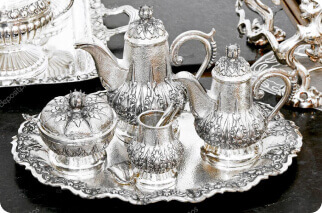
If you have old jewelry, flatware, coins, serving pieces, or other silver-colored items, you may be wondering:
Is this real silver, sterling silver, silver plated, or something else?
That distinction matters because real silver has precious-metal value, while silver-plated items usually contain only a thin layer of silver over another metal.
The good news is that there are several clues you can check at home.
The important thing to remember is that no single home test proves that an item is real silver. A stamp can be misleading, non-silver metals can pass simple tests, and older items may not have an obvious hallmark at all.
At Gold Kings, we evaluate silver jewelry, sterling silver, coins, flatware, and other precious-metal items. If you’re unsure what you have, professional testing can tell you much more than appearance alone.
Quick Answer: How Can You Tell If Silver Is Real?
Start with these checks:
- Look for 925, Sterling, or Ster marks
- Check whether the item is strongly magnetic
- Look for natural tarnish
- Inspect worn areas for signs of plating
- Consider the item’s weight and construction
- Have valuable or uncertain items professionally tested
A piece that passes several of these checks may be sterling silver, but professional testing is the best way to confirm the metal when value matters.
1. Look for a 925 or Sterling Silver Stamp
One of the easiest places to start is the hallmark.
Sterling silver contains approximately:
92.5% pure silver
with the remaining 7.5% generally consisting of other metals added for strength and durability.
Common sterling-silver markings include:
- 925
- .925
- STERLING
- STER
The Federal Trade Commission explains that products described as sterling silver contain 92.5% pure silver, and 925 means 925 parts out of 1,000 are silver.
Where you find the mark depends on the item.
Silver Rings
Look inside the band.
Silver Necklaces and Bracelets
Check around the clasp, end tabs, or connecting rings.
Silver Earrings
Inspect the post, back, underside, or another inconspicuous area.
Sterling Silver Flatware
Look on the back or underside of the handle for markings such as STERLING.
If you’re trying to understand unfamiliar numbers and letters on jewelry, our guide to how to read jewelry hallmarks explains many common precious-metal markings.
Does a 925 Stamp Prove Something Is Sterling Silver?
No.
A hallmark is a useful clue, but a stamp is not a laboratory test.
An item can be incorrectly marked, altered, repaired, or intentionally stamped with a misleading hallmark.
The opposite can also happen.
Older sterling-silver items may have marks that are:
- Worn down
- Difficult to read
- Partially polished away
- Hidden near a hinge or clasp
- Different from modern American markings
So don’t automatically throw something away simply because you cannot find 925.
And don’t automatically assume something is sterling simply because 925 is stamped on it.
If your jewelry looks gold-colored but has a 925 stamp, see our explanation of what 925 means on gold-colored jewelry.
2. Try the Magnet Test
Silver itself is not strongly attracted to an ordinary magnet.
So if the main body of an item strongly snaps toward a magnet, that is a warning sign that it may contain a substantial amount of iron, steel, or another magnetic metal.
However, this test has an important limitation:
Not sticking to a magnet does not prove that an item is silver.
Many non-silver metals are also nonmagnetic.
That means:
- Strong magnetic attraction: Suspicious
- No magnetic attraction: Possibly silver, but not proof
- Reaction only at a clasp or spring: May be caused by a separate component
Use the magnet test as a basic screening tool, not a final answer.
3. Check for Tarnish With a Soft Cloth
Real sterling silver commonly tarnishes over time.
Tarnish forms when the silver surface reacts with compounds in the environment, creating darker discoloration.
You can gently rub an inconspicuous area with a clean, light-colored soft cloth.
If dark or black residue appears on the cloth, that may indicate silver tarnish.
But again, this is only a clue.
Some genuine silver may be freshly polished or protected with a coating, while some other metals and surface finishes can also discolor.
Don’t aggressively polish an item just to test it.
This is especially important with antique jewelry, decorative silver, or collectible pieces where the original surface may matter.
4. Look Closely for Signs of Silver Plating
Silver-plated items are not the same as sterling silver.
A silver-plated object generally has:
a thin silver layer on the outside + another metal underneath
Look closely at areas that receive the most wear, including:
- Edges
- Raised designs
- Handles
- Clasps
- High-contact areas
- Scratched or damaged spots
If you see a different-colored metal showing through the surface, the item may be plated.
You may also find markings that indicate plating rather than solid sterling.
Silver plate can still be attractive, useful, antique, or collectible.
However, it generally contains far less precious silver than a solid sterling item and therefore usually has little precious-metal melt value.
Gold Kings generally buys sterling silver rather than ordinary silver-plated items.
5. Pay Attention to the Item’s Weight and Construction
Silver has a distinctive density, so experienced buyers often consider an item’s size and weight together.
But weight alone is not enough to identify silver.
Items may be:
- Hollow
- Weighted
- Filled with another material
- Made from multiple metals
- Constructed with steel springs or other components
This is especially important with items such as:
- Candlesticks
- Knife handles
- Serving pieces
- Hollow jewelry
- Weighted sterling pieces
A heavy item is not automatically solid silver, and a lightweight item is not automatically fake.
What About Acid Testing Silver?
Acid testing has traditionally been used as one way to evaluate precious metals.
However, we do not recommend performing a nitric-acid test yourself simply to find out whether an old piece is silver.
Testing acids are corrosive, and the testing process may also require scratching or filing the item to expose the underlying metal.
That creates two problems:
- You can potentially injure yourself using strong testing chemicals.
- You can damage jewelry, antiques, coins, or other items that may have value beyond their silver content.
If acid testing is appropriate, it is better handled by someone familiar with precious-metal testing.
For anything potentially valuable, professional testing is the safer approach.
Can Silver-Plated Items Be Marked 925?
A legitimate 925 mark normally represents sterling silver rather than ordinary silver plate.
But markings can be misleading, especially on counterfeit or incorrectly described items.
That is why the best approach is:
hallmark + visual inspection + physical testing
rather than trusting one tiny number by itself.
Also remember that terms containing the word “silver” do not always mean sterling silver.
For example:
- Sterling silver: approximately 92.5% silver
- Coin silver: traditionally approximately 90% silver
- Silver plated: base metal covered with a layer of silver
Those products can have very different precious-metal values.
How Do Professionals Test Silver?
A professional precious-metal evaluation may use several pieces of information together.
Visual Inspection
The item can be examined for hallmarks, wear, plating, repairs, construction, and other identifying characteristics.
Weight and Purity
If an item is sterling silver, its value is influenced by how much silver it actually contains.
Professional Metal Testing
Depending on the item, testing methods can help determine whether the metal is sterling silver, another silver alloy, silver plated, or a different metal.
Gold Kings uses professional testing methods, including XRF testing when appropriate, to help identify precious-metal composition without relying solely on a stamp.
What Is Sterling Silver Worth?
Once you’ve determined that something is real sterling silver, the next question is usually:
How much is it worth?
The basic precious-metal value depends largely on:
- Actual silver purity
- Precious-metal weight
- Current silver spot price
- Whether the item has collectible or resale value beyond its metal content
Sterling silver is approximately 92.5% silver, so you cannot simply multiply the item’s total weight by the pure-silver price without accounting for purity.
Also, not every sterling item should automatically be treated as scrap.
Antique, designer, collectible, or unusual pieces may deserve additional evaluation.
What About Old Silver Coins?
Be particularly careful with old coins.
Do not scratch, file, acid-test, or aggressively polish an old coin just to see if it contains silver.
Some U.S. coins have value beyond their precious-metal content because of their date, mint mark, condition, rarity, or collector demand.
If you’re sorting old coins, see our guides to:
Identify the coin before treating it as ordinary scrap silver.
Think You Have Real Silver?
If you have silver jewelry, sterling flatware, old coins, scrap silver, or another item you cannot identify, you don’t have to guess.
At Gold Kings, we can examine and test your item, weigh qualifying precious metal, and explain what you have before you decide whether you want to sell.
See the complete list of silver and precious-metal items Gold Kings buys.
Gold Kings of Snellville
Visit Gold Kings of Snellville for professional precious-metal testing and a free, no-obligation evaluation.
Gold Kings of Commerce
Customers throughout Northeast Georgia can visit our Commerce location for silver and precious-metal evaluation.
We test it. We weigh it. We pay you.
Frequently Asked Questions About Real Silver
Does 925 mean real silver?
A 925 mark normally indicates sterling silver containing approximately 92.5% pure silver. However, a stamp alone does not prove that the item actually contains sterling silver.
Is sterling silver real silver?
Yes. Sterling silver is a genuine silver alloy containing approximately 92.5% silver and 7.5% other metals.
Is silver plated the same as sterling silver?
No. Sterling silver contains silver throughout the alloy. Silver-plated items generally have only a layer of silver over another metal.
Is real silver magnetic?
Silver itself is not strongly attracted to an ordinary magnet. Strong attraction across the main body of an item is therefore suspicious, but lack of magnetic attraction does not prove that the item is silver.
Does real silver tarnish?
Sterling silver commonly develops tarnish over time. Tarnish can be a useful clue, but its presence or absence is not enough to authenticate an item by itself.
Can fake silver have a 925 stamp?
Yes. An incorrect or fraudulent 925 stamp is possible. Testing is more reliable than relying on the hallmark alone.
How can I tell if flatware is sterling silver?
Check the back or underside for markings such as STERLING or 925. Plated flatware may have different markings. If you’re unsure, have the piece professionally evaluated rather than damaging it with a home test.
Should I acid-test silver at home?
We don’t recommend using strong testing acids on valuable or uncertain items yourself. Professional testing avoids unnecessary chemical exposure and reduces the risk of damaging something that could have collectible or resale value.
Where can I have silver tested?
Gold Kings evaluates silver jewelry, sterling silver, coins, flatware, scrap silver, and other qualifying precious-metal items at our Snellville and Commerce, Georgia locations.